This website uses cookies. By continuing to use this website you consent to the use of cookies. Read the Privacy Policy.


Getting to Uganda
I’m touring Uganda anticlockwise, starting from Entebbe. It's a return visit, as last time I only dipped into the eastern corner, to Jinja and the reputed source of the Nile, from Kenya. This trip has begun with a bang. Literally. Twice. I woke up to find that a coke bottle had exploded in my fridge. There was a mess of sticky brown ice to clear up. Then my taxi turned up to take me to the bus station and the driver brought the tail gate down on my head. I now have a dent in my throbbing left temple. If I'm lucky I will get a black eye to match the one I picked up on my last trip, to Tunisia.
Finally, on the bus, the bus driver denies boarding to a young guy who looks as if he had a rough night. But more importantly he doesn't have a ticket. The would be traveller doesn't take it very well. He empties his daypack and trolley bag and throws the entire contents at the bus. It's not the best of starts.
Add to that the queues at Heathrow. Terminal 5 is heaving. It takes an hour in the check in queue, 20 minutes to get to the entrance to security and 20 minutes in security before I get airside.


I've already had a run in with my favourite airline (not) BA, who have given my paid for exit row seat to someone else. They rarely answer the phone, but I managed to get through to customer services which I discovered is now in Cape Town. Though they haven't been able to train the staff yet. It's an hour there before I finally get to speak to a supervisor who sorts the problem. I'm now in the exit row by the toilets, treated as a gangway by all the passengers. The plane is old and the screens tiny, with wavery pictures and touch screens that send you back to the beginning of the film all the time.
Thank God for Qatar Airways on the second leg. Polite, modern, spanking clean, entertainment that works and heaps of food. Though masks are demanded on both legs.
Arriving in Uganda
Immigration in Entebbe is the usual African chaos, with no adherence to any form of queuing rules. But I'm eventually in and out again and Hannington and James are waiting to greet me. Two guides just for me! Happy-go-lucky James is a trainee along for the ride and ready to polish his skills.
The official languages in Uganda are English and Swahili. But Hannington and James speak to each other in Luganda, as do most of the Ugandans. It's the language of Buganda, the largest of the Ugandan kingdoms, centred on Kampala.

On the Road in Uganda - Entebbe to Murchison Falls
The road round Kampala, east and north, is generally good, especially on the new toll section, but the traffic is slow through the urban areas, the road lined with small bustling markets. The buildings in the small towns are constructed wild west frontier style, with high brick stepped facias and shady pillared verandas. Stacks of red bricks stand drying in the fields. Most of the embellishment relates to advertising for telephone companies. Open air pool tables with thatched awnings. And solitary petrol pumps guarded by hopeful assistants.
All manner of dress: traditional with headscarves western long and short and nearly all immensely colourful. Chickens in cages, huge green hands of bananas strapped precariously onto bicycles, families of up to five, crammed on motorbikes. Motorcycles and scooters are called “bodabodas.” They’re cheap transport.
Further on, long horned cattle and flattish agricultural country, red termite hills erupting at various intervals. Plenty of maize and rippling sugar cane. The cane is being harvested and loaded onto top heavy trucks which lumber past. Cassava, mangoes, bananas. The cassava is drying by the road in pieces or pounded. Rows of bean and coffee processing plants. Tall fan like papyrus, used for roofing and decoration. It's placed outside buildings to signal a party. Watch out for it!

Ziwa Rhino Sanctuary
Ziwa Rhino Sanctuary was established in 2005 to reintroduce rhino into Uganda. Uganda was home to both the black rhino and the northern white rhino, but both indigenous species were wiped out by civil war, poachers and plain habitat mismanagement ,by 1982. Six southern white rhino were initially donated by Kenya and Florida(!) and the population is now 33. It's the only place in the country where you can find rhinos and it's a convenient stopping place on the way north, 100 miles from Kampala.
We creep out in single file to see seven of the pachyderms (have to get that word in somehow), in two groups, slumbering peacefully. Mostly young males, farting and snoring. There's a female Luna, who is pregnant. When she has her baby, the males will have to form their own group as she won't be looking after them any more.
There are also warthogs (Pumbaa of course) skipping around, and the odd bush buck sliding out of the bushes.


Murchison Falls National Park
Further north, gorgeous rolling velvety hills. The road is a big dipper, as we venture on to Murchison Falls. Here, astonishingly, is a two lane highway but they’re still constructing it, the rust-red soil churned up, the edges lined with JCBs. More hard work in the heat. The Chinese engineers always immediately distinguishable, in their straw brimmed hats.
Murchison Falls is the biggest national park in Uganda. The Nile runs east-west through the centre, with the game congregated in the northern areas, which are mostly exceptionally pretty emerald savannah, dotted liberally with fan palms. Who wouldn't want to live here ?
The lodge in the park is packed. They must be grateful for the custom. Things are only just reopening after Covid. This is Hannington’s fourth safari this year and his sixth since 2019. There are lovely sweeping views from here, down to the river. This is the Albert Nile which links Lake Albert with Lake Victoria. Although landlocked, Uganda consists mainly of the Nile Basin and is at the heart of the African Great Lakes. Lake Kyoga is the largest entirely Ugandan lake, and also notable is Lake George. Uganda shares Lakes Albert and Edward with the DRC and the huge (and largest lake in Africa) Victoria, with Kenya and Tanzania.


Murchison Falls
The eponymous park falls are billed as the most powerful in the world. They’re not very high, but still spectacular, as the Nile is forced through a six metre wide channel, thundering into a churning cauldron. You can view from up top or down the bottom. The latter involves a surprisingly long three hour boat trip. Two hours upstream and one back. There are crocodiles, elephants, antelopes and heaps of hippos to entertain us.
The elephants, protective of their babies, are much more unhappy about boats than they are cars and bundle the little ones away rapidly, forming a protective barricade of elephant backsides. They swivel back as soon as we pull away. One baby hippo unintentionally uses its mother as a waterslide. The boats keep a wary distance from the hippos and from the falls themselves, when we finally reach them. The impact causes plenty of foam and current and the zoom lens is required for any meaningful shots.


A road takes us to the top of the falls, where you can peer over the edge (almost) and get a real sense of the power of the boiling waters cascading over the edge. There’s a fantastic view back along the Albert Nile. You also get soaking wet and have to avoid the clouds of buzzing tsetse flies. Unluckily I've worn blue ( in addition to not donning my cagoule) and acquire four stings.


On Safari in Murchison Falls National Park
Safaris in the park are delightful and the game prolific. Giraffe, elephant and buffalo arrange themselves round every corner. Antelope abound. The square jawed Jackson’s hartebeest is the largest. Water bucks and bush bucks pose obediently. Kobs are the Ugandan equivalent of impala, redder brown without the distinctive black vee on the rump. They are abundant, flinging themselves across the tracks with gay abandon. The diminutive oribi, with their two tiny horns, follow suit. They make good prey for leopard, who can drag them up trees easily.


A large leopard has draped one a across a branch and lazes 20 metres up, every so often switching position to gnaw at another chunk. It's entertaining for the punters, as the relieved guides vie to get their clients to a reliable sighting. Every time we meet another van we have to stop and check what they have seen. There are a lot of vans. And there're already a gratifying number of ticks on my animal and bird checklists.

Journeying South and West. On the Road in Uganda Once More.
Our journey south again involves a stretch of unmade road lined with traditional villages. Square and circular huts with grass thatched roofs. (They're selling rolls of the stuff by the roadside. ) Tilling the soil with metal hoes looks like very had work.
Toddlers wave excitedly. Children and lines of women trudge along the roadside balancing yellow waterfilled Jerry cans on their heads. Too many villages still don't have pumps or wells. There are also a few large gated mansions. Hannington says they belong to government officials.
The road signs are British style. So are the many sleeping policemen (in every town and village ) and the speed cameras. The lollipop ladies here use red flags instead of circular signs to escort children across busy roads.
Hoima is the centre of the oil industry. This where all the companies and construction folk have based themselves. It's the nearest city to the game park. The Chinese have built all the roads round here to give them access to the newly found oil. Sadly, they found it in the middle of the park. The issue was debated in parliament, but money won of course. The animals are being moved to other areas. Let's hope they like their new homes.


Hannington has no watch and little idea about distances. He underestimates wildly. So our ETA is usually way off the mark and lunch eaten long after my stomach has started rumbling. He’s not always easy to understand. When Ugandans speak English, they often replace “l” with “r,” so play becomes pray. A toilet stop is usually a short call. Though there’s also the long call.
Around Fort Portal
Further south, the scenery increasingly gorgeous. Hills and mountains. Emerald tea plantations. Climbing up to Fort Portal, a tourist city with green cloaked views in every direction. We’ve just crossed from the Bunyoro kingdom to Toro. The king’s palace at Fort Portal has the best view in town.
The other side of Fort Portal the scenery is better still, as we skirt the Ruwenzori Mountains. . The Ruwenzori are the tallest range in Africa and contain the highest peak in Uganda ( Alexandra - 5,094 metres).


Queen Elizabeth National Park
There’s a bad day on most trips, or at least one that isn’t as good, and my first day in Queen Elizabeth Park is it. The Bush Lodge just outside the park, at Kazunguru, insists that my reservation is for a tent, not the Banda hut with en-suite by the water, described in my itinerary. The small, sweltering tent on offer has an outside shared ablutions block five metres away. No thanks. They argue that no Bandas are available, until I show them my itinerary hard copy and then there suddenly is one. Hannington says that the office of his company agree that a Banda was booked.
There are tranquil views from the veranda, of crocodiles and hippos in the Kazinga Channel, which separates Lake George from Lake Edward. It’s forbidden to walk alone to the huts at night. Escorts are required, as a pair of warring hippos wander the grounds constantly after dusk.
Kyambura Gorge
Chimp trekking in the Kyambura Gorge is the first activity here. It’s not as frenetic as the tracking in Rwanda and only involves sliding down a rainforest covered gorge and crossing two bridges over hippo frequented rivers. The first bridge is rickety, with slats missing and the second a fallen tree. Thankfully, the uniformed ranger, with his AK 47, is happy to assist. But the chimps are similarly uncooperative and stay firmly in the tops of their trees, peeing down from above. They are not really habituated. A second group, the other side of the river, are even more elusive. There’s a very cute tiny baby, but sadly my photos show him peering round his mother's backside. It's not pretty viewing.


On Safari in Queen Elizabeth National Park
Later, we go on a game drive, but there is nothing to be seen. Just a couple of water buck and small herd of kob. The dry yellow savannah stretches to the mountains and Hannington spends two hours driving us literally round in circles, searching for a lion and cubs he’s been told were there this morning. The only good bit is the sunset over the Ruwenzori Mountains. Very disappointing and I’m not happy. Hannington responds by sulking all through dinner. His parting shot - the office have told him that they think there was a mistake with my booking and they agreed to two nights out of the four in a tent. I told him I’m not leaving my Banda.
Next morning, Hannington tells me that I definitely have to move. I’m still not convinced, but the hotel manager says Hannington’s known all along that I should be in a tent. That’s what was booked and I was only in a Banda as a favour. I’ve read that Ugandans don’t like confrontation. Never shout at a Ugandan. But I do and there are tears (on my part).


To cut a long story short, I’m now in another lodge. It lacks the rustic charm of Bush Lodge and sadly there are no views at all from my room. But it’s a little palace with two enormous beds and a long thin bathroom. The toilet isolated at one end like a throne. The electricity can go out at any time for 4 to 24 hours. It’s known as load shedding. Most of the lodges have their own generators but of course those are known to play up too. My shower and hair wash is cut short mid lather tonight.
The game drive next morning is a little more productive. There are a herd of buffalo, a lioness (from a distance) and some hippos playfighting. There’s queue of vans along the track, a sure sign that there’s been a big cat sighting. But Hannington says I’m not allowed to look. These vans have paid for ‘The Lion Experience’ and the rangers have tracked their prey down for them. No money, no lookee.


The Kazinga Channel
In the afternoon, a boat trip along the Kazinga Channel. This is where all the wildlife have escaped to. The banks are lined with elephants, consuming their requisite 100 litres of water a day and in the interim squirting the liquid, or dust, over each other. The many babies have a great time rolling in the mud and linking trunks. The groups of buffalo lounge in the water, a wary distance from the elephants. The hippos can’t decide whether to duck or take centre stage, alternating between the two.
There are scores of different birds, crowned cranes (the national bird of Uganda featured on the flag), yellow billed storks, great and lesser pelicans, three types of kingfisher, fish eagles (one makes an audacious dive and scoops up a fish in his talons right under our noses. He’s much too fast to photograph). Cormorants, goliath herons, great herons and the boringly brown hamerkop (but notable because they have the biggest nest in the world according to our guide and their name refers to their hammer shaped head) and marabou storks, (on the Ugly 5 list along with the amusing pumbaas of course). The warthogs are everywhere running along with their tails erect like car aerials. The name pumbaa means stupid in Swahili. That’s even more unkind than putting them on the Ugly 5 list. We meander along the channel, waterside scenes the whole way, to a fishing village and back again.


Searching for Tree Climbing Lions
My last day in Queen Elizabeth Park also calls for patience. Today, we’re in search of the tree climbing lions of Ishasha. They are reputed to wake up early, go hunting and then climb into trees to sleep for the rest of the day. It’s a two hour drive up a very bumpy track to this part of the park. And the lions have been up and come down again when we arrive, according to the rangers. It might have something to do with the fact that they’ve been burning off the long grass and nearly the whole area is a scorched and still smoking. If I was a lion I wouldn’t be that keen on padding across it.
We spend the whole morning driving round in more circles, but the lions are even more reluctant to appear then the rest of the wildlife in these parts. I’ve been told (too late and possibly unreliably) that only one pride remains. A dozen or so cats were poisoned by locals, as they were thought to be taking their cattle. James and Hannington spend a lot of time on the roof of the van vainly looking. The only sighting is a veritable parliament of eagle owls, all surprisingly alert, and a blue monkey. There are a lot of monkeys in Uganda.


My Sightings
James is a little vague over the names (and even more so about the spellings) of the wildlife, so I’ve challenged him to write a list of everything we’ve spotted in both parks. This is my agreed sightings list, in James’ order:
Side striped jackal, crowned crane, egrets, tree squirrels, ground squirrels, ground hornbill, snake eagle, yellow throated longclaw, African jacana, marabou stork, open billed stork, hippo, Rothschild’s giraffe, African buffalo, African bush elephant, nightjars, vervet monkey, patas monkey, olive baboon, black and white colobus monkey, common hare, black headed heron, grey heron, goliath heron, white backed vulture, permanent vulture, lion, leopard, Uganda kob, water buck, African pied wagtail, Egyptian goose, yellow billed black back, slender mongoose, marsh mongoose, white tailed mongoose, common warthogs, long tailed starling, Bunyoro Rabbit (at night, quite rare), blue monkey, red tailed monkey, topi (from a distance), hamerkop, long crested eagle, fish eagle, eagle owls, scarlet ibis, common bulbul, weavers, tawny eagle, bush buck, oribi, Jackson’s hartebeest, side striped jackal, cattle egrets, oxpeckers, red turaco, bee eaters, flycatchers, kingfishers, bustard (careful with the spelling here), guinea fowls (known here as wild chicken), northern common bee-eater, Cooper’s sunbird, black and white cuckoo, barbets, yellow billed stork, pelican greater and lesser, cormorants.


Eating in Uganda
Food in most of the lodges relies on quantity rather than quality. It’s international buffets, pasta and some sort of chicken is the norm. Potatoes here are known simply as Irish to distinguish them from the indigenous sweet potatoes. Dessert is usually a tropical fruit plate: passion fruit, pineapple, watermelon, small sweet banana and mango if I’m lucky. When we stop for lunch its usually heaps of fries and fish (tilapia from the lakes) or chicken. Hannington and James eat what they term local food. Stews: beef or goat with lots of starch; cassava, big (bland) bananas, pumpkin and rice. Some of the lodges are a little more up market in their offerings, tiny pink lamb chops with mustard sauce is my favourite. Pork isn’t served at all in some restaurants. In villages there’s usually a ‘pork joint’- for roast meat. A “rolex” is an omelette (or meat, or vegetables) wrapped in a chapatti. Pan-fried grasshoppers are also considered a delicacy, but I've not been offered those.
From Kazunguru to Mabamba. On the Road in Uganda Again


It’s a very busy road through from the DRC to Kampala. The scenery is still gorgeous. There are numerous crater lakes in the Queen Elizabeth Park, evidence of past volcanic activity. Indeed, some argue that sulphurous odours indicate that they are still bubbling. Or road takes us through a scattering of these, the mountains beautifully reflected in the still water. Lake Nkugute is said to take the shape of Africa, a newish dam, creates the horn. An old man with a wooden rowing boat is fishing for crayfish, who nip his hand whilst he brandishes them aloft.
More neatly tiered tea plantations. And police road blocks. President Museveni lives in this area and it's apparently also a high risk accident zone. There are almost as many checks as in the DRC. Hannington has his licence confiscated and is made to pay an overdue speeding fine. I have to loan him 150,000 shillings so we can get back on the road. Finally, we make progress. We reach the Equator – I’m having my photo taken at the designated markers, (on some of the several main roads it crosses you have to make do with a small brown sign) when a small Ugandan boy sidles up. His parents are giggling from their car. ‘He wanted his picture taken with a mzungu, (foreigner).’ they call.

Mabamba Bay Swamp
Mabamba Lodge is up a 20 kilometre bumpy track in the rainforest above Mabamba Bay on Lake Victoria. There are amazing swamp and lake views. I have a small bungalow with views across the rainforest. The jungle noises are loud at night and the monkeys throw fruit onto my roof.

In Search of the Weird and Wonderful Shoebill
Farida, from Kampala, who I met on the Caucasus train in 2017 is coming to join me for a trip into the swamp in search of the rare shoebill (only 3-5,000 left in the wild). They're sometimes wrongly referred to as shoebill storks, as they've now been classified as a family all on their own. Their closest relatives are actually the pelicans.
We have a motorised canoe, but our crew are young and inexperienced and make hard work of poling through the narrow channels as jacana hop on lily pads and kingfishers and heron swoop by. There are ominous thunder clouds rolling over head. Nevertheless, the boys know the way to a, so very rare, it's almost unheard of, shoebill's nest.
The male is standing guard, motionless and silent, except for a swivelling dinosaur like head and huge beak 30 centimetres long, (shaped like a clog). It's either a monster dreamed up for Dr Who or an offbeat cuddly toy. A very tall one. The bill is sharply hooked to help grab prey. The shoebill feeds on fish, snakes and even small crocodiles and baby monitor lizards, lunging suddenly in surprise attack. This is a solitary and possibly fearsome creature and unsurprisingly receives a mixed reception amongst the locals, who often view them with suspicion.


The baby is on the grass nest, camouflaged by the undergrowth. We can glimpse him when he fidgets and preens. It's difficult to get a clear shot of either, because of all the waving papyrus stalks between us. Sadly, we are not the only people who know about the nest. It's become world famous. We're soon surrounded by other boats, with more experienced navigators edging their craft around us. The twitchers wander all over everyone else's canoes, hefting their huge lenses and raising them in unison every time the baby moves.
One guy has flown specially from France for the event and spent the whole week by the nest. He has four cameras. He tells me that the mother is out hunting for food while dad acts as security, fending off snakes and birds of prey. When mum comes back she feeds the baby and tends to him giving him a shower from her beak and shading him with her wings. Dad goes hunting in the afternoon. He gives his catch it to the female who swallows it and regurgitates it an hour later partially digested, to feed the baby.
Two eggs are laid, on a nest maybe two metres wide, at the end of the rainy season. The parents constantly add grasses to it. However, only one bird is allowed to live, to maximise the chances of survival. If the stronger baby doesn't murder their sibling the mother starves the weakest to death. That's nature.
We're fascinated and would dearly like to see the mother return, but naturally no one has any idea when that will be. The clouds are getting darker and more boats are arriving. Time to depart.


Kampala, the Capital of Uganda
Farida whisks me off into the capital Kampala. 8.5 million of Uganda’s 42 million, population live here. Ironically, the name derives from the impala that are now only found in a couple of small parks in Uganda. The ultimate contrast to the last few days. Traffic laden. Full of fumes. It's one of the fastest growing cities in Africa. Bustling with streets of several storied blocks, mini scrapers in the centre. Small malls, open fronted shops of all kinds, a couple of theatres. Farida’s family own some of these buildings. Her father has accumulated considerable property over the years and she points out some of them as we inch past. Further out, villas scattered across the undulating suburbs


There are no stand out sights, but we take in the independence monuments (Uganda was a British protectorate from 1894-1962), the national cultural centre, a mall (excellent cheesecake), some craft shops and the long established Sheraton Hotel. The beautiful-in-its-simplicity Bahai Temple competes for the best view of town, with the top of the Ghaddafi Mosque minaret . You have to pay to enter there. They won't even let you take a photo from outside unless you stump up. And they've recently started to insist that women wear headscarves and cover trousers too.
There are also, of course, government buildings and the parliament.
We also indulge in an exceptionally good meal, no banquet, at Izumi, a Japanese-Thai restaurant in a shady street full of upmarket eateries. Farida orders far too much and it's all delicious. Really good to meet up again and she showers me with presents from Uganda. An excellent day !


Entebbe, Main Airport for Uganda
Entebbe is located on a Lake Victoria peninsula, 22 miles southwest of Kampala. It was once the seat of government for the Protectorate of Uganda, prior to independence, in 1962. The city is the location for Entebbe International Airport, Uganda's largest commercial and military airport. Entebbe is also home to the State House, the official office and residence of the President of Uganda.
I’m staying at 2 Friends Beach Hotel. Beach is a little bit of a stretch. The lake is so vast, it's certainly like being by the ocean. Don’t swim in the lake (or any of them for that matter), you risk bilharzia. And there is sand. Held in place by netted stone walls that defend against the battering of the waves. A couple of tiny smelly strips allotted to fishing boats. The rest is manicured (well sort of ) covered in trees and requisitioned by the various hotels arraigned along the lakeside road. Its all beach bars and restaurants and I even see stacks of sunbeds. But what with the trees and thatched awnings there's no way for the sun to peep through. There are sunbeds by the goldfish pond like swimming pool directly in front of the hotel though.
An hour in the evening discussing the woes of the world with the owner, Icelandic Hinrik and an English guy from Derbyshire who has made Uganda his home. Both are very content and wouldn’t consider returning to Europe.


Entebbe Airport
But I can't hear the word Entebbe without thinking of the famous raid on the airport in 1977, when the Israelis rescued 100 hostages kidnapped by the militant group of the PFLP-EO and Revolutionary Cells.
It’s still a problematic place. I’m trying to get to Burundi next. The president is flying out today and security is intense. The car is searched thoroughly before we can enter. Vehicles are not allowed close to the departures area. I have to drag my bag uphill on a bumpy track. And it’s not till after check in that I discover that my flight time has been changed for the third time. I’m doomed to spend five hours airside. And that gets extended. They’ve given us free food vouchers and no firm departure time, which is ominous. And my biro has leaked ink all over me and my tee shirt. It’s another one of those days.
Read more about Uganda here.
I’ve flown out to Brazil from London overnight, along with a lady carrying a poodle in her handbag and several cats in wicker baskets. One escapes and they have to appeal for its owner to come and catch it, over the PA. Some members of the tour group are also on board. Candida is alone, but she’s being met by boyfriend Kurt, who’s been travelling in Peru and Chile. He’s waiting at the airport with a bottle of pisco sour and it’s the first time I’ve been inebriated before nine in the morning. We’re giggling in the back of the bus all through group leader Gabi’s introductions. I'm sure she's really looking forward to this tour now.
Rio de Janeiro, Brazil


I'm starting in Rio de Janeiro, Rio was founded in 1565 by the Portuguese, when it was the seat of the Captaincy of Rio de Janeiro, a domain of the Portuguese Empire. Then, in 1763, it became the capital of the State of Brazil, (still part of the Portuguese Empire).
Rio remains Brazil's most well known city and surely one of the most famous cities in the world with Copacabana and Ipanema Beaches, (don’t leave your belongings unattended), views from the towering summit of Corcovado topped by the immense statue of Christ the Redeemer (too much traffic and too many people) and the cable car up to the huge Sugar Loaf Mountain, from where the late afternoon views of Rio across a scattering of hills and islands are breath-taking.
I also squeeze in the bright, but sad favelas (of City of God fame) and a football match at the renowned Maracana Stadium. Lower league Fluminense are playing Santos and there is plenty of horn blowing and drum rolling, but not many spectators. Football is the country's obsession. Brazil is the most successful international football team ever. They have won the FIFA World Cup five times – more than any other country – and are first in the all-time rankings.
There's also plenty to try, in terms of food and drink. I've already sampled feijoada, the local bean and meat stew, which is traditionally eaten on Sundays, along with pigs' ears, manioc, pork scratchings, greens and garlic and been to a buffet restaurant where you pay according to the weight of the food on your plate. And I've been to several bars. Candida and Kurt are a bad influence and I’ve already learned to love the national drink, the caipirinha. A typical serving costs about 50 pence and is lethal. One is usually plenty. Kurt and Candida go one better than just getting drunk and participate in a mock wedding, at one bar. The ring is a free gift.


Iguassu Falls (Poor Niagara), Brazil and Argentina
Next, Iguassu, home to one of the world’s largest waterfalls. and arguably the most spectacular. There's a story that when US First Lady Eleanor Roosevelt visited Iguassu Falls, in 1944, she is said to have exclaimed, "Poor Niagara!" At 1.7 miles wide, with 275 drops, Iguassu Falls are more spread out than Victoria Falls, but there are more tourists. The horseshoe shaped Devils Throat is the largest and most popular waterfall section, a curtain of 14 separate falls. The air is full of spray, so decent photos aren’t easy, but the upside is plenty of rainbows. And, we view for over four hours, thrills, spills and soaked to the skin.


We follow trails. from the Brazilian side (smaller slice of the national park but better views of the larger Argentine Falls - 80% of them are in Argentina - and plenty of wildlife, like coatis, wandering around), the Argentinian side (many more trails and there’s a close up of the fitfully churning Devil's Throat at the top, where the water plunges over the drop, by navigating a series of catwalks) and from the very bottom in a bobbing (even wetter) boat.


Pantanal, Brazil
Via Sao Paulo to Cuiaba and into the Pantanal. This is the world’s largest tropical wetland, straddling the borders of Brazil, Paraguay and Bolivia. I've visited that area again so read about that trip and more about the Pantanal and my jaguar hunt here.


Manaus, Brazil
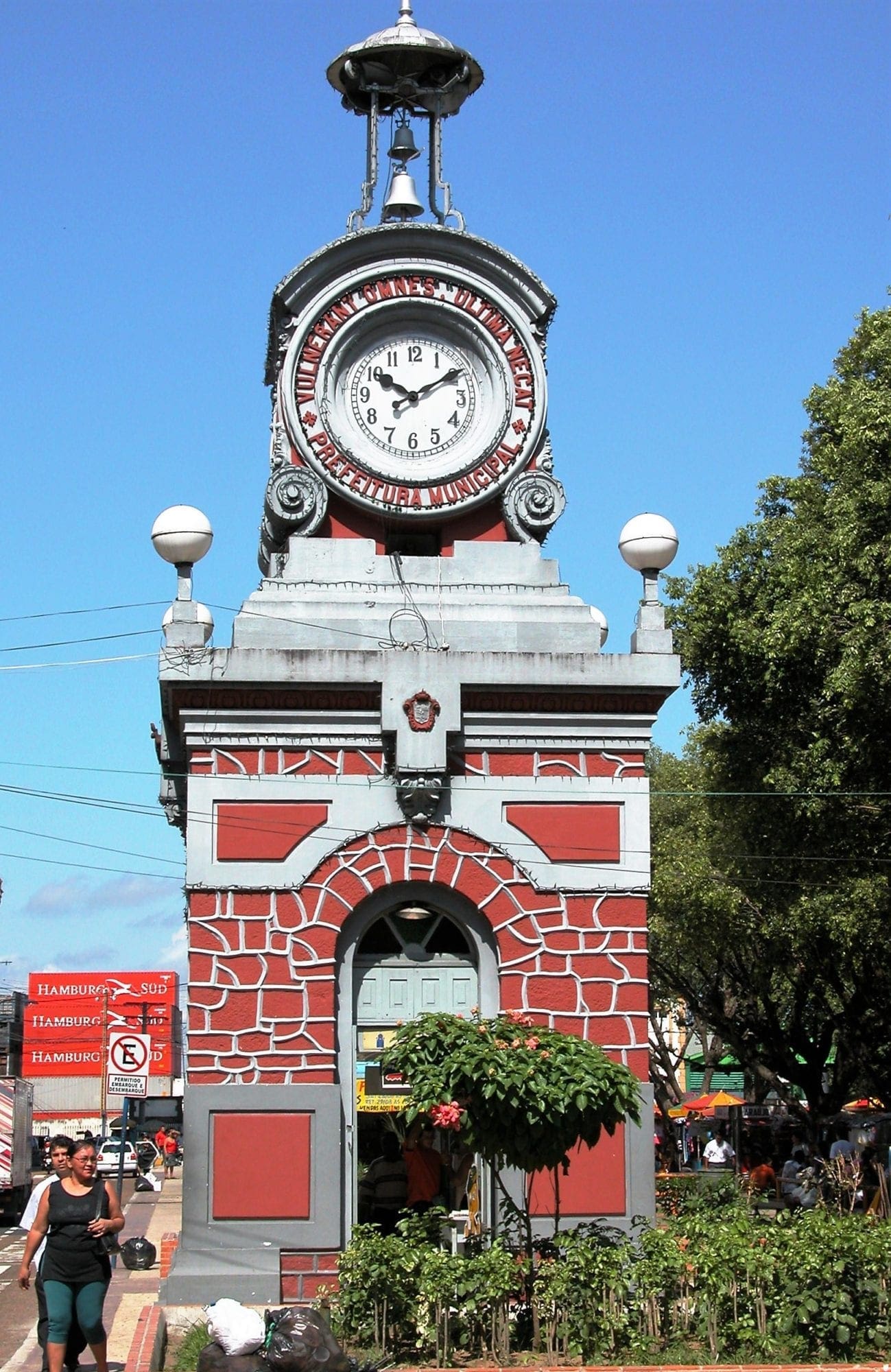
Manaus, in the heart of the Amazon basin, on the banks of the Negro River, has vast tracts of jungle stretching in all directions. That's why its known as The Gateway to the Rainforest. This is where all the Amazon tours and cruises begin.
Manaus was actually the richest city in the world for a while - between 1870 and 1910 - because of the rubber boom. Many wealthy Europeans were lured to the high life. epitomised by the extraordinary Grand Opera House. Just time for a quick visit, before we board the launch, to our stilted lodge.


The Amazon River
En route, we pass the spot where the dark river Negro runs alongside, and then converges with, the lighter brown, muddy amazon River (referred to as the Solimões River, in Brazil, upriver of this confluence). This results in the stripy phenomenon called the 'Meeting of the Waters.' The water flows side by side in different colours (mud-coloured and black) for six kilometres. It's a good moment to understand how huge the Amazon is, even here, 900 miles from the sea.


As we're so isolated, I’ve stocked up on food I can eat, including a can of cashew nuts. The monkey who scrambles across the moored boats to meet us has obviously encountered these previously. Before I can protect my bag, he has purloined my can and is perched high on a branch, devouring them. He has no difficulty with the ring pull. I could swear he’s laughing. The rest of the group certainly are.


To be honest, the much anticipated Amazon is an anti-climax after the Pantanal. It’s quiet and beautiful. We swim by the stilted lodge (no nasties here we’re assured) but there is little new to see. There’s a Caboclo village to visit, to gawk at the ‘natives’, long muddy jungle walks to learn about rainforest plants and fauna (we are exhorted to taste grubs - Kurt does this with glee) and we go piranha fishing – again. This time the guide hauls out some baby caiman for us to admire. Much vaunted river dolphins scoot by. Most of us miss them.
I’ve decided I’m never sharing a room on a tour again. My roommate, German Anne, snores mightily, (deja vu) comes in late and puts all the lights on, and insists on setting the alarm at least 90 minutes before we need to leave in the morning, so she can prink.


Salvador, Brazil
Our last stop is Salvador (Saviour), now the capital of the state of Bahia, It was founded, by the Portuguese settlers, in 1549, initially considered to be the nation's capital, before Rio was deemed to be more practical. It is one of Brazil's most historic cities and still the centre of Brazilian Catholicism.


I read that 'The Pelourinho area, the Portuguese colonial legacy, is regarded as the most important collection of seventeenth-eighteenth century architecture in the whole of the Americas.' It’s a hotch-potch of narrow cobbled streets, gilded baroque churches, and spacious squares surrounded by mansions in need of restoration.
Salvador's magnificent setting and soaring cliffs protect the bay. So, this is one of the most sheltered harbours on the eastern coast of the Americas. The city has a predominantly African feel. This is not surprising as most of the inhabitants are of African descent (working sugar cane and tobacco plantations); there is a real vibe and some incredibly flamboyant costumes. Bruce and Laurie, in the group, pose against a cut out, for photos, and invite me to Fort Lauderdale.


Newsletter Subscription
Stay in touch. Get travel tips, updates on my latest adventures and posts on out of the way places, straight to your Inbox.
I keep your data private and only share your data with third parties that make this service possible. Privacy Policy. No spam I promise. Unsubscribe any time.