This website uses cookies. By continuing to use this website you consent to the use of cookies. Read the Privacy Policy.


Return to Albania
Last time I came to Albania I was apprehensive. I had been told it was a dump. It was a short stay and it exceeded expectations - sort of. Now, I'm drawn back by claims like this:
'The Albanian Riviera features stunning turquoise waters and white sand beaches at a fraction of the cost of Western European destinations'.
I'm in need of R and R. I've spent the whole summer (the best weather the UK has ever had) recuperating indoors after a back operation. So, I'm giving Albania another chance, this time the southern part. Though expectations were slightly dashed by a fellow traveller I was speaking to at the weekend. My Spanish friend assured me that 'Albania is awful and the beaches are row to row sunbeds'. Let's see.
My British Airways A320 plane only has 45 passengers on it. Is that hopeful or a warning sign?
Tirana to Vlorë


I'm starting with three nights in what is a very expensive hotel by Albanian standards. Google persuaded me into it. It's in Vlorë. I've read that Vlorë is Albania's third-largest city and 'the ultimate gateway to the stunning Albanian Riviera, uniquely positioned right where the Adriatic and Ionian seas cross paths'.
I’m here in October. Partly because I haven’t been well enough to travel till now and partly because I'm told it’s really crowded in the summer months. Lets hope Spanish friend's information relates to then.
Its a two hour drive, south from Tirana (Mother Theresa) International Airport, via the (fairly) smooth A2 motorway. There's now a Vlorë International Airport, but sadly it’s not open. It's finished, but is mired in corruption scandals and indictments and sits unused whilst court battles rage on.
Nobus Hotel - a Cash Crisis
I arrive at the Nobus Hotel, just south of the city, in the Rahime area, at two in the morning and am anxious to get to bed. But oh no, I have to pay up front first. To my exceeding frustration my credit card is refused, even though it is set up for payment in Albania. is refused. So now there is an interminable argument, during which I am interrogated about how much cash I have in what currencies and encouraged to walk to the ATM! Eventually, the card machine accepts a lower amount and the receptionist clears out my wallet. Full payment or nothing. I know my bank does not limit credit card payments, so the cynical view would be that the hotel knows about this limit already (or has set it themselves), so as to 'encourage' cash payments.
My room is 402, but it takes me a while to realise, after overshooting on the lift, that it is on the third floor. The hundreds are on Ground Zero.

It is not a good start.
Nobus Hotel - and Luxury
I have very mixed feelings about my hotel and its value for money. I'm changing my mind every two minutes. My room is typical designer ‘ luxury’. Tiny, nowhere to store clothes except a rail and a few hangers. And oddly, nowhere to hang the four fluffy towels, except a couple of small hooks. Talking of fluffy. There is no sign of a bathrobe. A luxury hotel without fluffy bathrobes. That's a contradiction. And body lotion in two sample sized bottles that don't match and have clearly already been used.
However, morning brings a gorgeous view across the bay, clouds reflecting in the stillest of water. This is where the Albanian Riviera really begins. The twisting coastal highway dramatic mountain backdrop could belong to the South of France. Sand gives way to smooth (ish) white pebbles, the crowds thin out, and the water turns an impossibly brilliant shade of turquoise.
I breakfast facing the panorama, teetering behind a glass balustrade. Sickly sweet orange juice that is definitely not freshly squeezed, cold fried eggs and frazzled omelette pieces.

The infinity swimming pool is fabulous, at first glance, the water disappearing into the mountain vista across the bay. There’s an assortment of the mandatory beige parasols and double loungers with drapes. But don't look too hard. Slightly stained and mattress covers just beginning to split. And the bolsters attached to the mattresses just roll off the back of the bed, as soon as you attempt to lean on them. The pool water is freezing. I'm told it’s even worse in the plunge pools that come with some of the rooms. But I don't have one of those.
Attentive bar staff, very expensive, but delicious sushi. And the same goes for the restaurant. Wonderful fish, London prices and indifferent service from a waiter who is more interested in his phone.
The enigma continues. The beach club really struggles to hit the luxury vibe. It’s a five minute buggy ride away downhill and I'm advised not to walk because of the traffic. I have to wait fifteen minutes for the driver to arrive though. And then he has to set up the music on his phone, so it can blare out as we navigate the hairpin bends.
There is little luxe about the very stained mattresses, under a motley collection of umbrellas and the shingle beach with a couple of pretty bays. The bar seems to be made of timber sheeting. It doesn’t help that that there’s some super duper wooden beds over the water on the little peninsula right next-door.


The City of Vlorë: Where the Adriatic Meets the Ionian
Time to explore Vlorë. The palm and pine lined Lungomare Promenade (named after its Italian architect) is a lively five-kilometre seaside walkway – the social heartbeat of Vlorë day and night. It’s lined with parks, gelato stands, open-air beach clubs, and chic restaurants. And unsurprisingly has a very Italian vibe. Rented cycle cruisers cause as much bedlam here as they do in Brighton. Just off to the west is Karaburun-Sazan Marine Park. Sazan is Albania's only real claim to an island. Once a highly restricted, secretive military base during the Cold War era, there are a medley of kiosks offering boat excursions here, from the harbour. It's it's currently been in the news as being under development. It's reported that Jared Kushner has taken an interest.
Running alongside the city centre is Plazhi i Vjetër (Old Beach), wide and shallow. The other side of the harbour is Plazhi i Ri (New Beach), highly developed, buzzy, and fronted by plenty of lounge chair rentals and beach clubs.
At sunset, the palms illuminate whilst the Albanians indulge in their favourite pastime, the evening promenade. Driver guide Klajdi tells me that this is the summerside of the city. In winter, it is deserted and the facilities all locked up.


Vlorë: The Cradle of Albanian Independence
The old town is some five miles away in the winterside of town. This half of the city is apparently vibrant all year round. For Albanians, however, it is perhaps more important that this is the historic cradle of modern independence, where the national flag was proudly hoisted, on 28 November 1912.
The official Old Town is a small, pedestrianized inland pocket which functions more as a curated monument than an ancient neighbourhood. Restored late-nineteenth and early-twentieth-century candy coloured buildings, in a couple of atmospheric stone alleys, the intersecting axes of Rruga Justin Godard and Rruga Ceno Sharra. Quiet boutique cafes where the locals meet for their morning coffee. There are museums (of course) and the Town Hall, multi colour painted to match the renovated Old Town vibe. It was built in 1918, its neo-classical architecture designed to mimic the civic buildings of Rome or Florence and so, ironically, became the Royal Italian Consulate in Albania during the interwar period. Following World War II, the incoming communist regime seized the property in 1944 and converted it into the permanent city hall.


In neighbouring Flag Square, the revered Independence Monument, marks the birth of modern Albania. Just down the road, sits the genuinely sixteenth-century Muradie Mosque, a masterwork designed by the Ottoman architect Mimar Sinan, built of alternating stone and brick layers. It looks very pretty in the pictures, but I can't see it. It’s shrouded in scaffolding.
Zvërnec Monastery
Next, hidden away in the peaceful Narta Lagoon, just north of the city, a thirteenth century Byzantine Orthodox monastery. It's accessed via a picturesque 270-metre wooden walkway (slightly dilapidated - watch out for the gaps) over the water. I read that the surrounding pine forests and wetlands are home to over 200 bird species, including flocks of wild flamingos. Though these are absent today.
Zvërnec Monastery (officially the Monastery of Saint Mary) is in classic Byzantine cross style: a central dome over a drum built from alternating layers of natural stone, red brick, and lime mortar. Inside, intricate woodworking, icons and fragments of centuries-old frescoes. Inexplicably there are neo Roman additions. An outer portico, a bell tower and a line of seven arches supported by six columns, Around this overgrown courtyards, monks' dormitories, and a tiny cemetery.


It's a rewarding visit. The once isolated island has a tranquil feel. Not so isolated today as the car park fills up and an ever increasing swarm of tourists meanders over the boarding. The islet's seclusion (no bridge in the old days) has bred several legends. Klajdi tells me a tortuously long and complicated story about a nun based here and a soldier who had an affair, and came to bad end. Google offers a completely different tale concerning a Norman knight and the wife of the region's Byzantine commander, who betrayed him for love of the knight and was subsequently imprisoned in the monastery. But as the Norman invasions predated the construction of the monastery it doesn't seem very likely to be true.
Berat: the City of a Thousand Windows

Through beautiful olive covered hills framed yet again by mountains, northeast of Vlorë to Berat. The city turns out to be a real treasure. This is authentic Ottoman-era architecture, a UNESCO World Heritage site recognized for its remarkably preserved, eighteenth- and nineteenth-century Balkan residential architecture. The city’s nickname, the 'City of a Thousand Windows,' is entirely apposite. The houses are built in tiers up the steep terrain of the Osum River gorge, so their multi-windowed white facades face the valley, stacked vertically in uniform rows.
The traditionally Christian Gorica Quarter is across the river, but well connected by two bridges, one the seven-arched Ottoman stone Gorica Bridge. The traditionally Muslim merchant district, The Mangalem Quarter cascades down the hillside opposite. below the fortress.


All the houses follow the same format: the windowless ground floors built of thick, heavy stone, to act as stables and storage. The upper residential floors are cantilevered out, with timber frames and plaster, so as to maximize interior light and air circulation.
Nearly every Albanian town of substance has a castle and Berat is no exception. Set above The Mangalem Quarter this massive, thirteenth-century Kala (castle citadel) really does sprawl across the flat-topped hill. A town in itself, with winding streets, the Kala has been continuously occupied for over two millennia - roughly 100 families still reside here. Hidden inside its defensive stone walls are centuries-old stone houses, the ruins of the fifteenth-century Red Mosque, hidden Byzantine chapels, boutique shops and a multitude of compact ‘ authentic’ restaurants. And great views across the river plain and to the mountains beyond.


South to Himarë
On check in, at Nobus, I was given a white plastic wrist band that wouldn’t snap closed, so I didn't wear it and nobody ever checked or asked for it. On check out, I’m forced to wear an orange wristband if I want to stay on the premises. Presumably this is to warn the staff to make sure I pay for anything that I order. The hotel today is swarming with Canadians acting like loud Americans. It is a good time to leave.
Taxi driver Klajdi is taking me further south, down the Riviera coast, to Himarë and regaling me with more tales about the places we pass through. Add to that, stunning scenery. I'm enjoying my drive, through villages clinging to rugged limestone cliffs and peering down to the Adriatic Sea (very soon to be the Ionian Sea) .
South of Orikum, where the Ionian officially begins, we can either wind up the steep, hairpin turns of the Llogara Pass through the Ceraunian Mountain range, or take the Llogara Tunnel. The longest tunnel in the country, this roughly six-kilometre-tube cuts straight through the bedrock, below the national park, shaving 40 minutes off the trip. It's sort of a shame, to miss out on the panoramas of the high road, though we don't have to pay a toll. This is one of several projects in the country mired in corruption scandal. So it's not yet completed, whilst the arguments rage on.


The road then twists through the heart of the villages of Dhërmi and Vuno and their tightly packed stone houses. Historic old quarters rise sharply on the left and steep drop-offs fall away to the right.
The quiet settlement of Ilias has just 30 houses and is known as 'The Cursed Village'. Local folklore says that the Orthodox missionary, Saint Cosmas of Aetolia, visited the area in the late eighteenth century. When the villagers refused to give him water, he cursed the settlement, proclaiming, that they should not build any more houses (heaven knows why.) So, whenever a new house is built in Ilias, an older house in the village is mysteriously destroyed, collapses, or burns down, to keep the total count from rising. The village sits just above the extraordinary Gjipe Canyon and Beach, a hike or boat ride away.
It's a breath-taking but treacherous route and there have been several bad accidents. Klajdi tells me that he was involved, as a rescuer, in the most notorious modern accident occurred in, 2012, just north of Himarë. A bus carrying students and professors from the University of Elbasan lost control and plunged 80 metres down a steep ravine. Locals scrambled down to pull people out, both dead and alive (13 people were killed). A young Klajdi was able to wriggle in and access the bodies. He says it still haunts him.
Himarë
Potami, Himarë: It's all Greek to me


My next sojourn is in Potami, the southerly quiet part of the coastal town of Himarë. Potami is the Greek word for 'river' and sure enough, freshwater springs flow out from the Himarë Mountains here, and into the very end of the bay. There's a very large Greek community in these parts. Officially it looks very Greek and it sounds very Greek. My new host is called Dimitra and she is Greek. A lithe and slim whirling dervish, always on the move tidying up looking after clients making sure everyone is ok. She's wonderful.
My room, at the Potami Seashell, is about twice the size of the last one. It has drawers to put my clothes in, and a towel rail and I'm right on the beach. There are several restaurants very close by. Admittedly the sunbeds look as if they’ve seen better days though there's even an allocated sunbed and umbrella with my room number on it. Sadly some Lithuanians have already nabbed it today.
The pebble beach circling glassily clear water is owned by the hotel cat and her four kittens. Two tabby, two ginger. They ignore all the humans cooing and remain totally focused on their kibble. Until that is, they spy someone with food. Especially the local cheese pastries. Then they leap on the relevant sun bed and coerce the owner until a portion is handed over. And it’s not long before they’re back for more. And of course the shingle is perfect as their giant litter tray. Otherwise it's peacefully perfect.


A couple of cafes on the beach itself, a minimarket (little is priced I think I'm being sized up to deteremine how much I might pay without protest, though at least it's end of the season). The Rondo Grill over the road is run by another member of Dimitra's family. His two look alike sons do the waiting. The food here is good enough for repeat visits. Tender marinated meat, Greek salads and miniature lamb shanks baked in yogurt. They alternate Greek and Albanian music, I’m told, though I’m not sure I can tell the difference. They both involve linked arm dancing and stamping of feet.
Himarë Bay
It’s a half hour stroll to the other end of the bay. The block pavement has been engineered into an obstacle course over the years with dips and trip hazards, the occasional tree bursting through to completely block the path. The road lined with cafes, restaurants and more mini markets, boxes of fruit spilling down to the kerb higgledy piggledy, sits beside one beach and then swerves uphill to avoid a rocky outcrop. The next beach on from Potami is Namos.
I'm admiring the ubiquitous umbrellas beneath me.. No section of beach is unscathed. Some even have lace coverings, but most are straw or bamboo in traditional style. At the moment, many are covering empty spaces, surplus sunbeds forming ziggurats along the walls. Stacks of spare cones and heaps of metal poles with concrete bases also lie in wait, attesting to the crowds that may have been and gone, or are possibly expected. They even decorate one roof. It must indeed be horrendous in July and August.


A stretch of promenade above Sfageio Beach and then a break, before a longer tree lined beachside walk and finally, Spile. This is definitely the upmarket end of town. They’ve even got sand, instead of shingle. Glass plated frontages, scores of sea food restaurants and kiosks advertising boat trips up and down the rocky coast. Canyons and blue holes. 'Seas the Day' tours. I like a good pun. Another member of Dimitra's family runs one of the boat tour companies. Sadly, I don’t think bumping my back about over the waves is a great idea.
I’ll settle for a cheese pasty from a roadside booth. One of last night's waiters from the Rondo is loitering outside. He tells me this place is run by his cousin. Definitely a family affair in this town.
I smuggle my triangular treat onto the beach, watching out for felines. I’m safe. No harassment today, though I’m surrounded by the beating wings of sparrows descending, as soon as I shake the crumbs off my towel.


Himarë Old Town
Today, a trip to Himarë Castle and Old Town, which turn out to be the same thing. A 12 euro taxi ride away, they are perched on Barbaka Hill, on the edge of a dramatic gorge, the stream rushing down to the beach, at Spile, 200 metres below. In fact, dramatic views all round, mountains and coast. I've been charged three euros to climb up here, by a lady strategically placed in the car park, though its hard to define exactly what I'm paying for. Ruined stone walls, a turret or two and roofless stone shells. But also some prettily restored houses, their owners canny enough to create terraces overlooking the best views and charge for Greek coffee and ouzo.


This unpolished hilltop citadel that has been continuously occupied for over 2,500 years. At the base of the fortress lie dry-stacked megalithic stone blocks carved by the ancient Greek Chaonian tribe in the fourth and fifth centuries BC. Medieval masonry, lime mortar, and arched gates sit directly on top of the ancient stones, reflecting later expansions by the Byzantine Empire and the Republic of Venice. Then, there are the tightly packed, traditional multi-story stone houses built primarily in the eighteenth and nineteenth centuries.
Dimitra has told me to only do as much as I am able. If I had only done as much as I wanted to I wouldn’t have made it to the entrance. It's a steep and uneven climb, to an arch which might be the way in. But I’m not going back after I’ve paid up. So I wobble round, avoiding the rabbit droppings, savouring the panoramas and hoping my vertebrae won't take exception. And, that I maintain my footing, in any case. Some drops are fenced off. Some aren't.


Sarandë
Another expedition with Klajdi. He plays awful soul jazz all the time and berates me for drinking Coca Cola. 'So much sugar!' Meanwhile, he stuffs bags of flavoured chips, as he is driving. I’m saying nothing.
Down the coast, keeping Corfu alongside and an ever lovely mountain backdrop, to Sarandë, a port/resort city, with a buzzy quay and two 'pirate ships' on a horseshoe-shaped bay, edged by beaches and a promenade. The streets are narrow, there are no parking areas and the traffic consequently bad, as cars pull out and do three point turns, while everyone waits. At least that gives me time to check out remains of a fifth-century synagogue, later an early Christian basilica. I can just make out intricate floor mosaics are still evident. The sixteenth-century Lëkurësi Castle sits on a hilltop, above the town.


Ksamil
Ksamil is right on the Greek border. It was once very beautiful, a sleepy relaxing designation with white silica sand and the clearest of water. Miniature islands dot the bay. Today it has been curated within an inch of its life. Concrete boardwalks sunbeds and beach clubs abound. The 'European Maldives' is rammed, especially in high season, traffic gridlocks, and music blasts from every corner. Almost every patch of sand is privatized. A sunbed and umbrella here could set you back over €50 a day.


The Blue Eye
I'm not quite sure what the Blue Eye is but it is on all the tourist itineraries so Ive asked to go there. It turns out to be very blue indeed. A swirling spring at the end of a lake emanating from a vertical underwater cave (karst spring). It pumps out over 18,400 litres of water per second. The jet-black depths of the underwater cave resemble the pupil of an eye, while the surrounding shallow limestone pool glows in a vibrant, neon turquoise iris. Divers have descended 50 metres into the opening, but the intense upward water pressure pushes people back to the surface. So, the depth remains unknown.
You can either struggle along an undulating and not hugely scenic path for thirty minutes or so (it's over a mile) or hop on a toy train for three euros each way. At the other end, a bridge over a tumbling stream to The Eye. It’s worth the trip.


Lazarat - the Narco Village
Now we're heading to Gjirokaster -it's positioned at the head of the long flat Drina Valley. Past Lake Doftia and through the village of Lazarat. It's famous for all the wrong reasons. Early this century, Albania became the European centre for growing herbal marijuana. According to the Italian police, there were hundreds of marijuana plantations for export.
Lazarat gained international notoriety as the 'cannabis capital of Europe', producing an estimated 900 tons of marijuana annually, and generating over $6 billion a year- nearly half of Albania's official GDP at the time. Shielded for years by heavily armed local traffickers and political complicity, this lawless narco-state came to a violent end, in June 2014. Desperate for EU candidacy, the Albanian government deployed hundreds of special forces police, who fought a multi-week battle against rocket-propelled grenades, mortars, and machine guns to finally seize the village, dismantle the syndicates, and torch the fields.


Gjirokaster: The City of Stone
UNESCO recognised Gjirokastër is built like a flight of stairs on a 30-degree mountain slope: your neighbour's foundation sits directly above your roof. The town climbs 150 vertical metres from the valley to its fortress, forcing the entire layout into a maze of steep, tiered stone walls which prevent the streets from sliding down the hillside.
The town began life as a Byzantine outpost in 1336, called Argyrokastro, before the Ottomans took over, in 1418. During the 1700s and 1800s, local landowners accumulated wealth from regional trading and built kullas - stone tower houses designed specifically for warfare. These homes had thick, windowless ground floors, built to keep out rival clans during local blood feuds. In 1812, a ruthless local ruler named Ali Pasha took over the hilltop fortress, expanding the walls and adding an aqueduct to keep 5,000 soldiers supplied with water.
In the 1900s, the town became famous as the birthplace of Albania's communist dictator, Enver Hoxha. He used the old fortress as a prison for political enemies,. But he also declared Gjirokastër a museum city.' This label saved the historic centre, as it became illegal to tear down or modernize the old buildings. Because of that law, the old market still stands exactly as it was, with sharp, angled cobblestone alleys, too steep and slick for cars to drive on.


The castle is again the number one sight here, towering over the city. But this one, thanks to Hoxha, is renovated and battle ready. Two museums full of armaments, for which you have to pay extra and lots more artillery, stacked in arches. there's even (supposedly) the wreck of an American spy plane, brought down in 1957.
Great views down across the city. And not a shop inside the walls. Which is unfortunate, as the toe piece on my flip flop is broken and it isn't very easy to walk. I try barefoot, but shingle and sharp cobbles are not at all comfortable. Finally Klajdi finds a shoelace and I manage to bind the shoe to my foot. The City of Stone is spread beneath u,s the old town up near the castle, myriad stone steps, churches and bazaars.


It's been a very long day. We take the new road back to Sarandë: a tunnel and twisting bends, blasted through the mountains.
Home Time and a Spanner in the Works
I'm sorry to leave, but the weather agrees that it's time to go. It been perfect for my whole stay, but now it's starting to cloud over and rain. Klajdi is once more acting as chauffeur. On the way to the airport, the car breaks down on a busy two lane highway. Klajdi pops over the gantry to buy a spanner from a fortuitously placed hardware shop and fixes it. Only 20 minutes or so of adrenalin.
A Very Brief History of Albania
- The Illyrians, a group of Indo-European-speaking people who inhabited the western Balkan Peninsula in ancient times, were the dominant power in the area now known as Albania. Then came the Macedonians, followed by the Romans and subsequently the Byzantine Empire, after its partition.

- The Kingdom of Albania emerged between the thirteenth and fourteenth centuries. It was continuously threatened by the Ottomans, but the Albanians, famously held them at bay for 25 years, in the fifteenth century. Their then leader, Skanderbeg, is the national hero of Albania. He defected from the Ottoman army to unite warring local clans into a single military alliance, in 1443. Using brilliant guerrilla tactics and his intimate knowledge of imperial strategy, his outnumbered forces successfully repelled multiple massive invasions for a quarter of a century. By holding the fortress city of Krujë undefeated until his death, his fierce resistance stalled the Ottoman advance into Western Europe and earned him the title 'Champion of Christendom'. However, Albania eventually succumbed and remained under Ottoman rule for nearly five centuries. Statues of Skanderbeg, with his horned helmet abound. He's even the logo of petroleum company Kastrati.


- After the defeat of the Ottomans, in the Balkan Wars, the modern nation state of Albania declared independence, in 1912.
- Following the World Wars, Enver Hoxha formed the People's Socialist Republic of Albania and Albania became known as the most secretive country in Europe. The government sealed the country's borders and cut off nearly all political and economic ties with the rest of the world, even distancing itself from former allies like the Soviet Union and China. Information was tightly controlled and the population was heavily monitored. The paranoid dictator had over 170,000 to 750,000 concrete military bunkers built across the country. Many still stand today, some repurposed as cafes, storage, or tattoo shops. There was a tunnelled submarine bunker (at Porto Palermo) and even an underground airport runway, now apparently being considered as useful, by NATO
- In 1967, the communist regime banned all public and private worship, declaring Albania the world's first officially atheist state. Today, it is celebrated for its deep religious tolerance and peaceful coexistence between Muslims and Christians.
- Communism in Albania fell, alongside the dissolution of the Soviet Union, in 1991, leading to the establishment of the current Republic of Albania.


Is Albania A Safe Place to Travel?
Advice is that Albania has a low overall crime rate, and violent crime rarely impacts international visitors. There's the usual petty crimes, such as pickpocketing and bag-snatching, around crowded tourist areas, public transport hubs, and central Tirana. there are also warnings about public demonstrations and political protests take place occasionally in the capital, which can cause localized transit delays and closures.
The main hazard for travellers is apparently, road safety, due to inconsistent infrastructure, variable road quality in rural areas, and unpredictable local driving behaviours. (Drivers do tend to pull out without warning).
Outside of Tirana, emergency medical services and specialized healthcare facilities are limited. And also - beware of localized risks from unexploded ordnance and landmines persist in remote, mountainous border areas near Kosovo, particularly off marked trails.
Does Albania Have a Corruption Problem?
Corruption is a severe, systemic problem in Albania. The country consistently ranks amongst the lowest in Europe for public integrity. Bribery is common at all levels. A prolonged single-party concentration of power has enabled clientelism, illegal party financing, and the manipulation of public procurement tenders, with use of national and regional contracts repeatedly exposed for money laundering and embezzlement of public funds.


The problem is being tackled by SPAK (Special Structure Against Corruption and Organized Crime), Albania's independent anti-corruption agency. SPAK was set up, in 2016, under a major judicial reform package backed by the European Union and the United States. It comprises specialized prosecutors, an investigative bureau, and dedicated courts that operate outside the standard judicial framework, to prevent political interference. So far, the agency has since secured high-profile indictments and arrests of sitting mayors, former prime ministers, and senior cabinet ministers.
Most notably:
- Erion Veliaj (Mayor of Tirana): Arrested on allegations of corruption and financial crimes, resulting in the unprecedented situation of the capital's mayor attempting to address the municipality using an AI avatar from pre-trial detention.
- Belinda Balluku (Former Deputy Prime Minister): Faced expanded charges from SPAK regarding violations of equality in public infrastructure tenders, specifically involving the Llogara Tunnel, on the coast (I can testify that it remains unfinished with no tolls being charged) and the Tirana Outer Ring Road.
- Sali Berisha and Ilir Meta: Both a former Prime Minister and a former President have faced formal investigations, house arrest, or detention by anti-graft prosecutors.
- The brand new Vlorë International Airport remains frozen in time and unused, despite the long journey times south to the Albanian Riviera, with both state tender manipulation and corporate fraud cited. SPAK has indicted officials for rigging the 142 million euro concession bidding process to favour specific politically connected winners, while the Tirana Prosecutor's Office has launched separate criminal fraud and document forgery charges against the project's primary corporate shareholders.
- I drove past The Manastiri Resort tourist village near Sarandë, also the subject of a major anti-corruption case. This time it involves the illegal privatization of over 10,000 square metres of public beachfront land.


How Expensive is Albania?
Albania is classified as a developing country and ranks among the poorest nations in Europe, with more than 40% of households struggling to afford basic necessities. This makes it a more affordable country for travel, significantly cheaper than Western European destinations. Prices vary across the country and by season.
In the north, prices remain consistently low. Accommodation is mostly centred around rural guesthouses where an overnight stay frequently includes home-cooked communal meals at minimal cost. By contrast, in the more tourist developed south coast prices fluctuate heavily by season. Coastal destinations like Ksamil and Dhërmi hike their prices during July and August, with sunbed rentals on popular beaches range from €20 up to an astonishing €70 per day. The beaches are really crowded then too. come arlier-or later.


Albanian Food and Drink
Mediterranean meets the Balkans in Albanian cooking, Fresh, locally sourced ingredients like olive oil (plenty of factories where you can taste), seasonal vegetables, seafood, and grilled meats. I tried the traditional staple tavë kosi, a baked dish of lamb and rice in a seasoned yogurt sauce. The cafes and street-food stalls sell byrek, a flaky savoury pastry (or pasty) filled with cheese (deliciuos), spinach, or minced meat. As I travel south, along the Ionian coast, menus, unsurprisingly, become more Greek, leaning heavily toward fresh fish, grilled octopus, and Mediterranean salads. And of course, moussaka. The local drinking culture centres on espresso, mountain tea, regional wines, and rakia, (a strong, Balkan grape or plum brandy).


Albania - Facts and Factoids
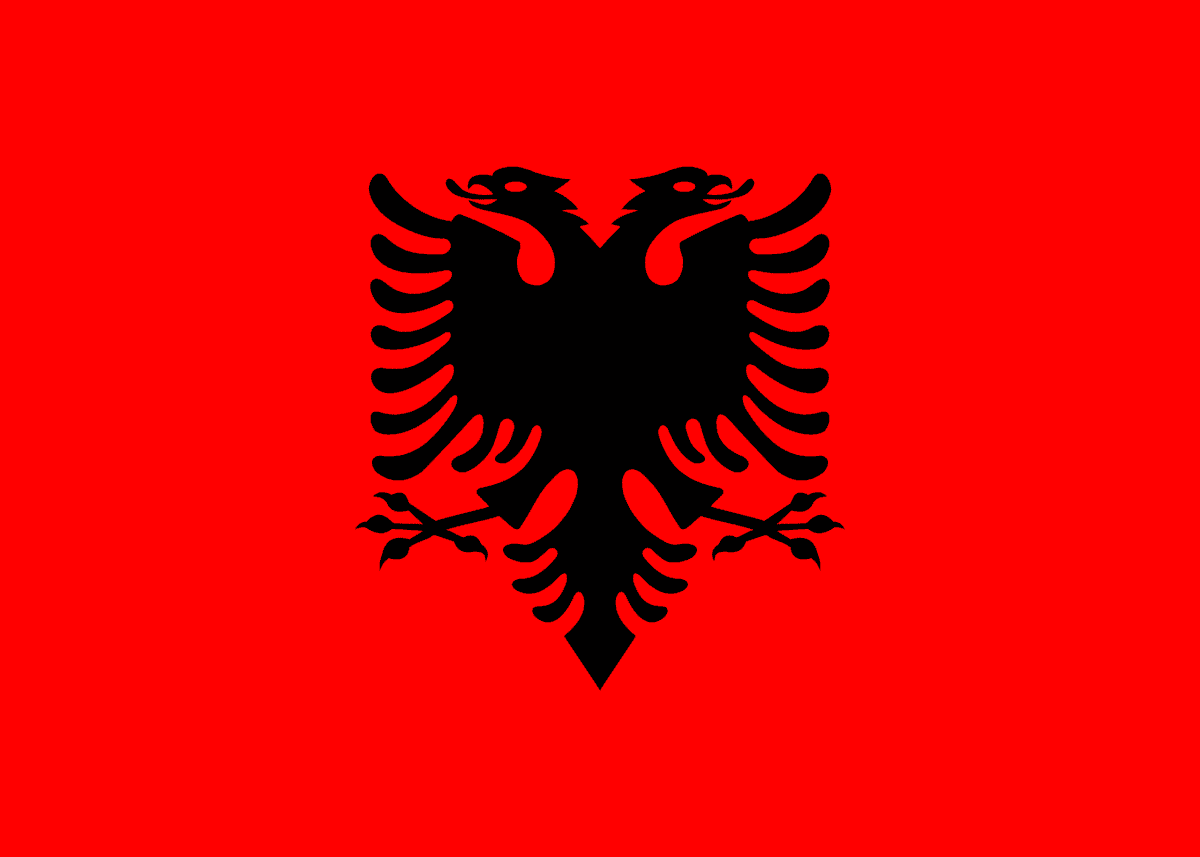
- Albanians call Albania 'Shqiperia', from the Albanian word for eagle – Land of the Eagles. One legend tells that the first king was elected because of his fearlessness and interaction with these birds of prey. This is reflected in their iconic double-headed eagle flag.
- 70% of Albania is mountainous
- More ethnic Albanians live outside the country's borders than the roughly 2.8 million living inside them. There are up to 6 million Albanians in Türkiye (no-one is quite sure).
- Albania is one of the few European countries with no official McDonald's franchises. There are a few Burger Kings though
- The Albanian language forms its own unique, independent branch of the Indo-European language family with no close living relatives.
- Albania shares Lake Ohrid with North Macedonia, which is Europe's oldest lake, at over three million years old.
- And careful - nodding means 'no' and shaking your head means 'yes', in some parts of the country.
- Every evening, locals take part in xhiro, a traditional leisurely stroll where main streets are closed to cars so people can walk, chat, and socialize.


Albania - Essential Travel Info
| Border and Entry Control | Visa Regimes | Citizens of the UK, EU, Australia, and Canada can enter visa-free for up to 90 days within a 180-day period. US citizens can enter visa-free for up to one full year (365 days). |
| Passport Regulations | Your passport must be valid for at least 3 months beyond your planned departure date from Albania. | |
| Finance | Accepted Currencies | The official currency is the Albanian Lek (ALL). The Euro (€) is widely accepted by hotels, taxis, and tourist businesses, but you will receive change in Lek. |
| Payment Ecosystem | Albania is a heavily cash-dependent economy. Credit and debit cards are accepted in major international hotels, large supermarkets, and upscale restaurants in Tirana, but smaller shops, cafes, local transit, and rural guesthouses only accept cash and all establishments ask for cash when they can. | |
| Banking and ATMs | ATMs are widely available in cities and tourist towns. Most local banks charge a standard (very high) flat fee (usually 700 to 800 Lek) for foreign card withdrawals. You should decline the machine's dynamic currency conversion (DCC) to avoid poor exchange rates. | |
| Tipping Culture | Tipping is customary but entirely discretionary. Rounding up the bill or leaving 10% in cash is standard practice in restaurants if a service charge is not already included. | |
| Electrical and Technical | Plug and Socket Types | Albania uses Type C and Type F wall outlets - the standard European two-round-pin configuration |
| Voltage and Frequency | The electrical grid operates at a standard supply voltage of 230V with a frequency of 50Hz, matching continental Europe and the UK. | |
| Internet and Connectivity | Prepaid tourist SIM cards and eSIMs from major local providers (Vodafone and One Albania) are inexpensive and available at Tirana Airport and city centres. Passport registration is required to purchase a physical SIM card. Free Wi-Fi is widely available in hotels, cafes, and restaurants across urban areas and coastal resorts, though connections can become unstable or slow in remote mountainous regions. | |
| Health | Water Potability | Tap water is not recommended for tourists. |
| Emergency Contacts | The unified national emergency number in Albania is 112 - it connects to police, ambulance, and fire services | |
| Vaccinations | There are no mandatory vaccine requirements for international travellers entering Albania. | |
| Communication | Language | The official language is Albanian, which uses the Latin alphabet. Official road signs, street markings, and public transit indicators are written using this alphabet, making them readable to international travellers. English signage is common on major highways, at international transport hubs, and throughout tourist areas, though signs in remote rural locations are exclusively in Albanian. English is widely spoken by younger generations and staff within the hospitality and tourism sectors in Tirana |

Where to go in Albania?
Today, tourists are very much encouraged, directed to beaches (especially in the south), dramatic mountains, and castles.
Here are my Albanian travel posts:
- North Albania: Capital (Tirana) and Castles
- Southern Albania: Fly and Flop -Vlorë and the Albanian Riviera
Expectations of Albania
When I did my Tour of the Balkans I couldn’t find an operator who covered all the ex-Yugoslav countries, as well as Albania, so I reluctantly settled for missing Albania out. Tantalisingly, we skirted all along the border. Two women on my tour had already been there for a long weekend. They assured me quite firmly that I hadn’t missed anything. In fact the word ‘dump’ was injected into the conversation several times.
Nevertheless, Albania has remained a white spot on my map for too long and I feel I need to see for myself if they were just unlucky. Maybe I’m not going to be very lucky either. When I booked I had no idea that an election was imminent. The FCO say this:
Summary – the political atmosphere is likely to remain changeable as the country approaches national elections on 25 June 2017; monitor local and international media, take extra care and avoid all political rallies and demonstrations; don’t attempt to cross any roadblocks set up by protesters as this might provoke a violent reaction


Getting to Albania - Too Many Babies
I won’t be forcing my way through any roadblocks then. The flight to Tirana is a contender for noisiest plane I have ever been on. Every row seems to contain a baby and I swear they are squalling in harmony. The performance lasts the whole three hours. The main international airport is named after Mother Teresa, who is claimed as Albanian, even though she was born in what is now North Macedonia. I’m met by a really friendly driver, Ergi, who tells me that most of the flights are very noisy and all his passengers complain. He says, ‘The Albanians have a lot of babies’.
Tirana Hotel
My hotel is just along a tree lined boulevard, with views of illuminated squares, and the delightful garden bar provides gentle pre-bed relaxation.
Half of Albania in a Day

I only allocated one day here, as the reports were so far from glowing. The guide books reckon that the sights of Tirana can be seen in half an hour, longer if I visit the park. And there are some museums. I’m thinking half a day walking round town and half a day in the tempting gardens by the pool. But then Ergi suggests a tour of ‘two or three cities’, so next thing I know I’m en route for two castles in the north.
Krujë and Shkodër are both hilltop fortresses, with good views across the countryside. And both forts involve very steep slippy approaches, on ancient stone paths claiming to be first century B.C.
Krujë Castle


Krujë Fortress (main image uptop) dates back to the fifth or sixth century, perched prettily above the city with the same name. The Krujë Fortress exhibitions are what the word eclectic was invented for. There's the Teqe of Dollme of the Bektashi (an Islamic Sufi sect), the National Skanderbeg Museum, the remains of the Fatih Sultan Mehmed mosque and its minaret, an ethnographic museum and a Turkish bath. The Skanderbeg Museum displays about a thousand different images of Skanderbeg, nose, helmet and plume featuring prominently. But this is, after all, where the national hero made his main stand against the Ottomans. The castle was besieged three times and even Mehmed II,' The Conqueror', could not break the fortress' diminutive defences until 1478, ten years after the death of Skanderbeg.
The ethnographic museum is a house, furnished as it would have been in Ottoman times. It's a very well organised and detailed display, showing the women carefully sequestered from the men.
Krujë Town


There’s a nice little bazaar, at Krujë. strategically located on the road to the castle, an unofficial part of the museum. But this wasn't a deliberately placed tourist trap. It is famous for being one of the oldest marketplaces in Albania, dating back over 400 years, and the starting point of free trade, among the city’s merchants. This is where Albanian bartering began and it's still the order of the day; very little is priced: everything from tourist souvenirs to traditional local crafts. Though the sellers look a little mournful and I feel mean for not buying. Maybe that’s their modus operandi.
Shkodër Castle
Rozafa Castle is more sprawling and ruinous, usually known as Shkodër Castle, as it's near the city of Shkodër, in northwestern Albania. It rises imposingly on a rocky hill, 130 metres above sea level, and no fewer than three rivers, the Drini, Buna and Kiri, are scenically meandering in the valleys below the castle.
This hill has been settled since the Early Bronze Age. The earliest fortification walls are dated to the fourth-third century BC. They were part of the citadel of the Illyrian city of Skodra, Today's visible walls are mostly Venetian.


The prominent, long mountain ridge rising directly to the west of the city, is Mount Tarabosh (593 metres). In the far distance, the faint, jagged grey ridges of the Albanian Alps. This impenetrable wall is also known as the Accursed Mountains. Probably because travel here is very difficult, but there are folk legends to explain the name too. The most prominent local legend attributes the name to a fleeing mother traveling through the dry peaks on a scorching summer day. Unable to find water for her dying children, she cursed the mountains to be forever barren and devoid of water. Another widespread piece of Balkan folklore claims that the devil escaped from hell and carved out the chaotic shape of the limestone crags during a single day of mischief.
Shkodër Town
Shkodër is the fourth-most-populous city in Albania. It has a pretty lake, named after the city, which is shared with Montenegro – we’re very close to the border; it has little rush covered islets, in a UNESCO park. Surprisingly, this is the largest lake in Southern Europe. Ergi says he had his wedding pictures taken here. We stop for a drink at a lakeside café. I can confirm that Ergi is not averse to a beer, even when driving. Though he did, at least, stop at one.


Ergi
Lunch can only be described as mediocre. I join Ergi in a fast food joint and we are served shredded dry overcooked chicken with some very bland chips and soggy salad. To my relief, Ergi says it’s not very good, so I don’t have to pretend to like it. It’s cheap - only a euro each. Ergi tells me that many Moslems here are only Moslem in name. He is a Moslem, but he drinks alcohol, eats pork and has never been in a mosque. Life is too short, he says.
He also tells me he only earns seven euros a day for this job. He was the national champion at weight lifting for three years, then he broke his arm. Now he supplements his income by doing private work, renting out a flat and managing a kitchen wares shop (his mother in law does the selling.) It makes me very grateful for what I have.


It’s a good trip out and I’m very glad of the opportunity to see more of the country. Ergi says I have seen half of it now. The castles on their own were worth the journey.
Tirana
Framed by the sweeping peaks of Mount Dajti, to the east, Tirana, the capital is right at the geographic heart of Albania. Officially founded in 1614, by Ottoman general Sylejman Pasha Bargjini, it remained a modest trading town until it was proclaimed the national capital, in 1920. Over the decades, its identity heavily shaped by monumental historical shifts, Tirana has completely reinvented itself into one of Europe's fastest-developing cities.
Tirana centres on sprawling Skanderbeg Square, with (naturally) a statue of the national hero, Skanderbeg. We get back to Tirana just in time for me to hare madly down to this square, taking pictures as the sun goes down. I manage to find enough light, at the right angle to capture the statue, frescoed Et’hem Bey Mosque, the blue domed orthodox cathedral, the famous clock tower, the and the beautiful crimson and yellow ochre 1930s Italianate government buildings.


The city has attempted to throw off its grey post-communist façade by painting the buildings of that era in bright, daring colours and creating welcoming urban spaces. Hence the eye catching, also frescoed, national history museum, the Palace of Culture and the bunker museums like Bunk'Art. The Pyramid of Tirana is a Brutalist monument, originally opened, in 1988, as a museum dedicated to 'the lifetime legacy' of the long-standing communist dictator Enver Hoxha, (the structure was co-designed by his daughter, Pranvera Hoxha). Closed during my visit, it's now been renovated and re-opened as 'a multi-functional community hu'b.


So I'm feeling very pleased with myself. Then I realise that the memory card in my camera has partially fallen out and hasn't recorded any images. I have to hurtle round the whole route again. I can confirm that the sights of Tirana can be done in fifteen minutes.
Is Tirana a Dump?
What’s the verdict on Albania? Well it’s most definitely not a dump. Tirana doesn’t make me squeal with excitement, but it has tree lined streets, smart pavement cafes and some good food. There are free street concerts in a couple of corners and it’s lively. It’s a pleasant place to be.

Albania Overall Verdict
The same sentiments apply to the countryside. We followed the chain of mountains north, The Skanderbeg Range (naturally) . They are rugged, but not amazing. The lower slopes are covered in pretty greenery. Farms and vines line the road for much of the way. There’s a great deal of young maize growing, some small modern industrial areas, very high tech service stations, some roadside stalls and a carwash every 500 metres or so. It seems to be the key service provided in the country. Ergi says that all the hand car wash operations in England are run by Albanians. He should know - he lived in Birmingham for a couple of years.
The elections? A couple of roads in town are blocked but I don’t see anything other than a diversion sign. And I can hear a megaphone or two from my bedroom. But it’s all very low key. Ergi’s not going to vote on Sunday. He is registered in his home town in the north, (we drove through it and waved to his sister’s house). It’s too far to travel (It’s also Eidh, so the traffic will be bad) and it’s his daughter’s birthday to boot. He’s going to take her to the beach at Durres, the second city of Albania. And the president, who’s doing a good job, will get in anyway.
I’ve had a very lovely day with my good natured guide He clearly loves his country and is keen to share it. Will I come back to see some more? If I do, I will certainly get in touch. Will I tell people in the UK that it’s not scary here like they’ve been told? I’m happy to do that. Would I class it as one of the top five countries in the world? I’m not sure I can go along with that one. And maybe it’s unfair to judge. Isn’t it a bit like trying to critique England after only taking a trip up the M1? However, I can definitely put the taxi-drivers in the top percentile.


Trying to Leave Tirana
I should know better than to make judgements before I’ve entirely left the place shouldn’t I? I’m already stressed by the information that I need to check in just one hour before departure for my Blu Express flight to Rimini and San Marino and therefore only need to order a taxi at 6. 00 a.m. I’m not unhappy about this, as I don’t deal with an early alarm well, but I’ve never been on an international flight where the recommended check in time was under two hours before. ‘I check with hotel desk twice. ‘It’s a very small airport’- they say. I don’t sleep well and come down early just to make sure, but there is no taxi.
Eventually, the receptionist calls a city cab. Ergi said it would almost certainly be him who would come, but he would wait for the hotel to call with the arrangements. I assume they never did. Once at the airport (after a pell-mell taxi ride on fortunately empty roads) things don’t improve. My ticket (agent bought) says Susan and my passport Susan Patricia. So I am forced to buy a new ticket for 60 dollars. No-one has ever been that pedantic before. They call it ‘a penalty’. I call it a nice little scam. I don’t think I will bother to come back for the other half of Albania.
Albawings - An Uncertain Vintage
The flight isn’t even being run by Blu Express, who I booked with. The operator is new low cost company Albawings, who own two planes of uncertain vintage. The seat belt is so old I can’t work out how to fasten it and the TV monitors, slung above the aisle, are Dark Age creamy yellow. Not that they seem to be working. The stewardesses hand us a plastic cup of water and then sit at the back of the plane and giggle loudly (the babies have just stopped wailing). It’s going to be a long hour. At least the water’s free. That’s one up on British Airways coming out.
Newsletter Subscription
Stay in touch. Get travel tips, updates on my latest adventures and posts on out of the way places, straight to your Inbox.
I keep your data private and only share your data with third parties that make this service possible. Privacy Policy. No spam I promise. Unsubscribe any time.