This website uses cookies. By continuing to use this website you consent to the use of cookies. Read the Privacy Policy.


A Brief History of Georgia
- Georgia has a long history. During the classical era it was divided into two main kingdoms, Colchis, in the east and Iberia, to the west. This is exciting. Colchis was where Jason ventured, with his Argonauts, to fetch the Golden Fleece. Apparently, fleeces were used to sift gold dust from rivers at that time. The people here were known as "Gurj". They were devotees of St George. Theory has it that the crusaders made the connection and named the country Georgia. The flag definitely represents St George too.


- Georgie emerged from the World Wars, as a Soviet republic, and then an independent republic, under Soviet style leadership. President Eduard Shevardnadze was ousted in 2003, in the (bloodless) so called Rose Revolution. Since then Georgia has strongly pursued a pro-Western foreign policy, aimed at membership of NATO and integration into the European Union. Unsurprisingly, this led to worsening relations with Russia and, at one point, a brief war. It's all peaceful now, I hope.
What Continent Does Georgia Belong To?
- Georgia is positioned between both Asia and Europe, but is often considered to be more European in its politics.
Facts and Factoids
- Georgia on my Mind, though not the American state, which is what Google overwhelmingly throws at you, if you type Georgia into the search engine. But the country of Georgia sits right at the intersection of Eastern Europe and Western Asia. It is a part of the Caucasus region, bounded to the west by the Black Sea. Debatably - in Europe. In Asia, if you count the Caucasus as the boundary. Ask the Georgians? They want to be European. Well, the ones in capital, Tbilisi, do.
- The Georgians don't call their country Georgia - that's the western name - see above. They call their country Sakartvelo.
- Joseph Stalin was born here and there are a multiplicity of portraits of him around. The people aren't sure whether to be proud or ashamed.


- This is a religious country. Most of the people say they belong to the Orthodox Church of Armenia. And there are plenty of churches.
- The Georgian language is very different. Georgians have their own alphabet, possibly (like the Armenian one) based on the Ethiopian. Mama means daddy and dadi means mummy. (Honestly.)
What To See in Georgia?
Read about my train trip here.
Transnistria - A Safe Place to Visit?
‘Even though it´s unlikely that bringing up sensitive matters will have any other consequences than a KGB interrogation, it´s best to avoid it to be on the safe side. Remember that your embassy will have limited ability to help you if you run into trouble with the authorities, given that Transnistria is not recognised by any other sovereign state.’ Perhaps I should have read this Wikitravel advice before I set off.
‘Be careful when taking photos. Avoid brandishing your camera around military checkpoints and other places that might have some sort of "strategic importance" (this definition can vary wildly). That said, taking photos of most public places and buildings in Tiraspol should be OK. The major cities are safer than Western European and American cities of similar size and economic makeup. Also, despite the political situation with Moldova, there is essentially no threat of being caught in a military action. There has not been fighting in Transnistria for many years. By far the biggest threat to the traveller is scamming.’ It adds.’ However, even when scams are attempted, it is often for no more than a few euros.’ That’s ok then.
The Three Musketeers

I booked my tour to visit Transnistria on the Internet and am a little alarmed, when my car turns up to fetch me, in Chisinau, the capital of Moldova. It contains three stocky men wearing leather jackets. One guide, called Vladimir, one driver and one driver instructor I’m told. I feel as if I’m on a Mafia excursion, but decide not to pass on this information. Instead, I tell them they’re my Three Musketeers. TC Ted is D’Artagnan. They say I must be Milady, then, so that’s ok. I don’t understand why there’s an official border if Moldova doesn’t recognise Transnistria, but there is, and visas have to be obtained. They must not be lost under any circumstances I’m warned, or a great deal of bribery will be necessary.
Transnistria - in a Nutshell
Transnistria, officially the Pridnestrovian Moldavian Republic (PMR), is an unrecognised breakaway state (since Moldova declared independence in 1991), which is internationally recognised as part of Moldova. Transnistria controls most of the narrow strip of land between the Dniester river and the Moldovan-Ukrainian border, as well as some land on the other side of the river's bank. The Council of Europe considers the territory to be under military occupation by Russia.
Bendery


Despite all the scare reports, everything goes smoothly. We navigate two border posts from Moldova and enter Bendery. It's extremely quiet, if not effusively welcoming; there are very few tourists. Bendery is the Russian name. the Moldovans call it Bender and officially its part of Moldova and not Transnistria. First stop is a circular monument and some Russian statues. There's also a Russian tank at the ready (under cover) that Vladimir tells me not to photograph. Beside the Dnieper River a restored Ottoman fortress, but I can't visit that as it's full of Russian soldiers.
Russian aid is immediately obvious, from the moment we cross the border, and the car stops juddering. Here, the roads are smoothly surfaced. Lenin presides outside one of the many government buildings. There are soviet apartment blocks and memorials, as well as Russian police, The official language is Russian, all the signs are in Cyrillic and the currency is the Transnistrian ruble. This is appropriately pronounced rubble, as no-one will change it back to another currency. It’s all clean and neat.
Tiraspol


Next we visit Tiraspol, the capital. The Green Market here is extraordinarily cheap and Vladimir buys me far more fruit than I can eat (you can taste it all first). Then it's the memorials, Lenin, another tank on a plinth (I’m allowed to photograph this one) and a church or two. There are beggars singing in the park, as well as a woman selling cats (Vladimir says this is common) and we saunter along the high street nibbling grapes. Vladimir says the apartment blocks are original, middle aged, but still in good nick. ’Like me,' then. He laughs again.


The Sheriffs of Transnistria
So Transnistria is almost like being in Soviet Russia, but there are parallels with today’s Russia too. Much of the country’s economy is run by two brothers. This is why the name Sheriff is plastered over gas stations, shops and hypermarkets throughout the fifty mile strip. They have just installed an extraordinary complex of 14 football stadia and are now constructing a mammoth market in the centre of town. I point at another large store and ask if they own that. ‘No’, replies Vladimir. ‘Not yet,’ I suggest and he grins.

Transnistrian Politics
I’m still grappling with the absurdity of the political situation. Russia won’t officially acknowledge Transnistria, but is clearly providing much support, including free gas and supplementing residents' pensions. Vladimir envies the financial support and the industry of the people. He says, unlike the Moldovans, they work hard and grow food here. But it’s too quiet for him. Russia also provides over 1,000 troops (or more depending on who you believe), to the consternation of Ukraine, on the other border. Vladimir says that this was the site of more or less the entire Russian arsenal, post-war. It’s unclear how much of the biggest weapons deposit in Europe still remains. No wonder the Russians like things just as they are. And no wonder Moldova just has to put up with it.

Getting to Chisinau, Moldova
I’ve already discovered, checking in, that the capital of Moldova, Chisinau, is pronounced “Kishi-now”. In order to visit Moldova I have to fly from Almaty via Moscow, on Aeroflot. It’s an adequate experience at best. There is no entertainment, or alcohol, the toilet is smelly and there’s a queue half way up the aisle to reach it. The stewardess offers me a choice of chicken or meat. I plump for chicken and am given fish. The woman in front has reclined her chair so far back that my laptop screen is in danger of being crushed - there have been words - and the battery expires anyway, an hour and half from landing.
I’m on the plane with Deborah and Martin from the Golden Eagle train, who are on a very tight connection back to Manchester. They scramble onto the airport bus, at Moscow, but the doors shut in my face. ‘There’s another one coming,’ a passenger behind me says, in a very strong accent. ‘But they’re my friends and I haven’t said good bye’, I reply. ‘This is Russia’ he grunts.

Moscow to Chisinau
I’m now very grumpy. I’ve got to wait four hours for my connection, which takes off at the equivalent of 1.30 a.m. Kazakhstan time. My travel agent cunningly didn’t point this out. There are even lengthier queues for the toilet, in the terminal, and I have to wait so long that the vacant battery charging spots I noted, on my way in, are now all taken. I’m falling asleep and hungry and thirsty and I can’t work out how to use a card in the vending machines. The instructions are in Russian and I don’t have roubles.
The connection is running half an hour late, the plane is packed with miserable, pinched looking and poorly dressed people and it reeks of sweat, beer and farts. There’s turbulence to boot. It’s possibly the worst flight I’ve ever been on.
Three planes land at once, so there are crawling queues at immigration, where the officer doesn't so much as crack a smile. There are more, very long, queues to pay for the car park and then there's an even longer queue to physically get out, as some folk have driven up to the exit barrier and then got out to buy their ticket. It's now 1.30 a.m.- 5.30 in the morning Kazakhstan time. It's even late, using UK time.
I hope the poorest and least visited country in Europe is worth it. It was a last minute addition to my trip, when I realised that I had been to every other country in this continent.


A (Very) Brief History of Moldova
I've struggled to try and follow Moldovan history, as reported on Wikipedia. Perhaps you will have better luck then me. As I understand it, most of the current Moldovan territory was a part of the Principality of Moldavia from the fourteenth century until 1812, when it was ceded to the Russian Empire by the Ottoman Empire and became known as Bessarabia. The conflicts between the Ottoman Empire and Russia for control of Moldova are renowned. Then, it seems to have been in and out of Romania and Russia/Soviet Union for some time. It became a republic, after the dissolution of the Soviet Union, in 1991.
To and From Transnistria, Moldova

My first proper view of Moldova, is the road to and from Transnistria, with my Mafia, three stocky men wearing leather jackets. One guide, called Vladimir, one driver and one driver instructor. As advertised, Moldova has varied terrain including forests, rocky hills and vineyards. It also, unsurprisingly, looks vaguely Romanian, but there is nothing remarkable. Little colour, nothing out of the ordinary, no mountains. There are mosaic factory signs depicting workers waving blow torches and scatterings of soviet style apartment blocks, mostly back from the highway and alternating with more traditional villages and the spires of churches. The road could do with a visit from Tarmac and many of the houses are dilapidated and have corrugated roofs.
Vladimir says that very little is grown here, even though the soil is very good and Moldova is supposedly twelfth on the list of world wine exporters. All the manufacturing industry was either in Transnistria or abandoned after the Soviet collapse. The main sources of income are wheeling and dealing - importing and exporting at a higher price and the EU. (Moldova pleads the threat of Russian incursion.) What is positive about Moldova? I inquire. I’m informed that it has the fastest internet speed and coverage in the world (The Internet says third fastest. I suppose they need it for all the wheeling and dealing,) In addition, I'm told, it had the first Soviet supermarket and the first McDonald’s in the ex-Soviet Union.
Facts and Factoids
- This,(along with Ukraine), is the poorest country in Europe.
- It's also the least visited by tourists. It's not very accessible. And there doesn't seem to be much to see. It's great, if you like wine festivals.
- Moldova is one of the world's largest exporters of walnuts.
- The national dish is maize porridge - mamaliga. You can even eat it with cottage cheese.
Sampling Placinte


The highlight of the road trip is a stop at a road side café, which makes very acceptable stuffed and coiled flaky pastries known as placinte (I think they might have attempted them on Bake Off recently). Vladimir informs me that they are so famous, folk drive out of the city specially to fetch them. No delivery service here. We sample meat, cheese (with the usual dill) and cherry. They are all good, but the cherry is exceptional. I doggy bag the remains for supper, along with the remainder of the tons of fruit we bought in the Green Market in Tiraspol.
Touring Chisinau
Vladimir (I can’t help thinking of Vlad the Drac or Vlad the Impaler) is keen to give me a tour of Chisinau. I’m so tired I’m zombified, but I can’t pass up the opportunity and there might be more to Chisinau than the internet and observations so far suggest. I’m a little disconcerted, when the car stops and we are deposited on the one main drag. A walking tour then - just me and Vlad. There is supposed to be Soviet-style architecture and a nice park. There is indeed, but not enough to revive me.
The most impressive sight is the huge staggered apartment blocks, at each side of the entrance to the city (see above). These are known as the City Gates and are gargantuan and utilitarian, rather than attractive. There are some very upmarket shops for the residents of the new upmarket apartments, which back onto the main street. One shopping block is named Mall Dova. I like a good pun. I’m not sure if this qualifies.
The Soft Revolution

The guide’s information is more interesting than the buildings. There’s the new parliament house. Vladimir says the old one was burned down in what the government called the ’soft revolution’ in 2009. He wants to know how many people have to die before it’s called a hard revolution. After the revolution, there was a political deadlock, leading to no president for three years. Nicolae Timofti was elected, after 917 days.
There’s a statue or two (Lenin has been removed here) and a church or two. The Moldovan Orthodox Cathedral of Christ's Nativity dates back to 1830. (The high priest stole the gold off the dome according to my guide.) The separate bell tower was destroyed by the Soviets and rebuilt in the 1990s. Next, the mayor’s residence at the City Hall. Both he and the vice president are in jail for corruption I’m told.


The Cathedral Park has a plaza, with a Triumphal Arch, celebrating Russia's nineteenth-century victory over the Ottoman Empire. It's also crammed with beggars. One mother, with two youngsters, waves her finger at the fruit that Vlad is bearing and he allows her children to select some. They are extremely aggressive while choosing, attempting to pull out still more and then run off without a word of thanks. Vlad declares that the important thing is to keep an eye on their hands, as they usually pick your pockets. He says to watch the little ones especially. Stephen the Great Central Park is named for a Moldovan prince who resisted Ottoman rule.
(Back at the ranch, I’ve checked Vlad’s commentary. Whilst generally accurate he seems to have exaggerated about the scale of the inflagration and mixed his politicians up a bit. Certainly, several of them seem to have been involved in siphoning off a billion dollars -about 12% of Moldova’s GDP - a couple of years ago. Most of what’s written about it on the World Wide Web are garbled accounts in very bad English.)


Loving Moldova
Vladimir is scathing about the government, but says he loves his country. He is 32 and the only member of his family who has stayed in Moldova. The others have dispersed around the globe. He is working very hard to keep me engaged, refusing additional money for the tour extension, on the grounds that ‘he likes me’. I’m too tired to walk any more and feel guilty when he is so keen that I should love Moldova, but I have to lie down. Alone. I’m not quite sure what he means by saying, ‘I like you’, but a retreat seems the best option on several counts. Moldova might be the poorest country in Europe. It’s possibly the least scenic. And it’s the last country in Europe. I’ve visited them all now and this is one I won’t be coming back to.
Leaving Moldova

It’s raining, so Chisinau still looks miserable and I’m off home on a Lufthansa Cityline mini-jet via Munich. They have attempted, unsuccessfully, to put my hand luggage in the hold. Not only have I outwitted them, but one passenger, for some reason, has swapped seats with me, so I’m the only person in the two exit rows. The stewardess is very smiley and offers me a choice of chicken or egg. ‘Chicken’ I request. It’s some sort of synthetic spam. On leg two I select egg. I'm given cheese.
In Moldovan, Drum Bun means 'Have A Nice Trip'.
Ashgabat Airport
We have a chartered Embraer 190 (about 90 seats) to take 13 of us over the Caspian from Baku to Ashgabat, the capital of Turkmenistan. TC Ted gets his own seat, so he makes 14, and there are three cabin attendants. For lunch we are given a hot pancake with chocolate sauce and canned fruit cocktail. The airport is all white marble, green and gold, with every modern device possible and cascades of automatic escalators and moving walkways. It is eerily absolutely deserted – even more so than the one in Pyongyang. There are machine passport readers and scores of x-ray scanners. Maybe the men on customs duty are bored, but they find something to question in everyone’s case. They are particularly interested in medication, so Doctor Tino gets a hard time, until ennui sets in for them again.


Ashgabat – The Marble City, Turkmenistan
Our hotel is a smaller version of The Sail, in Dubai. We can see it as we come into land, standing proudly isolated outside the city. And as for the city: if other capitals have been space age, this one is in another galaxy. It’s all white marble. I’m going to change my mind about where Kim Jong-un got his inspiration. This place is the UAE, meets Las Vegas, meets Pyongyang. It’s so over the top I’m almost lost for words. Ashgabat was rebuilt in Soviet style in the mid-twentieth century, when it was part of the Soviet Union. Since independence, the resulting monoliths have all been re-clad in marble. Some have had neoclassical pillars added. In a city of just 22square kilometres, there are 543 buildings covered with 4.5 million cubic metres of imported Italian white marble.


Turkmenbashi and Gurbanguly Berdimuhamedow
As if that wasn't enough, the city is filled with grand monuments honouring former president Saparmurat Niyazov - or Turkmenbashi. (The name Turkmenbashi means exactly what it suggests, Leader of the Turkmen.) This man was a specialist in building a personality cult. He renamed the city of Krasnovodsk after himself and then set about placing gold statues of his image around Ashgabat. Just as in North Korea, there are statues to commemorate the dead and pictures for the current incumbent. The current president, Gurbanguly Berdimuhamedow, was born sixteen years later and is, officially, no relation. But he looks uncannily like him, as is evident from his many pictures. The opposition party (at least there is one) have dubbed him The Turkmenator. Gurbanguly Berdimuhamedow became president in 2007 after winning a non-democratic election (he had been vice-president and then acting president previously);
Wikipedia reports that, 'the country is widely criticized for its poor human rights, its treatment of minorities, press and religious freedoms.'
The Neutrality Monument


There are also gold domes, towers, an enclosed Ferris wheel (unsurprisingly unique in the world), towering pillars, a rocket shaped memorial, a whole line of sports stadia, strings of fountains, parks and a multiplicity of other extravaganza. The highlight is the tripod/rocket shaped Neutrality Monument. (Apparently, Turkmenistan is the first officially neutral country in the world. I will have to check that. What about Switzerland? ) This is all in the new town, which is criss-crossed by three lane highways. The gantries, lamps and traffic lights are white, with a filigree gilt finish and there are videos running on LCD screens (with white and gold frames) at the sides of the road, showing the president and other dignitaries working, and also, bizarrely, fun fairs and other jollity.
Where Are the People in Turkmenistan?
There are no people around here, other than cleaners, pretending to sweep and wash the stone paths and men on mobile platforms polishing all the numerous lamps that illuminate them. Almost 90% of workers in Turkmenistan are employed by the government. The many elite apartment blocks look empty and another car on the mega highways is an event. Our guide says that the old town is livelier - he lives there - but we haven’t been taken to visit it.
A 5.5 Star Hotel


Like Pyongyang, much seems fake. There is no roaming cell phone signal and little Wi-Fi. All the social media sites are blocked. Our out of town hotel also fits the bill. It's a modern tear drop shaped beacon. At 5.5 stars it’s much more stylish than anything in North Korea, but it’s isolated and is reached using its own deserted three lane highway. There’s no sixteenth or seventeenth floor button in the lift (!) I have a view across the Marble City and there’s an illuminated star encased globe on the next hill, which turns out to be the Happiness Palace, where people get married.
The room is decorated with fancy wood furniture. The bathroom has a heated floor and there’s even a TV at the end of the bath. There are Bulgari toiletries beautifully arranged- all very elegant with glass and marble fittings, shower and separate toilet. And then a tube of Colgate toothpaste and a tooth brush in their original wrappings. Very odd. The service is interesting, the staff look surprised and little put out if you ask them to do anything. At breakfast, there is no-one at the egg station, and when she does return the chef has a hissy fit if she gets more than one order at a time.


Facts and Factoids
- Turkmenistan has long served as a thoroughfare for other nations and cultures. Merv is one of the oldest oasis-cities in Central Asia, and was once the biggest city in the world. It was also one of the great cities of the Islamic world and an important stop, on the Silk Road.
- Annexed by the Russian Empire in 1881, Turkmenistan figured prominently in the anti-Bolshevik movement in Central Asia. In 1925, Turkmenistan became a constituent republic of the Soviet Union, the Turkmen Soviet Socialist Republic (Turkmen SSR); it became independent after the dissolution of the Soviet Union in 1991.
- Turkmenistan is nominally an Islamic country and only 30% of the population are practising Muslims, but the women are fully covered, with very long skirts. Before they are married, they sport small skull caps and long plaits. When partnered up, they move on to bright headscarves, tied to make it look as if they have as much hair as possible, Iranian style. (Iran is only just the other side of the mountains). Some of the men wear small skull caps too. They are all very reluctant to have their photographs taken. Elvin says that newly married women are forbidden from speaking to their fathers in law at all. When they have had a baby they may inquire what he wants for dinner.
- Natural gas is the country’s main export.
- Most of the country is covered by the Karakum Desert. The population is about six million, the lowest of the Central Asian republics, and Turkmenistan is one of the most sparsely populated nations in Asia.
Nisa


There’s also almost a small traffic jam, in another part of the new city, as we progress to and from the mud remains of the Parthian Fortresses of Nisa. It's mainly two 'tells', but apparently it's the site of one of the earliest and most important cities of the Parthian Empire, a major power from the mid 3rd century BC to the 3rd century AD. The most exciting thing to do here is walk round the mud ramparts for great views of the Kopet Dag mountains and across the flat valley.
Kipchak Mosque
The Kipchak Mosque is also gleaming in the haze. There’s a green roofed village nestling below the peaks, the remnants of old Soviet collective farms. Winter wheat and cotton are major crops, as well some grapes. The guide says the wine isn’t very nice, it’s very sweet.
The huge mosque is built in memory of Turkmenbashi and his mother and is one of the largest mosques in Central Asia. It's adorned with an immense golden cupola 50 meters in diameter and four tall minarets 91 meters high (Turkmenistan gained independence in 1991), Inside are interlocking eight-sided stars from cherry wood and pillars cased in Carrara marble and a huge handwoven carpet. There's room for 10 000 worshippers inside the mosque, but it usually sits empty, as the mosque is somewhat controversial. It incorporates scripts from the Ruhnama, the former president’s moral guidebook, which are given equality with the Koran. The family mausoleum is alongside, suitably guarded by goose stepping soldiers.


Across Turkmenistan
Then, back to the train, which has crossed the Caspian Sea to reach Turkmenistan on a ferry. It’s the first time, on this journey, that I’ve sat in my cabin and been able to look out in daylight. So far all I’ve seen is acres of scrubby flat desert, a herd of camels grazing and the odd industrial plant, which I assume is for the extraction of natural gas.

Darvaza Gas Crater, Turkmenistan
Gas certainly contributes to the country’s most impressive sight. The Darvaza Gas Crater in the middle of the Karakum Desert has been alight since the early 1970s when a gas rig collapsed, creating a huge hollow. It was lit deliberately to eliminate the leaking poisonous gas. They thought it would take a week to burn out. It’s astonishing in the dark, like a giant cauldron, and we tiptoe round the edge with torches and then, at Tino’s insistence, scramble up a much too steep hill for the view, tumbling into thorn bushes on the way. There’s definitely no way back out if you fall in, assuming you don’t catch light straight away.


Turkmenistan to Uzbekistan
The showers in our compact cabins are a little annoying, as you have to keep your hand on a knob to maintain the flow of water. It’s not easy to do this and spray yourself holding the showerhead simultaneously. Shane suggests that we should adopt the yoga Tree Pose, standing on one leg and pressing the knob with your knee. I’ve tried it, but it’s not hugely comfortable.

We’re supposed to be over the border in Uzbekistan when we awake, but the train is still sitting at Dashoguz on the Turkmen border. They seem to be changing the engine. Here, there’s a built up area and an insight into the real Turkmenistan. The houses are mainly crumbling clay and stone shacks, though they all have a satellite dish on the roof. There’s an Uzbek flag waving tantalisingly in the distance as we, perplexingly, reverse out of Dashoguz station. We’ve decided the drivers are more used to freight trains as they have not yet mastered the art of braking smoothly. Everything in the carriage topples over as we halt.
I was wrong, that wasn’t the Uzbek flag, it was the Turkmen flag – Dashoguz must have been a terminus and this is the border area. There are soldiers observing alongside the track every 100 metres or so now. Uzbekistan here I come. Farida from the train is re-joining us when we do finally get there. She was refused a visa for Turkmenistan, no explanation given.

The Golden Eagle Luxury Train
I’m finally on the train, in Georgia, after crossing the border from Armenia. It's not quite 'Midnight train to Georgia'. The railway station is dark and embarkation is far more subdued out here, on this border outpost, than it was on my Moscow journey. Then there was a VIP lounge with champagne, a harpist and a brass band. But opulence still rules ok. We still get the cute cabin attendants standing on red carpets to help us into our cabins, which are still all swags, lace and brocade. My attendant has a husband to help her too. He lugs all the cases. I wonder if they squash into her tiny cabin together.
There’s still a huge bowl overflowing with fruit at the end of the corridor, and too much to eat. The caviar welcome dinner involves vodka and champagne in crystal glasses and tiny delicious blinis with cream. Some of the staff are the same as on my last trip. I have photos to prove it. And we have three chefs, one Russian, one Chinese and one Ukrainian on board. This trip is not cheap and my fellow passengers are an affluent bunch. Some are on the trip of a lifetime. Most are movers and shakers. Laura, for example, is a VP of one of the most well known companies in the world.


The Riff Raff Club
Those in Imperial Class get a separate car and guide, so they don’t have to travel in the bus with us. I’m in lowly silver class. I can’t find anywhere in my cabin to put my clothes, but otherwise it’s comfy. My compact bathroom is a wet room, which converts to a shower cubicle by unfolding a curtain all the way round. Amazingly, it works. Four of us, who occupied the back of the bus have formed a breakaway group called the Riff Raff Club. Shane, who is part of our group, was a big wig at a very large American company. Farida runs her own business in Uganda. And Tino is the train’s doctor, so that’s useful.
Space Age Tbilisi, Capital of Georgia.
There is medley of architecture in Tbilisi; a startling amount of it is space-age. Here is yet another president (Mikheil Saakashvili) with a penchant for flashy prestige projects to impress foreign investors and politicians. There are towers, statues and cupolas aplenty (illuminated at night of course). There's a golden statue of (patron) saint George, slaying his dragon dominating Tbilisi's central square. It's on a 35 foot coulmn so you can't escape it.


There are also a pair of long steel and glass tubes that were going to be museums and may or may not get completed. In addition, a new parliament building - a concrete bubble, and a futuristic bridge that has unfortunately, (according to Lonely Planet), been nicknamed the Always Bridge, because of its curvy shape. The spanking new police stations are all glass and see through, symbolic of Georgia's aspirations for democratic transparency. The developments don't sit well alongside subsistence farming in the countryside. And the glass doesn't work too well in the hot summers. The modern side of town has French style boulevards, lined with crumbling shabby chic villas, many dabbling in art deco.
Old Town Tbilisi
It’s all a complete contrast to the maze-like, cobblestone streets of its old town, on the other side of the Kura River, which bisects the whole of Georgia. Perched above are the domes of the sulphur spring bathhouses, tiled and terracotta and a fortress and mosque. The mosque is the only one, so is unique in being used by both Sunni and Shia Muslims. There are plenty of churches, the Sioni cathedral, 13 renovated caravanserai (mostly now converted to shopping malls) and a lively balconied street full of cafes and restaurants. Slightly incongruously, Leonard Cohen is playing in one of them.
Then there’s a very long lunch - again. Most of them last two hours and involve mezze of different kinds of flat bread, baked on the premises, tomato, cucumber and herb salads, dolmades, aubergine rolls and soft cheese, before minced patties, stew or kebabs emerge and some roast potatoes. Dishes arrive one at time so there is never a complete plate of food English style. There’s a really good inside out cottage cheese pastry or pizza. Finally, out comes a bottle of chacha, the lethal Georgian schnapps.


Dinner is in yet another local restaurant and involves much the same food as lunch, accompanied by a lengthy dancing performance involving many changes of costume, cossack leaping in long black boots and fake plaits.
Wine Growing in Kakheti, Georgia
Today, we head into the countryside, where the Caucasus Mountains (the tallest range in Europe proper), still snow-capped, frame our back drop and farmers scratch out a subsistence living that’s very different to the show of Tbilisi. Some of the roads are narrow and windy and in need of repair. It doesn’t help that last night’s repast is disagreeing with me badly and I have to ask for the bus to halt at a gas station before the planned toilet stop.


Georgia is famous for the ancient wine-growing region Kakheti. It borders the Great Caucasus range with summits over 3,000 metres. The earliest evidence of wine to date in the world has been found here in Georgia, where 8,000-year old wine jars were uncovered, hence its importance. There are said to be about 500 varieties of vine in Georgia today and the wine, we are told, symbolises Georgian hospitality, friendship and tolerance and is the key to Georgian longevity. There you go..
The Tsinindali estate is a former aristocratic family residence, with a well manicured 'English style park'. It's now a little museum, with wine-tasting of course. It has views over the Caucasus, as does Shumachmann’s Winery in the Kizikhi, area, with lunch and more wine tasting.
Sighnaghi

It’s a long and tiring drive with a final stop at Sighnaghi. This is a royal town on the Silk Road, containing a multitude of wooden balconies with sloping tiled roofs. Its surrounded by walls with 23 towers. Each of these towers were named after nearby villages and respective families and served as a refuge in case of danger. It's said to be the longest defensive wall outside China. There are more good views, this time across the lower part of town, with a fortress and church
Georgia, Home of Stalin
Overnight, the train has moved 100 kilometres to Gori. This involves much crashing and banging, as the engine is shunted. The rails are clearly not in very good shape. At one point all my clothes come showering down from their overhead niche and land on my bed. It’s a rude and much too premature awakening.
We’re again on the bus, which is taking us back to Tbilisi, where the train will have already returned. First, the Stalin Museum; and it's a timely visit. It's the hundredth anniversary of the October Revolution and there are a plethora of Stalin based books, video and radio programmes around in the UK at the moment. (Iannuci's film, The Death of Stalin is particularly good.)


In the museum, is more or less every object you can think of that might possibly be emblazoned or engraved with pictures of Stalin. Laura points out that in his youth Stalin looks like George Michael. In most of the pictures his small pox scars and withered arm are airbrushed out. Though I think they called it retouched then. Gori is his birthplace and he is still revered, despite being responsible for more deaths than anyone else in the history of the world. His old house is encased in a neoclassical villa in the grounds, which are home to numerous dogs, all tagged and cared for by the town. We are told that this is because Stalin liked them. However, I’ve also read that he used to attach explosives to dogs and send them into the Nazi camps.
Uplistsikhe


It’s a diverse itinerary today. The ancient city at Uplistsikhe is a troglodyte warren of cave homes, halls and temples, dating from the sixth century BC. Up top a pretty, red roofed basilica which is relatively young, as it was built in the ninth or tenth century. It's best appreciated from a distance as the caves are devoid of decoration.
The weather is still, beautiful, much to the guide’s surprise: ‘But it’s always windy up here,’ We are shuffling around, sweltering in the big coats we wore, as instructed. Lunch is inserted in-between and follows a sealed menu (rolled and tied with gold ribbon), with more Cossack style folk dancing.
Mtskheta


Mtskheta is one of the oldest cities of Georgia, located at the confluence of the Mtkvari and Aragvi rivers. Today, it's a small provincial town, but, for nearly a millennium until the fifth century AD, Mtskheta was a large fortified city, the capital of the Kingdom of Iberia. Mtskheta is seen as the birthplace of Christianity in Georgia, and has two significant churches (of course) in and above the old capital. One of these is Svetitskhoveli Cathedral. They became a UNESCO World Heritage Site in 1994. A multiplicity of weddings seem to be taking place at both, but above has the best views.


Back on the train, and on to Azerbaijan.
Kiev, the Capital of Ukraine - Friendly and Efficient
The journey from Minsk, to Ukraine, is amazingly quick. (I'm on a lengthy trip, so I'm only visiting the capital, Kiev.) The plane takes off exactly on 1.30 and I’m in my hotel room in Kiev at 3pm. Astonishing efficiency at Kiev airport where they even manage to bid me ‘Welcome to Ukraine’ in immigration. I’m so early the taxi driver is still scurrying through the door trying to find his Susan Rogers sign. At first glance Kiev looks much more like the down at heel fraying at the edges city I expected from Minsk. But it’s raining and better weather is promised. Let’s see what the sun brings.
The staff on the hotel reception are very friendly and the concierge Ivan quickly sorts me out a private guide for tomorrow. Some of the sights are fairly spread out and a car will be helpful. As he reminds me, I’m only here once. It’s a good if unoriginal line to justify 45 dollars an hour; Ivan’s already famous on trip advisor for his helpfulness. (I’ve decided to pass on visiting Chernobyl. Kiev is quite close enough.) The bell boy has a blue military style jacket and he zooms off, not even expecting a tip. All is well.
Khreshchatyk Street


At first, it feels as if I’ve landed in the back of beyond, location wise, but once I’ve worked out which way to go (up the hill), I’m soon in the humming part of town and wandering along Kiev’s main thoroughfare, Khreshchatyk Street. It's apparently referred to as the shortest, yet widest,main drag in the world. It is remarkably broad, but not as wide as the streets in Minsk, so I’m unimpressed. It’s closed for traffic today, there are police cars parked at each end, so I can saunter up the middle and admire the brown mock renaissance buildings, towering on each side. (As well as Soviet towers and a GUM department store. there are several street exhibitions, one on the history of Kiev. (the anniversary of the Russian revolution is approaching) and one that has a religious theme.


The Golden Globes of Kiev
Kiev is growing on me. It’s much more European than Minsk; I only see a few statues and very little brutalism (the odd Soviet style statue) with cobbled streets (well brick), tree lined squares and familiar chain stores. There’s an excess of neoclassical pillars too, as well as a multiplicity of gold domed churches and cathedrals, including the eleventh century World Heritage Saint-Sophia Cathedral. It’s an upmarket café culture but there are also more fancified McDonalds. The McDonald’s next to the main train station is claimed to be the third busiest in the world.
My hotel room is nicely furnished, not huge, but big enough, and seems to have everything I require. Molton Brown toiletries. You can eat from the same menu in the main restaurant or the bar (which is very smoky) or the hotel vestibule (very opulent with piano). The menu itself is fun. Potatoes are listed under the heading ‘starches’. The waiter helps me choose local food – bortsch (which turns out to be from Ukraine not Russia) and shuba salad (herring and potato). It’s really good, with lashings more cream. There’s no Chicken Kiev though. They tell me that doesn’t come from Kiev. It is thought to be a nineteenth-century French recipe, brought to the east by Russian aristocracy, fascinated by French cuisine. The national drink is called horilka. It's a clear spirit. While vodka means “little water”, horilka means “burning water”, as the drink is often flavoured with chili pepper.


Kiev, The Cradle of Russian Civilisation
Today, I’m off on a tour of Kiev, with my guide and driver. Both of them are called Alex, so that’s easy to manage. My guide speaks good English, is interesting and doesn’t go on too much, though he is passionate about his city. I’m given to understand in no uncertain terms that Kiev is the cradle of Russian civilisation. It was blessed by Andrew, the apostle, according to legend and, from the the late ninth to the mid-thirteenths century, was the capital of Kyivan Rus. Kiev was said to rival, Athens or Rome, with its own acropolis and was ruled over by the Rurik dynasty, The modern nations of Belarus, Russia, and Ukraine all claim 'Kievan Rus' as their cultural ancestors, with Belarus and Russia deriving their names from it.
I’ve also learned that Vitali Klitschko, the boxer is the current mayor of Kiev. Alex says he only makes very short speeches. That sounds like an advantage to me. He and his brother donated the very bright gilded angel on the top of St Michael’s monastery. The weather today is perversely and wonderfully, gloriously sunny (if brisk). All the golden domes are showcased to their very best advantage, against a clear blue sky, with the faintest suggestion of puffy clouds.
Golden Gate


First stop is the Golden Gate in a central square. This 'restored' edifice (it's not golden like the globes) was the main gate in the eleventh century fortifications of the capital of Kyivan Rus. It was named after the Golden Gate of Constantinople. The structure was entirely demolished in the Middle Ages and was rebuilt completely by the Soviets authorities in 1982. There were no pictures of the original so no-one has a clue if this building is a an accurate reconstruction. It's surrounded by plenty of statues.
River Dnieper


But visiting Kiev is essentially a tour of churches and monasteries (both Ukrainian and Russian Orthodox - there was yet another schism). Like Rome, Kiev is built on seven hills (give or take a few) with catacombs below. Some of these were utilised by monks and hermits and later developed into monasteries.
The other main tourist attraction is the river walk alongside the River Dnieper, with great views across the water and the city. There are several monuments to the Second World War in the Park of Eternal Glory. It's a relaxing saunter.
Pechersk Lavra Monastery


The 11th-century Kiev Pechersk Lavra (Senior Monastery with caves) and pilgrimage site has more gold domes and candle lit subterranean passages, lined with the tombs of naturally mummified Orthodox monks and saints. You can even see some bones, peeking out of the elaborately embroidered coverings. If you’re a woman, you have to wear a cloth tied over your jeans and a scarf on your head, to see them. If you’re a man, the Russian Orthodox god doesn’t mind. He doesn’t get upset about miniskirts either, just women in jeans.
There’s also a charming bohemian area, up one hill lined with art galleries and little market booths and surmounted by one gilded domed church. Unsurprisingly, it known as the Montmartre of Kiev. This city definitely rewards wandering.
Botanical Garden, Kiev


Alex has told me that I should spend the rest of the afternoon in one of the monastery museums, but I’ve had my fill of churches, so I'm going to be disobedient. The botanical garden is just down the road and I’m off in search off autumn colour. (Though there is the very pretty St Volodymyr's Cathedral (bedecked in the national colours) to be admired on the way).
The garden area is verging on scruffy, relieved by a little faded orange foliage and the park is chock-full of locals enjoying the sun and posing for photographs. I check to make sure I haven’t been teleported to Japan.
A Brief History of Ukraine
- Ukraine has a long history. The territory of modern Ukraine has been inhabited since 32,000 BC.
- As I've explained above, this area is viewed as the cradle of Russian civilisation, the centre for Slavic expansion. But this powerful nation, of the early Middle Ages, had disintegrated by the mid-12th century. During the 14th and 15th centuries, the present-day Ukrainian territories was conquered in turn by: the Golden Horde, the Crimean Khanate, the Grand Duchy of Lithuania and the Kingdom of Poland. The last two then merged into the Polish–Lithuanian Commonwealth.

- Ukraine was then divided between Russia (as a Cossack vassal state) and Poland, in the seventeenth century. No-one seems entirely clear as to the exact rationale or the legality of the various treaties involved, but Cossack rebellions and pressures from the Ottoman Empire contributed.
- The Great Northern War followed (the Cossacks allied with the Swedes). Poland was now partitioned and present day Ukraine was divided between the Russian Empire and Habsburg Austria, for over a hundred years.
- Ukrainian nationalism developed in the 19th century. The Hapsburg dynasty collapsed after the first World War, Ukraine had a civil war, was briefly independent and was promptly swallowed up by the Russian Bolsheviks. Incorporation into the USSR followed.
- In 1932 and 1933, millions of people in Ukraine, starved to death, in a devastating famine, known as the Holodomor.
- After World War II, Ukraine was expanded and Crimea was transferred from Russia.
- Ukraine became independent again when the Soviet Union dissolved in 1991.
- Relations with Russia deteriorated from 2013 onwards, with political frictions over closer ties with Russia. On 20 February, the Russo-Ukrainian War began when Russian forces entered Crimea and annexed the area in 2014. This escalated into full scale war after Russia invaded Ukraine in 2022.
Bessarabian Market, Kiev


The Bessarabian market is my last call, in search of a different type of colour. It’s mostly magnificent heaps of fruit and vegetables. The stall holders are happy for me to take pictures, but not happy to be in them. I can see elements of Asia intermingling with Europe here and outside. Many of the people thronging the streets have dark hair and brown eyes and there are huge underground shopping malls, warrens of trinkets and spices. It’s reminiscent of Tashkent.

Facts and Factoids
- Ukraine is the poorest country in Europe, alongside Moldova, suffering from a very high poverty rate and severe corruption.
- It's the second largest country in Europe (if you count Russia) and therefore has extensive fertile farmlands; Ukraine is one of the largest grain exporters in the world. It was known as the 'Bread Basket of Europe', but Stalin redesignated it Russia's Bread Basket.
- Ukraine is also the world's largest producer of sunflower seeds, enough gorgeous yellow fields to cover the whole of Slovenia.
- Ukraine maintains the third-largest military in Europe after Russia and France - it has had to, because of ongoing conflicts with Russia, since the pro Russian alliance fell apart in 2014 and Russia annexed Crimea.
- As I've mentioned above, the national dish is not Chicken Kiev. It is actually borscht, a distinctive red soup made from beetroot and beef and often associated with Russia - that doesn't go down too well with the Russians either.
- Decorated Easter Eggs originated in Ukraine.


Borispol Airport, Kiev, Ukraine
I should have known better than to write nice things about air travel in Ukraine. I’ve been misled, by the superb hotel staff, into thinking all Ukrainians are super friendly. My flight to Yerevan goes out of a different Kiev airport, Borispol, some way out of the city. The city traffic is bad and the ground staff begrudging with their barked commands to self-check in. There are only four booths, the queue at the bag drop-off is long and the mechanical check in process duly replicated by the clerk. The airport is dark and the few seats already taken by men in leather jackets who smell of Turkish tobacco and play videos loudly on their phones. I'm on my way to Armenia.
Belavia to Belarus - Grey, Grey and More Grey
Friday 13th isn’t the most auspicious day to travel, but it’s only a number on a human invented calendar. Isn’t it? I’m having the usual nerves about setting off on my own, to Belarus, not helped by the fact that my Belarusian and Ukrainian beauty therapists have told me that I will get ripped off in taxis, and cheated in restaurants, as soon as the locals hear me speaking English. I’ve also read that Minsk is still very much ensconced in the Soviet Era. Alexander Lukashenko (complete with bad guy moustache) has been president since 1994.
The Belavia plane certainly harks back to communist times. It’s only four seats to a row, all grey, there’s no entertainment and about twenty people on board. The stewards are grey and grim faced too. When I checked in, the clerk told me that there weren’t any window seats left. I think she just couldn’t be bothered to reprint my ticket. There’s an empty window seat next to me. I’ve also got an emergency exit row, though God help us if there is an emergency. I can’t understand a word of the announcements. I can catch the odd bit of English. I’m sure I heard ‘lunch’ and ‘alcoholic drinks’. Perhaps that’s just wishful thinking.


‘Lunch’ does materialise, quite quickly. Some sort of grain (barley?), tinned carrot, tinned beans, some dry lumps of chicken and a roll, with the Russian equivalent of a Dairylea cheese triangle. Only the triangle is edible. Having dispensed this gourmet delight the crew retreat to the back of the plane and read the in-flight magazines.
It’s even grey out of the window. We don’t seem to be able to escape the clouds.
And, when I land at the airport, it’s nine degrees, raining and the welcome sign over the door is - grey.
On the up side I don't need a visa, when I arrive - as I'm staying five days or less. But I am interrogated about medical insurance and get away with my EU medical card. They won’t let you in without it and will make you buy at the airport.
Minsk, Europe's Least Liveable City


It’s time for exploration of Europe’s least liveable city (according to Mercer’s most recent Quality of Living Rankings, based on factors including political stability, crime, currency exchange, recreational facilities, housing and climate). Temperatures in Minsk regularly fall to -25C and below in winter - but can reach as high as 35C in summer. I'm feeling reasonably warm in October. I’ve left my bank cards in the safe and I’m carrying the minimum of money (Belarusian rubles).
Previously, Minsk, the capital and largest city of Belarus, was only remarkable as the remote place where Phoebe’s scientist boyfriend went in Friends. It has mostly been reconstructed, since the World Wars, and is by no means boring. There is the anticipated (grey) Soviet architecture lining the route from the airport, the standard tall blocks of apartments. There are also enormous Soviet government buildings with red stars galore and more recent huge brutalist grey and glass plated edifices. But the roads are eight lane boulevards and the Soviet apartments give way to affluent baroque style (think St Petersburg, but darker), giant monuments, massive domes, parks with pillared entrances and huge squares.
There are also dollops of neo classical with columned palaces and museums. Even the public toilets are embellished citadels. I’ve lost count of the number of McDonalds I’ve seen, all housed in pseudo baroque. Some of them even have turrets. It’s quiet. Quite a few of the locals around are carrying small bunches of flowers. I’m not sure if this is a Saturday tradition or it’s a special occasion.
Minsk: Soviet Grandeur and Main Squares


Minsk is famous for having some of the world's most pristine and complete examples of Stalinist Empire style architecture. Independence Avenue (Prospekt Nezavisimosti) is the 15-kilometre main artery of the city. It's lined with perfectly symmetrical, grand limestone buildings, constructed after World War II.
Independence Square is located at the start of the avenue and is one of the largest public squares in Europe. It houses the grand Supreme Soviet Government House (home to the National Assembly of Belarus), Minsk City Hall, a massive statue of Lenin, and the Church of Saints Simon and Helena (also known as the Red Church), built in 1910. It used to be known as Lenin Square and was the main venue for parades and demonstrations.
It’s another grey, drizzly day; the rain is helpful though. I’ve read (since) that you’re not supposed to take photographs of any government buildings, the station or (especially) the KGB building, but there’s no policeman on duty to tut at me, delete my photos or even cart me off to prison. And, in my defence, I didn’t know it was the KGB building when I framed the photo.
Beyond this, The Gates of Minsk are two symmetrical, 11-storey towers located directly opposite the central railway station. Built between 1947 and 1953, as part of the post-war reconstruction, they were intended to demonstrate the city's resilience and serve as a dramatic and beautifully illuminated welcome to the capital.


Along Independence Avenue, and just off it, various museums and government buildings: the domed Belarusian State Circus (this grand building was the very first permanent, stationary winter circus constructed in the entire Soviet Union) and the Army Palace, which is actually pre-war and one of the oldest monumental buildings in Minsk. That has a Soviet Tank outside it, just in case you weren't sure where you were. The sprawling 85 year old Presidential Administration Building (or Presidential Residence) also managed to survive the war, but it has been superseded by a modern glass Independence Palace on Pobediteley Avenue.
There are more: The Palace of Culture of Trade Unions is 70 years old, having been officially completed in 1954 and opened to the public on 3 July 1956. And, on the northern bank of the Svislach River, tucked just slightly back from the main road, in a leafy park area (there are a lot of those) and, in a completely different style. Opened in 1923, this wooden building marks the site of the clandestine March 1898 founding meeting of the Russian Social Democratic Labour Party. Yet another style and another iconic soviet building, on the far side of the river, in Kommunisticheskaya Street (which Google doesn't recognise) is the upper section and tower-like turret of the landmark House Under The Spire. This 'Stalinist Neoclassical' structure was constructed in the early 1950s, as a premium residential complex specifically to house elite Soviet military families.
Close to the house, but firmly back on Independence Avenue, is Victory Square. The Victory Obelisk dominates the entire square, a massive 38-metre grey granite monument. It is topped with a large, three-metre bronze replica of the Soviet Order of Victory. The base features detailed bronze relief sculptures depicting scenes of Soviet soldiers and Belarusian partisans fighting Nazi forces.
Positioned directly at the base of the obelisk, The Eternal Flame was lit on 3 July 1954 and has burned continuously ever since. It is surrounded by heavy stone wreaths and fresh flowers. The oval-shaped square is flanked by symmetrical post-war apartment blocks.
On top of these buildings, large red neon lettering spells out the message in Russian 'The Heroic Deed of the People is Immortal'.
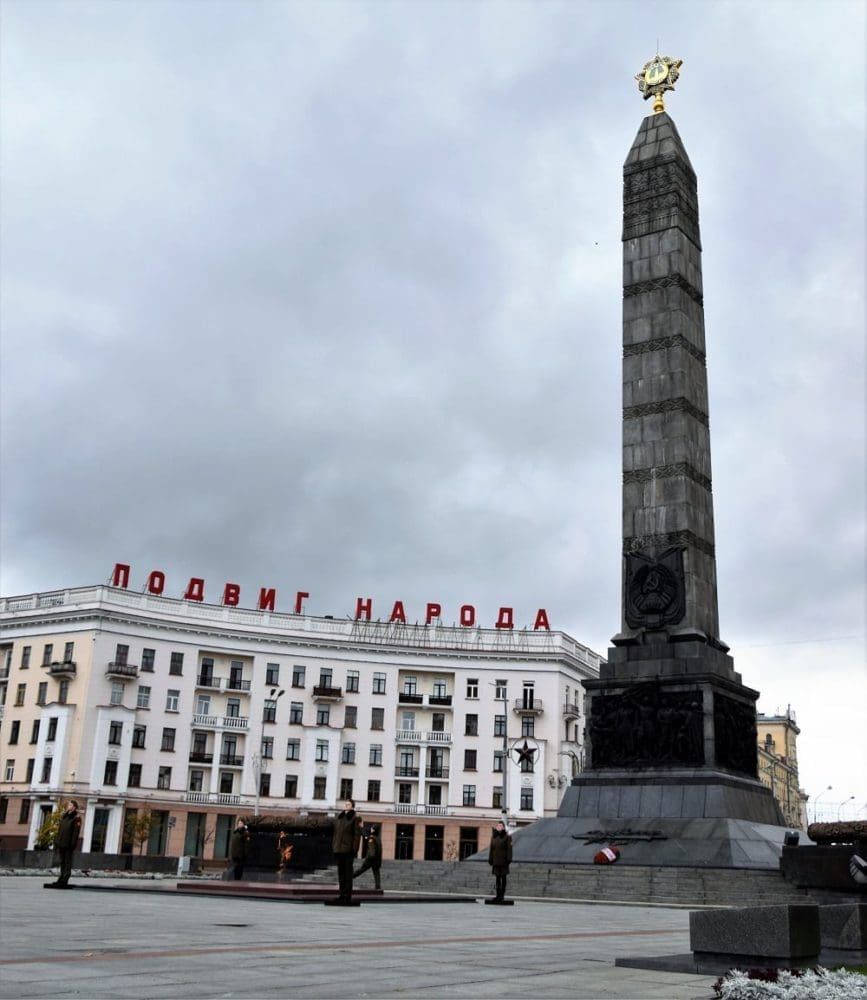
Hopefully, you now understand why I think that, overall, Minsk feels more Russian than Russia. There’s a Lenin Street (and a Lenin statue), a Karl Marx street, a GUM department store, a Gorky Park (and the KGB). Everyone speaks in Russian. There are very few signs in English and some saying they can speak Belarusian, if necessary. It’s almost a given that I will get lost, and I do, but not too badly.


Belarus - Facts and Factoids
- The literal translation of Belarus is White Russia, but nobody is sure why that name applies - there are a lot of theories.
- Belarus covers a total land area of approximately 207,600 square kilometres, making it roughly the same size as Great Britain or the US state of Kansas.
- The entire country is completely landlocked, bordered by Poland to the west, Lithuania and Latvia to the north, Russia to the east, and Ukraine to the south.
- The terrain consists almost entirely of flat lowlands and low, rolling hills formed by glacial activity, with no major mountain ranges anywhere in the country. The highest point in the nation is Dzyarzhynskaya Hara, which reaches an elevation of only 345 metres above sea level.
- Belarus contains over 10,000 lakes and roughly 20,000 rivers, with the Dnieper, Neman, and Western Dvina acting as the primary waterways draining the landscape.
- More than 40 percent of the total Belarusian territory consists of dense forests and deep swamplands, giving the land its geographic nickname the 'Lungs of Europe.'
- Belarus is home to Europe's largest land mammal, the European bison, which was saved from extinction and now thrives inside the protected primeval forests of the Belovezhskaya Pushcha National Park.

- The country is a prominent global producer of heavy machinery, manufacturing roughly one-third of the world’s mining dump trucks under the BELAZ brand, including a vehicle capable of carrying 450 metric tons.
- Belarus has one of the largest potash salt deposits in the world, near the southern city of Salihorsk, making it a critical player in the global agricultural fertilizer market.
- Belarus has established its own time zone, to match Moscow time, instead of the rest of Eastern Europe. The country has locked its clocks into permanent daylight saving time (UTC+3) all year round. So, Belarus is one hour ahead of its Baltic neighbours and Ukraine during the winter, and two hours ahead of Poland, despite sharing the same basic longitude.
- This remains the only country on the European continent that has not abolished the use of the death penalty for capital offenses.
- Marc Chagall, one of the most influential modernist artists of the twentieth century, was born and trained in the eastern Belarusian city of Vitebsk, which heavily inspired the dreamlike imagery in his most famous paintings.
- The national economy relies on a massive state-supported IT sector, based in the Belarus High Tech Park. They developed the globally ubiquitous messaging app Viber and the online multiplayer game World of Tanks.
Historic Pockets of Minsk
But, whilst much of Minsk was levelled during the war (the retreating German forces destroyed roughly 80% of the city.), two charming historic pockets have been restored or preserved.
Trinity Suburb


Trinity Suburb is a picturesque nineteenth-century neighbourhood on the banks of the Svislach River. That happens to be where I'm staying. Winding cobblestone paths and brightly painted pastel facades. Trinity Suburb was historically a bustling suburban market and residential quarter for craftsmen, merchants, and peasants, just outside the city walls. It was completely restored, in the 1980s, to showcase how a nineteenth-century European Belarusian neighbourhood looked.
From here, cross a foot bridge to the Island of Tears, a small island monument dedicated to the fallen soldiers of the Soviet-Afghan war. There's also the Maxim Bogdanovich Literary Museum. The Kitajeŭskaja Synagogue, originally built in 1874 for Hasidic Jews, is now a nature museum. The riverfront strip is described as being lined with subterranean bars, traditional Belarusian taverns, and craft shops selling handmade linen and straw goods. But today, it's so deserted it's hard to make out these features. I'm sure they're there, somewhere.
Up Trinity Hill, in the beautifully manicured park behind, is the 88 year old rotunda of the neoclassical National Opera and Bolshoi Ballet House. The area around here is known as Ballet Alley. There's a statue to prove it. And more, of esteemed cultural and literary figures.


A Very Brief History of Belarus
- The territories comprising modern Belarus were unified in the ninth century under Kievan Rus' and became the birthplace of several early Slavic principalities.
- Following the fragmentation of Kievan Rus' and Mongol invasions, the region was integrated into the Grand Duchy of Lithuania in the thirteenth century and later merged into the Polish-Lithuanian Commonwealth in 1569.
- The Russian Empire annexed the Belarusian lands during the late eighteenth-century partitions of Poland, initiating a long period of official Russification policies.
- After the Polish-Soviet War, Belarus lost almost half of its territory to Poland, although some of this was reintegrated after the Soviet invasion of Poland.
- Belarus only really emerged as a nation in the twentieth century, when the Byelorussian Soviet Socialist Republic (SSR) became a founding constituent republic of the Soviet Union, in 1922. (Belarus briefly declared independence as the Belarusian Democratic Republic, in 1918.)
- Nazi Germany occupied the territory during World War II, devastating the infrastructure. Almost 40 % of residents of the Soviet Republic of Belarus (between two and three million) were killed during the Second World War - a higher proportion than any other territory. Most of its 290 cities were destroyed and its Jewish population was wiped out. It wasn’t until 1971 that the republic’s population returned to pre-war levels.
- Then, in 1986, Belarus bore the brunt of the fallout from the Chernobyl disaster.
- The country achieved full sovereignty following the dissolution of the Soviet Union, in 1991, establishing its current borders and national institutions.
- Alexander Lukashenko took office as the nation's first president in 1994, maintaining a centralized political and economic system closely aligned with Russia. He is still there.
Vierchni Horad


Set on the high ground, on the other side the Svisloch River, is the Upper Town, Vierchni Horad, the historic heart of Minsk, A rare fragment of pre-revolutionary brickwork which escaped both Nazi bombs and the subsequent Soviet obsession with grandiose concrete avenues.
Here, we're back to heavy seventeenth-century Baroque style, dominated by the twin towers of the Holy Spirit Cathedral and the unadorned walls of St. Joseph Church. (The Soviet state repurposed the latter as a secure archival vault for decades). Minsk City Hall is right in the centre of Freedom Square (Plošča Svabody).The original stone structure was completed in 1600 to mark Minsk gaining self-governance under Magdeburg Law. It housed the city court, archives, and local administration until 1857, when Russian Emperor Nicholas I ordered the building completely demolished. So, the white, Neoclassical building standing today is a modern, exact replica built from historical blueprints and archaeological excavations. It was actually completed and inaugurated on November 4, 2004.
The Governor’s Carriage is is a life-sized bronze replica of an eighteenth-century carriage, parked permanently on the cobblestones, outside the City Hall walls. The pedestrian square surrounding the building contains glass floor panels built directly into the ground. These are observation windows allowing views into the preserved, excavated stone foundations of the original seventeenth-century structure.
More museums and low brick archways reveal a labyrinth of interconnected rear courtyards, where utilitarian stone walls now shelter small basement bars, coffee shops, and independent art spaces.


Minsk: Exceptional Museums and Modern Architecture
Minsk today is not afraid of bold, futuristic engineering designs. The Belarusian State Museum of the History of the Great Patriotic features a striking façade, shaped like a sunburst or exploding shell. Adjacent, The Minsk Hero City Obelisk. Inside, 10 massive halls showcase authentic World War II hardware, fighter planes, tanks, and immersive dioramas. So I read. I don't like war museums - it's all too upsetting.
The National Library of Belarus is an unmissable avant-garde architectural marvel, a 26-sided diamond (otherwise known as a rhombicuboctahedron). There's an open-air rooftop observation deck for panoramic views. Also unmissable is The Palace of the Republic. Completed in, 2001, this is actually a huge concert hall, not as its name would imply, a government administration building. It's on the eastern side of October Square, directly on Independence Avenue, facing the older Palace of Culture of Trade Unions and Army Palace. They are separated by rows of national flags. The flag of Belarus is unusual: it has a large red horizontal stripe on top, a narrower green stripe on the bottom, and a vertical white-and-red traditional Belarusian decorative pattern on the hoist (left) side. (Though the patterned bit is sometimes omitted.)


The list goes on: sports palaces. I can't possibly mention everything. Everything is built on a grand scale and monuments abound. Two depicted are the Monument to the Fallen Employees of the Ministry of Internal Affairs and Internal Troops and the Monument to the Sons of the Fatherland. The buildings are surrounded by plenty of parks, as I have said, especially lining the banks of the river. This weekend, they are gorgeously autumnal.
At night, many of the buildings are illuminated in gaudy pinks and blues; there is a fiery torch surrounded by a circlet and the National Library is an enormous glittering disco ball. I can see where Kim Jong-un got his ideas for renovating Pyongyang. The military hats here would also give the North Koreans a run for their money - they have enormously high brims.
Sunday in Minsk

Sunday in Minsk is even quieter. I’m fitting in, as my blonde hair is straight today, and I clearly look like a local. The few people people around keep wandering up and chatting to me. I hope I’m smiling in the right places. There are groups of Belarusian tourists but there don’t seem to be any other Europeans. I’m the lone diner in the hotel restaurant, where I retreat in the end, cold and damp. I’m sampling draniki, the national dish, which is stuffed potato pancakes. They come with a huge dollop of cream alongside. And vodka. The average citizen of Belarus consumes more alcohol than anywhere else in the world according to the Internet, but it says this about several countries, all in the ex U.S.S.R.
Another perambulate through the cathedrals and city halls of the ‘Old Town’. The cathedral service is being broadcast in the square through speakers. It’s peacefully inviting and there’s a stream of well bundled up locals (mainly female) through the main door. It’s packed inside here.


Chauffeur Driven to the Airport
I have a chauffeur driven car to the airport (to make up for forgetting to book me in at all). The effect is rather spoiled by the driver’s beanie. In daylight, I get a better look at the outskirts of the city. It’s grandiose, even to the edges. Beyond that is deciduous forest, like the parks, enlivened by gorgeous autumn colour. In the city, the golden yellow contrasts effectively with the marble facades, though it’s not quite New England, it’s missing the rosy red and orange hues. I seem to have escaped the worst aspects of the least liveable city in Europe. All I’ve seen is quiet, calm efficiency, on agrand scale. The plane takes off early again. Ukraine next.
Train Across Russia, Moscow to St Petersburg 1992
- It was January, cold and snow covered - very atmospheric when I first went to Russia
- Moscow was drab, with towering Soviet monoliths and the Lubiyanka prison a highlight
- We were warned to chain the door of our train compartment totally shut as robbers had been spraying anaesthetic into the carriages
- Musicians played outside the Catherine Palace and all the grand buildings looked splendid in the snow
- The Hermitage Museum is home to around 70 cats, which guard its treasures against rodents. But it was closed for the New Year - no-one told me before we went....
- A branch of Subway had opened on the main shopping street

Moscow, the Capital of Russia, in a Nutshell
Moscow, lining the River Moskva, is the biggest city in Europe if you don't count Istanbul, which spills over into Asia, home to 13 million people. It was founded in the twelfth century and has been the capital of Russia since the fifteenth century, except from 1712 to 1918, when the capital was transferred to St. Petersburg.
Moscow is very different from the city I visited in the early nineties. It was really grey and dank then, hardly any shops and virtually nothing in the few shops I saw. Now it's bright and clean and very European, very French. and surprisingly, one of the greenest cities in the world. Boats drift past on the winding river and twenty five percent of the city is parkland. Moscow now also has more billionaires per capita than anywhere else in the world.
The old soviet monoliths known as The Seven Sisters still soar above the skyline, but they've been turned into hotels and other useful buildings. I'm staying in one of them, joining the Golden Eagle Luxury Train tour across Siberia to Mongolia. I've already done the St Petersburg to Moscow stretch, so this is the second leg of the Trans Siberian Railway.


The hotel is very plush. There's a Rolls Royce showroom in the foyer. A sign says it has a panoramic terrace, so I venture up in the lift to see the view. Stunning. Green lawns, the river and those unwieldy gargantuan rockets that are the Stalinist era skyscrapers.
Men in dark suits are loitering on every corner and staircase, eyeing me up suspiciously. Maybe things haven't changed that much then? My camera is given the once over and barred as being too professional. Apparently, I might take pictures of the spanking new White House over the river. (I can't imagine where they got the idea for the name from). That's where the government is based and the prime minister works. So I acquiesce and sulk and go down again, to the river and takes lots of photos of the White House. It's very picturesque against the blue sky and cotton wool clouds.


Turandot Restaurant, Moscow
We have dinner at the famous Turandot restaurant. It took 12 million dollars and six years to create this fantasy of gilt baroque, classicism and renaissance. It's even got genuine Gobelin tapestries, ancient clocks and fireplaces. Presentation of food is designed along the same lines. Dry ice abounds. Even the toilets are really fancy - gilded blue and white florals porcelain. I have the photos to prove it. The urinals are especially pretty.
The Kremlin, Moscow
I had looked forward to some sleep, as I had an early start yesterday, but it's another early departure and Moscow is three hours ahead of BST, so I'm up at three in the morning. Today is spent touring the city. First, the Kremlin (the name "Kremlin" means "fortress inside a city"), the home of the tsars. There's the Grand Kremlin Palace, that was formerly the Tsar's Moscow residence. five other palaces and four cathedrals (a proliferation of gold onion domes), nestling within the red bricked enclosing Kremlin Wall, with more Kremlin towers.
The complex now serves as the official residence of the President of the Russian Federation The Kremlin is also home to the largest bell in the world and the largest cannon in the world. For a moment, I wonder if I've been misdirected to Texas.
But first a tour of the Armoury Museum. We are lucky enough to get the whole thing to ourselves. Wedding costumes with impossibly nipped waists, an assortment of thrones, carriages, crowns, icons and book covers with jewels the size of eggs, armour ( of course) and fabulous Faberge eggs. I waste time deciding which one I would select if offered the choice. The Great Siberian Easter Egg contains a clockwork train with gold engine and coaches. And plenty of history.


A Brief History of Russia
- The first tsar, Ivan the terrible (apparently he was awesome rather than awful) created the Tsardom of Russia in 1547, from the Duchy of Moscow and other petty principalities. Peter the Great called it instead an empire and moved the capital to St Petersburg. Catherine the Great (a bit of a goer who may have bumped off her husband). ushered in the era of the Russian Enlightenment. Catherine's grandson, Alexander I, repulsed an invasion by the French Emperor Napoleon, and so Russia became one of the great powers of Europe. Despite peasant revolts and attempts by parliament, the Duma, the emperors refused to relinquish autocratic rule. the Russian Revolution took place in 1917.
- The end of the monarchy initially brought into office a coalition of liberals and moderate socialists, but they were overthrown in their turn in the October Revolution (November in the new calendar) by the communist Bolsheviks. In 1922, Soviet Russia, along with the Ukrainian SSR, Byelorussian SSR, and Transcaucasian SFSR signed the Treaty on the Creation of the USSR, officially merging all four republics to form the Soviet Union, as a country.
- Between 1922 and 1991 the Soviet Union was a communist state covering roughly the same region as the Russian Empire. The USSR's network of satellite states in Eastern Europe accumulated after World War II, helped the country become a superpower.

- In the mid-1980s, Mikhail Gorbachev's reforms led to dissolution of the Soviet Union, leaving Russia again on its own and no longer a superpower. However, Russia assumed the USSR's permanent membership in the UN Security Council, and inherited the Soviet Union's entire nuclear arsenal. And when Vladimir Putin came to power he resolved to attain superpower status again.
Red Square, Moscow
Then, Red Square. This has to be one of the most famous squares in the world, located on the eastern walls of the Kremlin. It has been a UNESCO World Heritage Site since 1990. I'm told that red in Russian also means beautiful. More red (or beautiful?) brick towers and Lenin’s Mausoleum, prominent in the middle. You can go and see him but they are likely to remove the body any time now. He's no longer really a hero. The statues of most of the communist leaders were ripped down a long time ago.
GUM, once the largest department store in the world, still runs all down one side but it is now a galleried flower bedecked shopping mall. At the far end St Basil's Cathedral still entrances, kaleidoscopic onion domes and more icons. It ought to be garish, but somehow it isn't. Ivan the Terrible had it built to celebrate his victories and then blinded the architect, so he could never build anything so beautiful again. Terrible sounds like the right adjective to me.


Café Pushkin, Moscow
Lunch is at the Cafe Pushkin, another famous eatery in Russia. It started life as an apothecary serving hot chocolate to attract customers and the toilets in the old stone basement are still authentic. I'm getting a bit of a reputation for taking pictures of all the porcelain. Poor Pushkin. His statue is just up the street. He was killed in a duel over his too pretty wife and left her with five children to look after. The food here is very Russian. Bortsch and beef stroganoff. The story is that Count Stroganoff invented the dish for a man who couldn't chew very well. It sounds less romantic when put like that.
Cathedral of Christ the Saviour, Moscow
Back out into the awful traffic. More constructivist (modern Soviet) architecture, all renovated. And another gold domed church, the Cathedral of Christ the Saviour in the middle of the city. Like much of the city this has been very recently restored. Although in this case it was entirely rebuilt. The Soviets demolished the last one (commissioned by Alexander I to mark the departure of Napoleon) to build another gigantic monolith (The Palace of the Soviets) and so they could make use of the 20 tons of gold on the domes. But they discovered that they couldn't build foundations strong enough to take it. So then they built a swimming pool, the world’s largest, naturally, (called Moskva Pool) and now there's the cathedral's been rebuilt here again. It was reopened in 2000.


A quick tour of the famous extravagantly decorated metro stations. Chandeliers, mosaics and bronze statues.
The Golden Eagle Luxury Train Across Russia
Then to the station, to embark on my journey. I'm off across the largest country in the world. It will hold the USA and all of Europe (except Russia!) with room to spare. It crosses eleven time zones in all, so while the sun is rising in Moscow it is setting over Vladivostok and the Bering Straits.


So far, opulence rules ok. At the railway station there is a VIP lounge with champagne, a harpist and a brass band. Cute cabin attendants stand on red carpets to help us into our cabins, all swags, lace and brocade. Up front there are two restored locomotives, getting up steam. The drivers are already black faced and brow mopping. I clamber up the iron ladder onto the cab and peep into the huge firebox - it’s just like the Gates of Hell. Lots of piercing whistles and our Trans Siberian Express is off.

Tatarstan, Russia
I thought I might catch up on my sleep, but once more maybe not. The train is swaying and rattling, the tracks not yet welded all the way. It's light most of the night and I've eaten too much. It's a continuous feast. There's a smiling attendant in each car ready to indulge my slightest whim and a huge bowl overflowing with cherries, grapes and other essential items at the end of the corridor, Having a shower is an adventure. My compact bathroom is a wet room that converts to a shower cubicle by unfolding a curtain all the way round. Amazingly, it works.
Into Tatarstan, a self-governing region of Russia, which is larger than many countries. Conquered by Ivan the not so Terrible. Lurching on to Kazan the capital of Tatarstan on the sweeping Volga River, I'm singing the boatman song quietly but to my dismay no-one else seems to feel the need to do so. Here, there is a very white medieval looking kremlin. There is a fancy new turquoise mosque in the centre, (many of the Tatars are Moslem), next to still more onion domed Russian orthodox cathedrals. Light blue with gold stars this time. There's also a seven storied wedding cake column of brick, which leans, the Suyumbike Tower. Ivan had this one built, at her demand, for the woman he insisted should marry him. She did. Then she went up to the top and threw herself off. So the story goes.


Kazan is a very modern clean town, like Moscow there's been lots of renovation. The locals are very proud of it. Our guide says 80% of the people are happy to live there. I suppose that's good. There are huge sports complexes, enormous stadia, long shopping streets and brown glass university and government buildings in French Renaissance style with curling decorations on top.There's also a bowl shaped wedding palace built on the bank of Kazanka River It has a double-story observation deck on the roof, 32 metres up.
Today's lunch is in a Tatar restaurant - sturgeon soup and potato pancakes followed by opera singing. And back to my hotel on wheels. Nothing it seems has been forgotten; there is a pianist in the bar and the harpist has been installed in the dining car. There's also a doctor and a guest lecturer. It's twenty five years since the railway company was founded, so the president, Tim, is also with us. Fewer guests than usual though. The problems in Ukraine are making travellers wary.

Still not caught up with myself or my sleep. We have crossed a time zone, so I lost another two hours last night. The toilet roll managed to unravel itself with the motion of the train. It looks as if my bathroom has been savaged by the Andrex puppy. Past swathes of birch forest - there's an awful lot of this - and over the Ural Mountains to Yekaterinburg. Mountains is an exaggeration. They are green wooded hills here, old mountains creeping up to not quite 2000 metres in the north, near the Arctic.
The Continental Divide
Great excitement, as the Urals are the Continental Divide between Europe and Asia. We are taken to a line next to the wooded highway with a little spiral monument marking the spot. So you can stand with one foot in each continent. It is incredible to think that we're only one quarter the way across Russia. Asian Siberia occupies 75% of Russia but is home to roughly one fifth of the population. A soldier meets us and demands to see ID. None of us have any so he threatens to fine us - with champagne! So I chase him with his baton. All very jolly - there's a wedding up here too. Apparently, this is the place to have your nuptial photos taken.

Yekaterinburg - The Church on Blood in Honour of All Saints Resplendent in the Russian Land
Yekaterinburg is not exactly humming. Prosperous, but not like Moscow or even Kazan. Neither Asian nor European. Everyone seems to be scratching around to find us something to do. Other that is. than visit the city's main claim to fame, which is the place where the last tsar and his family, the Romanovs, were assassinated. There's a church built over the basement of the Ipatiev House, where the gruesome and amateur shooting was conducted. It's been named Church on the Blood (in Honour of All Saints Resplendent in the Russian Land), which only goes part way to conveying the barbarity of the execution.
Boris Yeltsin came from a peasant family in this area of Russia and studied civil engineering here. So there are statues of him, though they have been vandalised. There's also, as always, a statue of Lenin. It's the only one in town that the pigeons don't sit on. So it's either got a hidden source of electric current or the pigeons are still communists. Another frilly restaurant, more Russian food. And back to the train, past decorative malachite painted wooden houses and bypassing half a dozen more brides. They are all out posing for pictures. The grooms are hiding in their cars.


Siberia, Archetypal Russia
Hurrah, that was a better night’s sleep - I found my aeroplane mask. Though it could have been all the vodka I was given with last night's feast of Russian pickles. (The word "vodka" derives for the word "voda", which means "water".) And we have gone forward yet another hour. That's six hours in front of BST. Now, we are actually in Siberia, which stretches over four thousand miles, from here right to the Pacific coast. Siberia is notorious for its harsh winters and for being a place of exile, first to the salt mines and then to the gulags. Though it seems that the prisoners were more likely to work in the gold, silver or coal mines than the less common salt mines.
Lots more birch and aspen forest. It's becoming lower and swampy, proper taiga now, thinning out into the flat steppes, which are synonymous with Russia. There are also quite a few villages and towns. Most of the houses are made of timber, with very steep pitched roofs. In winter, it's continuous snow and often minus 40 degrees. Fortunately, it's still a very pleasant summery 25 for my visit.

Novosibirsk
The morning is spent on the train, more time to catch up on snoozing, the swaying of the train is very soporific. Then to Novosibirsk, a town like Chicago, which grew up recently and very rapidly, because it is on crossroads of the east-west railroad and the north-south River Ob. It's the largest town in Siberia, with plenty of industry. Here, they have the second biggest theatre in the world, designed to accommodate the annual December Soviet military parades, so the dignitaries didn't have to sit outside in the cold and watch. As you can imagine the stage is huge, large enough to take all the soldiers and tanks. We get a back stage tour while the poor director is trying to rehearse a musical that's about to go into production.
Now more railways - a whole outdoor museum full of brightly painted locomotives, with a few Dr Zhivago carriages, a grim prison truck and an equally grim hospital on wheels. There's rather too much information about dates and factories for me.


Life on the Train in Russia - and Russian Food
Yet another hour forward. Seven hours in front of BST. Today there are no long stops and we are exhorted not to wander off the platform should we dare to alight at any short stops for water and fuel. I have a late breakfast assignation with Tim, the president, as I told him at dinner last night that the scrambled egg wasn't very good and he wants to see if they cook it the same when he is there. They do, but not for him.
Otherwise, the food has been plentiful and tasty - mainly Russian and beautifully presented. We've had sucking pig, all decorated with latticed pastry and cherries. Russian pickles. Pot meals served in individual loaves. Huge salmon, dumplings. And caviar with sour cream and blinis followed by chicken Kiev. All washed down with champagne and vodka. Cut glass and embossed china. Lovely - and hugely calorific.


It's a good time to take stock of my fellow passengers. They are a mixed bunch, nearly all retired. There is a gay couple from Melbourne who supply the Ascot set there with hats, scarves and jewellery, retired doctors, farmers from Australia and Wyoming and several entrepreneurs. One guy owns the Danube Express. I’m not sure if he is sussing out the competition, but I think he and Tim are going into business together. Another Turkish passenger operates rail holidays out of Turkey. There's a lot of geek talk at meal times. Most of the staff are lovely and they all have stereotypical Russian names: Olga, Tatiana, Igor, Nikolai. I haven't been able to make the barman smile yet. Tim says he's sacked him three times already but he keeps turning up for work.


A good time also to find out more about Russia.
Facts and Factoids
- As I've already said. Russia is the largest country in the world. It occupies one-tenth of all the land on Earth. It spans two continents (Europe and Asia) and has coasts on three oceans (the Atlantic, Pacific, and Arctic).
- Russia straddles two continents: Asia and Europe.
- Russia has about 100,000 rivers, including some of the longest in the world. It also has many lakes. These include the two largest in Europe: Ladoga and Onega. we're on our way to Lake Baikal. That contains more water than any other lake on Earth.
- There are about 120 ethnic groups in Russia who speak more than a hundred languages
- Russia is home to the endangered Siberian tiger, the largest cat in the world. They can measure up to three metres (not including their tail) and weigh up to 300 kilos.
There's a really interesting documentary shown on Putin and a lecture on Russian politics, by our tame professor. Then I practise reading my Cyrillic alphabet. It's not hugely different to Greek. What with all that, the time is flying by. So does the scenery. The guide books all say that the Siberian scenery is boring. The authors obviously haven't been here. It's mostly really pretty, green hills splodged with purple rose bay willow herb and dotted with little wooden villages. Meadowlands and of course, still more forest. There's a huge contrast between the countryside and the large modern, concrete railroad towns.

Irkutsk
Eight hours in front of BST. Irkustsk is a melange of old and new, traditional wooden intricately carved houses with bright painted shutters and grey apartments. There's a handful of pretty churches, river parks and a market that is very much like the one in Leeds, except that this one has wide faced ladies of Mongol extraction serving the butter and cream.


I get to drink tea with a dentist from the Soviet era in her very middle class apartment. Its three main rooms are stuffed with furniture and knick-knacks and there's a TV in each room. Aspirations seem to be the same the world over.
Lunch is palmini, small dumplings in broth, served in velvet booths in a swish business restaurant. Then there’s a visit to Prince Volonsky's house. He was a Decembrist exile from the 1825 uprising, in Russia. When they were released from gaol and work in the mines the exiles were allowed to build houses. Some of their wives followed them to Siberia and the families were very wealthy so (if they had survived) they led an affluent life style, staging their own recitals and concerts, as they were not allowed to visit public places. The city was therefore often described as the Paris of Siberia, though again one wonders if the instigators of such quotes had ever been to Paris.


We are given our own concert of opera singing, ending with the rousing drinking song from Traviata and more champagne. Then we are driven out past yet another huge river to a cluster of wooden summer cottages, the dachas. Here, a family serves us a meal of salad from their garden and surprisingly good meat balls. And more vodka.
Lake Baikal, Russia
No time change!! We have chugged a short distance to the southern tip of Lake Baikal. Chugged is the right word. We have now picked up another steam locomotive and we are allowed up onto the platform of the rear locomotive to take photos of the engine, as we amble along the bays of the lake. I feel very adventurous. The whistle is really shrill and there is plenty of smoke, especially as we pass through some longish tunnels. It wasn't the best day to wash my hair.


A boat trip to a village across the River Angara. There's a museum with some facts and figures about the lake. It's 20 to 30 million years old and nearly 400 miles long. At over a mile to the bottom it is the deepest lake in the world, but it used to be over five miles deep; it's gradually silted up. 336 rivers empty into it and only one, the Angara flows out.
A local legend says that old man Baikal had 336 sons, but only one daughter, Angara. She was beautiful and wilful and angered her father by refusing to marry the feeble Irkut, preferring the strong Yenisei (Russia's longest river). One night she slipped away and fled north to her lover. As she escaped her furious father hurled a huge rock after her. Angara got away, but the rock remains at the mouth of the river, with only a small peak of it showing.
The lake contains 20% of the word's fresh water and in winter it freezes over. The water is certainly very clear. The Russians are proud of their scenery here, with rolling green hills all around and mountains with a lick of snow just visible to the north. There are a couple of freshwater seals frolicking about. The seals feed on the many fish that are caught in these waters.


We feast on some of the fish and shaslik (kebabs) at a barbecue lunch by a bay. Some hardy souls also go swimming. The water is so deep that it never gets warmer than four degrees. When they come out (and they are definitely not in for very long) the bathers are presented with certificates. Personally, I think they should be certified instead.
Museum of Vernacular Architecture
Another museum in the afternoon, this time vernacular architecture, much of it rescued - not dissimilar in style (if not building design) to the open air museum at Singleton in Sussex and equally fascinating. Nearly everything here is constructed of pine planking.
Life By Lake Baikal


We're still sampling Russian cooking. Tonight, herring salad and stuffed cabbage leaves. (With sour cream of course, everything comes with sour cream). Really delicious.
We didn't move last night. Strange going to sleep without the rocking and rolling of the carriages. A longer boat cruise north along the lake and some fishing, catching the local delicacy, omul. The wind is chilly over the icy water and we are pleased to be wrapped in blankets.
There is enough fish caught to provide lunch and this is smoked over aspen wood fires. The professional fishermen from the boats also show us how they make herb tea and soup with great bundles of leaves from the forest. As the day progresses, the sun is reassuringly warm on our backs and there are pretty walks to be had, ambling along the lake shore. We can also try panning for treasure in the old gold rush area at the mouth of the creek where we have set up our picnic.
Then there is a folklore concert with an accordion and balalaika. (I was beginning to think they only featured in films set in Russia). Vodka fuelled tourists participate in the dancing with more enthusiasm than grace.
Ulan Ude, Russia


Ulan Ude is a sprawl of colourful wooden houses that developed on the tea caravan route from China, to Russia. It is the capital of the Buryat Republic, where many of the people originally migrated from Mongolia. We are a long way now, from modern concrete constructions, though there is a cluster of civic Soviet buildings around an enormous bronze Lenin head in the centre, appropriately named Sovetov Square. At nearly 8 metres tall this lays claim to being the largest Lenin head in the world (and there are a lot of them in Russia).


This is the most strongly Buddhist area of Russia and shamanism is still a dominant religion here too. We also visit an Old Believers Village. The people of this Christian religious sect fled persecution by the tsars in the seventeenth century. They have survived the more recent destruction of their churches by the Soviets and live a quiet rural life adhering to their old rules. Priests do not cut their hair or shave and church services are commonly eight hours long. Twelve hours at Easter. There aren't any chairs in the tiny churches and the people are only allowed to consume water whilst the service is ongoing.
The houses are delightful, mainly blue and white carved floral designs, with summer and winter areas. The equally brightly dressed people cook lunch for us, although the repertoire is now familiar. Soup, meatballs, shaslik, smoked fish, doughy pastries and vodka. This is succeeded by the inevitable cultural performance, including audience participation.

The view from the carriage window is increasingly scenic, as we begin to head through the south of Russia. Craggy grass covered hills, lakes, wide meandering rivers and the odd ravine. It's our last night on the train, so it's sturgeon and steak, with too much champagne and port that was bottled in 1880.
Tomorrow, we arrive in Mongolia
Where Does the Name Romania Come From?
- The name “Romania” comes from the Latin word “Romanus” which means “citizen of the Roman Empire.”
A (Very) Brief History of Romania
- The earliest Homo sapiens fossils, up to now, were discovered in 2002 in southwestern Romania, in the Cave of Bones. The fossil’s age is estimated at 37,800 to 42,000 years old.
- The Romanian language is 1,700 years old.
- Modern Romania was formed in 1859 through the union of Moldavia and Wallachia. The new state, officially named Romania since 1866, gained independence from the Ottoman Empire in 1877. At the end of World War I, Transylvania, Bukovina and Bessarabia were incorporated into the Kingdom of Romania.


- During World War II, Romania was an ally of Nazi Germany against the Soviet Union, until 1944, when it joined the Allied powers and later faced occupation by the Red Army forces. Following the war, Romania became a socialist republic until the 1989 Revolution.
Facts and Factoids
- The first ever perfect 10, awarded in the Olympic Games, went to Romanian gymnast Nadia Comaneci, for her performance on the uneven bars, in Montreal, Canada in 1976.
- Bucharest’s vast Palace of the Parliament, begun during the final years of Nicolae Ceaușescu’s rule and not finished until 1997 (seven years after his death), is the world's heaviest building (and the second largest after the Pentagon..
- Romania is inextricably linked with Count Dracula, created by Irish author Bram Stoker. But it's a tenuous link, supposdedly based on infamous ruler Vlad the Impaler. (Read more here.)


Is Romania a Poor Country?
- Romania is a developing country and one of the poorest in the European Union.
- 45 percent of Romania's population lives in rural areas and 70 percent of this population lives in poverty.
Is Romania Safe to Visit?
- Romania is considered to be a relatively safe country to visit, but there are warnings about pickpockets and road accidents.
- The roads are not in great condition.


What are the Highlights of Romania?
Newsletter Subscription
Stay in touch. Get travel tips, updates on my latest adventures and posts on out of the way places, straight to your Inbox.
I keep your data private and only share your data with third parties that make this service possible. Privacy Policy. No spam I promise. Unsubscribe any time.