This website uses cookies. By continuing to use this website you consent to the use of cookies. Read the Privacy Policy.


The Pantanal, Brazil
The Pantanal - the world's largest tropical wetland, a vast floodplain spanning parts of Brazil, Bolivia, and Paraguay, known for its incredible biodiversity and high concentration of wildlife. This UNESCO World Heritage Site is subject to seasonal flooding, which creates a rich, open ecosystem, making it one of the best places in the Americas to experience nature. It is home to over 1000 species of bird and 300 different mammals.
I've arrived via Sao Paulo to Cuiabá and I'm really looking forward to seeing the again. Last time, it was the unexpected highlight of my trip to Brazil. This time, I have much longer to enjoy the area, with jaguars as the main goal. Along with pumas, ocelots, tapir, anteaters, giant river otters, capybara and assorted birds.


Cuiabá
The airport at Cuiabá, the gateway to the Pantanal, isn't actually in Cuiabá, but in twin city, Várzea Grande (The 'City of the Great Lowlands'). The only reason to build any city, let alone two, in a place so hot, is gold. Though this area was originally an indigenous farming community, in a partly Spanish area, at that time, as the borders had not been set. Slaves were brought in, from Africa, to work the fields, when the Jesuits converted the locals and outlawed their use as slaves, as they were now considered to be people.
The journey to Cuiabá/Várzea Grande is smooth, except that the Amazon Airport Hotel denies all knowledge of my reservation and says they will have to rebook me at today’s price. Oh no they won’t. I win eventually. But now I need to cool down. Especially as it's a baking 40 degrees Celsius. And they have a tiny pool. There's also an excellent restaurant ( tapioca tortilla stand at breakfast) and a mall over the road, which features dinosaurs.


Poconé
There are six of us on this Pantanal tour: Fran, from Brighton, near me, Jeff and Dave, zoo keepers from the USA, Martin and Annette from Denmark and guide Andre. Travelling south, we're quickly into the Pantanal and its savannah, sprinkled with lakes, rivers, forests and snow white cattle. There are eight million beef cattle in the Pantanal. Far more than is economically viable and the pasture is running out, so the youngsters are sold on to be fattened. The cattle ranchers are known as Pantaneiros.
The horses are all white too, descended from imported Arabs. It's baby season and tottering calves and foals are literally running rings round their parents, as they test their new legs. Ranch buildings with corrugated roofs sit amongst cleared areas either side of the highway. This area floods in the rainy reason, so is only forested on higher ground. The flooded areas are flat grasslands, in the dry season.


The flat topped hills in the distance are the residue of gold mines. Poconé began life as a gold town and transitioned to farming. Now, tourism has arrived. We are staying at Piuval Lodge, a 10,000-hectare working farm-cum-ecolodge. Here, we will undertake five truck safaris.
Capybaras (great name) are waiting to greet us, oddly angular. The world’s largest rodents cavort around the pool, hoping to evade the jaguar we are seeking, as they make one of the big cats' favourite meals. Luckily for them there aren’t so many round here.


A Parade of Anteaters
The highlight is the giant anteaters, who emerge for their morning exercise run, just before dawn. So, we are up, to set off at five, to find the termite hill strewn fields, around the posada, alive with the bizarrely shaped mammals. Maybe God used up all his spare parts when he made them. Misshapen Afghan hounds, gliding on their wrists, keeping their large claws ready to tear open those termite mounds. Their front legs hydra like, the fur colouring suggesting an additional head. Long snouts and beady eyes to find and examine the mounds. Sticky tongues, up to two feet long, to excavate the ants and termites. The females transport cubs who cling onto their backs, heads lolling, even though they look too large to be carried.
They promenade in solitary fashion, stopping to wander in a circle or sniff at a termite mound (these look suspiciously like the dementors in the Harry Potter movies, at times, with the holes for eyes). Each anteater wends their own path. One male heads for a female, but he is quickly seen off, when their paths meet, and he lollops away in ungainly fashion.


We follow all this excitement from our safari truck, careering across the savannah and trying to avoid the termite hills and the deep sandy ruts. But we maintain a respectful distance from the animals. Internet sources can't agree on a collective noun for anteaters, which isn't surprising given their solitary existence. Candle, weirdly, is suggested. I'm sticking with parade - that's exactly what they're doing. By the time the sun is over the yardarm they have all disappeared. But for now they are my favourite animal, up there with aardvarks.
More Wildlife at Piuval


Birds
At dusk and dawn there are mosquitoes to contend with. As the day moves on, the heat becomes intense and baking. but there are still plenty of birds. Fran, Jeff and Dave are all keen on the fowl spotting and naming. So every flutter ( and there are many) calls for a stop and prolonged observation. Most of them are pretty enough. And I have to agree that the horned owls are fascinating. Woodpeckers are always cute. And there are rheas roaming the grasslands. These south American ostriches are one of the largest birds in the world, placing ninth behind assorted ostriches, cassowaries, the emu and the emperor penguin.
Speaking of penguins, waterfowl too, are always interesting. Here we have herons of all kinds, egrets, jabirus, white storks and spoonbills, in their giant nests, whilst the parakeets piggyback on these, creating their own small dwellings underneath. They flutter in and out, with a cacophony of shrill tweets.


Mammals
Howler and capuchin monkeys crouch out of reach, behind leaf covered branches. Coati and agouti wander onto the track and then off again, more speedily, when they spot us. Diminutive red brocket deer hop out in front. A herd of peccaries race past. Wild cavies (much smaller capybara cousins) play hide and seek in the bushes.
Other bucket list mammals are ocelots, pumas and tapirs. An ocelot scoots across the road and into the bush. We see the pale rump of one animal, which the driver says may be a puma as that too, disappears rapidly. After four runs out my interest is beginning to 'tapir' out. But suddenly there is one standing so close I can’t get her into my camera frame. Another strangely awesome creature, hippo like, with an odd sucker like snout.
Reptiles
Jacare caiman stand guard, in rows, along the banks of the water holes, so still they seem to be sculptures, until they blink an eye to show they’re watching. Or slither under the water hyacinth carpet, if someone gets too close. And we are not even in the Pantanal proper yet.


The Transpantaneira Highway
The bumpy gravel covered Transpantaneira track (they decided not to finish building the road which was planned to connect north and south Matto Grosso) carries us 145 kilometres, over 122 rickety wooden bridges, across the wetlands of the Pantanal, to Porto Jofre, where it finishes. Some of the bridges are impassable and we are diverted off them. A few are brand new concrete, rather than timber. In the old days, you had to check there were no gaps before you ventured over.


It's not the most comfortable of rides, but it’s scenic. There are plenty of ponds replete with birdlife. Abundant white cattle and the odd marsh deer, wielding enormous antlers, mingling amongst them.
Into the Heart of the Pantanal at Porto Jofre


The hotel at Porto Jofre, like the last, is modern, but utilitarian. No fripperies, not even a glass in the room, and buffet meals. It’s beautifully situated on the banks of the River Cuiabá and six seater canopied speed boat trips carry us the 30 minute ride into the Meeting of the Waters State Park, rather than safari vehicles. (Matto Grosso Sul on the south bank. Matto Grosso on the north.) We’ve been assigned five of these.
It's a pleasure to zip along the river, the speedboat creating a cooling breeze, in the searing heat. The forest for the most part is dense, covering the banks. The sides are lined with bobbing water hyacinths and small sandy beaches, beloved of the capybara, caiman and water birds. (But not all at the same time.) The Cuiabá is broad (it has a long way yet to go to join the Paraguay River), with plenty of tributaries (including the Negro and the Piquiri) and tranquil ox bows. That's why it's called the Meeting of the waters, though Google is getting this utterly confused with the Meeting of the Waters on the Amazon.


The target here is jaguar. They were almost unheard of, on my last visit but, now protected, they have multiplied and currently number over 100, in the park. But, to start with there is a great deal more bird life, which is a mixed blessing, as we still have to stop to identify anything with wings. Assorted kingfishers, raptors, herons, storks and cormorants and their relatives. The endearingly magnificent clowns of the forest, the giant hyacinth macaws. (This is the largest macaw and the largest flying parrot species) And huzzah, toucans (one of my favourite birds), posing for new Guinness advertisements:


"If he can say as you can, Guinness is good for you, How grand to be a Toucan - Just think what Toucan do".
Jaguar Jamboree
Jaguars
- The jaguar (Panthera onca) is the only (living) large cat species which is native to the Americas.
- It is the third largest cat in the world.
- It has a distinctively marked coat, with pale yellow to tan coloured fur, covered by spots which transition to rosettes on the sides,
- The jaguar kills with a powerful bite, which allows it to pierce the carapaces of turtles and tortoises, or directly through the skull of mammalian prey, between the ears, to deliver a fatal blow to the brain.
- The jaguar has featured prominently in the mythology of indigenous peoples of the Americas, including those of the Aztec and Maya civilizations.
Marcella


Then, the crackle of the radio and the sound of other small craft about-turning on the water and motoring off signals a jaguar sighting. After several wrong directions and more turns, a row of boats crammed with excited photographers suggests we’ve hit the spot.
New mother Marcella (two cubs) is alternately swimming and strolling along the banks looking for caiman. These are their staple diet. The boats hold their ground in a relatively orderly line, drifting and then heading to the back of the queue as she passes by, though one or two try to sneak ahead. There’s more of a scrimmage when she decides to cross the river. The boats all cross the river to watch. It’s far worse than the get close to the shoebill battle in Uganda. So, unsurprisingly, the poor jaguar retreats.
Then, our guide and boat driver decide that Marcella has her eye on the little capybara family, sunning and swimming on the strip of beach, just a tad further along. There are two pups. We head for a mooring just off the sand and anchor. And, of course, all the other vessels follow, jostling for position.
It’s a long wait. The jaguar (no specific name exists for a female jaguar) does indeed cross over, once her path is clear and settles herself in front of the reeds, just round the corner from the group of giant rodents. She has a very beautiful face and soft amber eyes. There’s a lot of tail whisking and ear flattening, but nothing else happens. The capybara are blissfully unaware for some time, but eventually raise one of their high pitched alarm calls. Perhaps it’s the vulture strutting up and down, in anticipation, which alerts them. Eventually she trots off, into the undergrowth. Maybe back to her cubs, maybe to try again when it’s dark. Very David Attenborough. It’s not nice seeing babies get eaten. But these are all present and correct at their beach home, next morning.
The Rest of the Jaguar Jamboree


Internet sources can't agree on a collective noun for jaguars. Leap, prowl and shadow are all offered, but I'm sticking with jamboree. And our tally is so far beyond expectations as to warrant a celebration. Over the course of our next journeys we see Marcella’s mother Amber ( she gave Marcella the eyes) Marcella’s grandmother Patricia, a non relation female Ibaca (twice), Ibaca’s female cub Apeiara, females Carvarinha and Ti and one male, Bagua (twice) who is apparently adept at forming alliances with other lone males. On the second occasion he’s unusually crossing paths with Carvarinha, but nothing salacious ensues. She already has a young cub. Finally, on the land, Tango a two year old male settling down, on a beach, for the night.
While we watch, they’re all embarked on the same routine. Sauntering down the river, in and out of the water, climbing on the bank and then swimming again, where the sides are steeper. Ibaca puts on more of a performance, chewing grass and pouncing with great splashes. Her endurance outlasts that of the massed audience and she’s still swimming, as the boats drift away. There’s an annually produced guide book on sale, detailing all the jaguars' names, families, and the unknown visitor sightings too.
More Pantanal Wildlife


We also encounter a pair of giant river otters, gliding serpent like, their huge tails acting as rudders. They would easily win the Olympic gold medal for synchronised swimming. The guide then points out almost a dozen well camouflaged proboscis bats, crammed into a tree trunk crevice. He knows, you know. A solitary water buffalo eyes us mournfully, as he wallows in the cool water.
Next, an invasion of frogs, creeping up the sides of the boat. Annette squeaks.


The jaguar haul has exceeded our expectations, but watching jaguars swim or waiting for them to reappear is becoming less than exciting, after two and a half days. And, the tapirs are elusive: ‘But I’ve seen them on this stretch of the river before', says the guide. We're told the other family of giant otters have moved on. It must be time for us to do the same.
Aymara Lodge, Pantanal
Last Time at Aymara
Back up the Transpantaneira, to Aymara Lodge, where I stayed before. But then it had a different name, it was still the rainy season and there was considerably more water, alongside the approach road. Then, there were fishermen, caiman and a plethora of birds. The boat trips here, animal spotting in the remote wilderness, were my unexpected highlight, and I got to see capybara, jabiru storks, howler and Capuchin monkeys, toucans, the striking hyacinth macaw, agouti, a coiled anaconda and numerous Jacare caiman. The locals seemed oblivious to the latter and happily fished in the water right next to them, despite the wide-mouthed yawns and glistening teeth. There was a tame caiman (we were told), called Pandora, at the lodge. Piranha fishing on nearby waters was less exciting and not very productive, but I enjoyed the painted skies of the gorgeous sunset over the river.


The River Clarinho is very low, today, too low for motorboat outings. but still tranquil and covered with water hyacinths. Stacks of wooden boats on the strip of beach, which is home to several pairs of bare-faced curassows. The female, for once, is prettier than the male. We take out three canoes and I’m paddled through the water hyacinths, herons scattering before us. The river is maybe only 20 cm deep at times, so it's more of a punting and pushing the hyacinth pads out of the way and unwrapping the roots from the paddles exercise, but it’s relaxing and peaceful.
Safari Drives
A dusk safari drive brings quality rather than quantity. Hidden in the dry mixed forest are two solitary tapirs. And an armadillo scuttles across the road, almost squashed by our truck He disappears rapidly, in a cloud of dust. Two more drives, dawn and dusk, reveal a juvenile male jaguar, name Macaw, one of only two in the area, and a pair of foxes having a stand off with a raccoon. We stake out yesterday’s armadillo sighting spot, standing ready on a hillock, with lenses trained ready, but he fails to materialise.


The dawn drive is chilly and very much an endurance test. My one souvenir is a photo of a cactus flower.
From My Hammock
But they say the jungle comes to you at Aymara. From my hammock, I can see capuchin monkeys leaping through the canopy above the cavorting hyacinth macaws. On the ground, an agouti nibbles at some fruit and a skinny ground lizard l scuttles by. The rooms have been upgraded since last time. Very acceptable after the basic, but comfortable, so far and the buffet meals are delicious.


Chapada dos Guimarães National Park
North again, and back through Cuiabá, to the National Park of Chapada dos Guimarães, part of the the Pantanal Biosphere Reserve along with the Pantanal, and Emas, and Serra da Bodoquena National Parks, as well as the Serra de Santa Bárbara, Nascentes do Rio Taquari and Pantanal do Rio Negro State Parks. It's a huge area overall. This park marks the transition of the Amazon basin to the Paraguay River basin, protecting the headwaters of the Cuiabá, the chief river (and for a long time the only mode of transport) in the Pantanal.
The park is also notable (possibly) as the geographic centre of South America, at the Geodesy Lookout. The citizens of the city of Cuiabá got ahead of themselves and erroneously marked it there, with a white marble obelisk. More importantly, the park is strikingly beautiful. Astonishing tepuis (flat topped mountains) meet Monument Valley formations. This is dramatic cinnamon soil and emerald vegetation land.


Exploring the Chapada dos Guimarães National Park
Then, we’re deep into forested valleys and a canyon carved into the ground by an 86 metre waterfall, on the River Claro. It's called Bridal Veil - as they often are. The falls are surrounded by parrots' nests and red and green macaws frolic around the edges. A toucan zooms over head, toying with us, as we try and follow him with our lenses. An extraordinarily impressive view.
An undignified scramble up a rocky outcrop for a panoramic vista. More walking, below canyons and on the edge of canyons, peering down precipitous drops into into fabulous U shaped valleys and escarpments. On top of the ridge is what I honestly thought was a ruined city. It's called Cidade de Pedra (Stone City), but it's actually formed by rock erosion. And a swim in a pretty dappled spot, where the river forms an infinity pool, as it swirls round a bend. Tiny fish nibble at my legs, tickling and I have to be careful that the current doesn’t carry me with it, over the fall.


The Town of Chapada dos Guimarães
The town of Chapada dos Guimarães, is a historic one, founded in 1719, and the second oldest in Matto Grosso, after Cuiabá. The church, Igreja de Sant'Ana do Sacramento, now renovated, was built by slaves who wrapped each tile round their thighs. The plaza is prettily lit by hundreds of lights.

Brazilian Food
In-between walks we’re sampling varieties of Brazilian cuisine, so this seems a good moment to talk about Brazilian food. Buffets are common on the tourist trail and the fare is pretty much the same at each establishment. Rice, beans, falofa (ground manioc), plantain, tough beef and cardboard chicken. Battered pintado (catfish) yuck. Others like it, but I can't get past their wide lipped, whiskery appearance and it's fatty. What's more they don't have scales, so are banned, according to the Bible. (I'm ignoring the bit about lobster.) I'm happy with rice, beans and plantain and there are some delicious salads. And I love the balls of pão de queijo (cheese bread), which tend to feature warm, at breakfast.
In Cuiabá, it's rodizio/churrascuria. Churrascaria is Brazilian barbecue and rodizio is the practice of the servers (or gauchos) rotating the cuts on offe. Essentially, a huge salad buffet is the orders of the day and pieces of meat (mainly beef) are offered, on skewers, until you can't eat any more. In Chapada dos Guimarães, another typical Brazilian buffet, where you help yourself to all manner of meat, rice and veg and your plate (huge to encourage large helpings) is weighed to calculate your payment. Cachaça (Brazilian spirit made from fermented sugar cane - not molasses, like rum) ) based caipirinhas, of course, feature everywhere, much to my delight. Though at the pizzeria in Chapada dos Guimarães they are incredibly strong. This causes suffering.


Next day, I’m covered in incredibly itchy insect bites, acquired during my swim. This causes even more suffering.
Nobres
Danish Martin still points his long lens at everything that moves, determined not to miss a shot. The Americans still won’t allow a single bird to go unnoticed. Dave (also known as Snackman) has a bag full of assorted packets of cookies with him at all times. And guide André launches into long stories about past exploits, but neglects to give us basic instructions about what we are going to do and need to bring. A performer rather than an informer. He doesn’t even tell you where the toilets are, but you can work that out, as he always leaps off the bus first and makes his way to them.


A little further north, in the Pantanal, to the Nobres area and a pousada surrounded by orchards and macaws, enjoying the ripening cashew fruits. Hundreds of fluttering cream and orange butterflies. Basic rooms, with showers which are either scalding hot or lukewarm and air con which only operates at freezing cold but an antique themed bar area with wood and glass display cabinets like an Edwardian parlour hammocks and rustic benches and cupboards.
A first for me, snorkelling down a shallow river, the Triste, alongside the fish. It's an easy journey, as the current carries us along. Though we have to beware of jagged rocks below the surface. Then, Lagoa dos Araras, for the popular macaw display. As the sun sets, the blue and green macaws return to their nests, in the dead palm tree trunks. The lagoon is scenic enough on its own and the landowner makes a tidy sum, as the tourists pay their fee, to watch the spectacle.


Return to Sao Paulo
Back to Cuiabá and a return flight to Sao Paulo. Last time, I was on a challenge to find the most appalling souvenir and the airport was a a rewarding hunting ground. Stuffed piranhas, surrounded by shells, in domes filled with fluorescent coloured striped gel. Sadly, they've disappeared. Then it’s on to Mexico.


A Very Brief History of Brazil
- Brazil was inhabited by various indigenous peoples, prior to the landing of Portuguese explorer Pedro Álvares Cabral, in 1500. It was claimed and settled by Portugal, which imported enslaved Africans to work on plantations.
- Brazil remained a Portuguese colony until 1808, when the capital of the Portuguese Empire was actually transferred from Lisbon to Rio de Janeiro (because Napoleon was invading). In 1815, the United Kingdom of Portugal, Brazil and the Algarves was formed.
- Independence followed, in 1822. Leaving the Empire of Brazil, Rio de Janeiro subsequently served as the capital of the independent monarchy, until 1889, and then as the capital of a republican Brazil, until 1960, when the capital was transferred to Brasília.
- Before colonisation, the indigenous Tupi peoples called this area Pindorama, 'Land of the Palm Trees'
- The official Portuguese name of this land, in original Portuguese records, was the 'Land of the Holy Cross' (Terra da Santa Cruz), but European sailors and merchants commonly called it the 'Land of Brazil' (Terra do Brasil), because of the brazilwood trade. So Brazil is named after the nut, not the other way round.


Brazil - Facts and Factoids
- Brazil - here come the superlatives: the largest country in both South America and Latin America, the world's fifth-largest country by area and the largest country to have Portuguese as an official language.
- Brazil borders every other South American nation except Ecuador and Chile, and makes up just under half the continent.
- This is one of the most multicultural and ethnically diverse nations. It also has more Roman Catholics than any other country (61% of the population).
- Brazil is megadiverse ecologically, considered the most biologically diverse country in the world. It is home to a significant portion of the world's known species, with ecosystems like the Amazon rainforest (where processes like deforestation cause massive global concern) and the Pantanal wetlands. Brazil has a total of four million plant and animal species.
- The Amazon River (mainly in Brazil) is the world’s largest river by volume of water discharged (and almost the longest).
- Brazil has been the world’s largest exporter of coffee for more than 150 years.


Is Brazil Safe to Visit?
Most visitors to Brazil have a jolly good time with no problems. And it's by no means the most dangerous country on the planet. Nevertheless, the level of poverty has still not dropped below 25% and the FCO list a daunting list of possible issues. You have to exercise caution and stay alert.
Issues include:
- Terrorism - avoid crowded places and public gatherings in large Brazilian cities.
- Protests and civil unrest - ditto
- Avoid the slums known as favelas, even on organised tours. Watch you don't enter one inadvertently.
- Theft and robbery is common. Hide your phone and camera. Don't wear valuables. Be especially careful on beaches. Pickpocketing is common, especially at Carnival.
- There is more- but that's enough. Take care..
- Always carry a copy of your passport and another form of photo ID, if you have one.


What Can I See and Do in Brazil?
Brazil is a huge and fascinating country. Read about what I did here:
I’ve flown out to Brazil from London overnight, along with a lady carrying a poodle in her handbag and several cats in wicker baskets. One escapes and they have to appeal for its owner to come and catch it, over the PA. Some members of the tour group are also on board. Candida is alone, but she’s being met by boyfriend Kurt, who’s been travelling in Peru and Chile. He’s waiting at the airport with a bottle of pisco sour and it’s the first time I’ve been inebriated before nine in the morning. We’re giggling in the back of the bus all through group leader Gabi’s introductions. I'm sure she's really looking forward to this tour now.
Rio de Janeiro, Brazil


I'm starting in Rio de Janeiro, Rio was founded in 1565 by the Portuguese, when it was the seat of the Captaincy of Rio de Janeiro, a domain of the Portuguese Empire. Then, in 1763, it became the capital of the State of Brazil, (still part of the Portuguese Empire).
Rio remains Brazil's most well known city and surely one of the most famous cities in the world with Copacabana and Ipanema Beaches, (don’t leave your belongings unattended), views from the towering summit of Corcovado topped by the immense statue of Christ the Redeemer (too much traffic and too many people) and the cable car up to the huge Sugar Loaf Mountain, from where the late afternoon views of Rio across a scattering of hills and islands are breath-taking.
I also squeeze in the bright, but sad favelas (of City of God fame) and a football match at the renowned Maracana Stadium. Lower league Fluminense are playing Santos and there is plenty of horn blowing and drum rolling, but not many spectators. Football is the country's obsession. Brazil is the most successful international football team ever. They have won the FIFA World Cup five times – more than any other country – and are first in the all-time rankings.
There's also plenty to try, in terms of food and drink. I've already sampled feijoada, the local bean and meat stew, which is traditionally eaten on Sundays, along with pigs' ears, manioc, pork scratchings, greens and garlic and been to a buffet restaurant where you pay according to the weight of the food on your plate. And I've been to several bars. Candida and Kurt are a bad influence and I’ve already learned to love the national drink, the caipirinha. A typical serving costs about 50 pence and is lethal. One is usually plenty. Kurt and Candida go one better than just getting drunk and participate in a mock wedding, at one bar. The ring is a free gift.


Iguassu Falls (Poor Niagara), Brazil and Argentina
Next, Iguassu, home to one of the world’s largest waterfalls. and arguably the most spectacular. There's a story that when US First Lady Eleanor Roosevelt visited Iguassu Falls, in 1944, she is said to have exclaimed, "Poor Niagara!" At 1.7 miles wide, with 275 drops, Iguassu Falls are more spread out than Victoria Falls, but there are more tourists. The horseshoe shaped Devils Throat is the largest and most popular waterfall section, a curtain of 14 separate falls. The air is full of spray, so decent photos aren’t easy, but the upside is plenty of rainbows. And, we view for over four hours, thrills, spills and soaked to the skin.


We follow trails. from the Brazilian side (smaller slice of the national park but better views of the larger Argentine Falls - 80% of them are in Argentina - and plenty of wildlife, like coatis, wandering around), the Argentinian side (many more trails and there’s a close up of the fitfully churning Devil's Throat at the top, where the water plunges over the drop, by navigating a series of catwalks) and from the very bottom in a bobbing (even wetter) boat.


Pantanal, Brazil
Via Sao Paulo to Cuiaba and into the Pantanal. This is the world’s largest tropical wetland, straddling the borders of Brazil, Paraguay and Bolivia. I've visited that area again so read about that trip and more about the Pantanal and my jaguar hunt here.


Manaus, Brazil
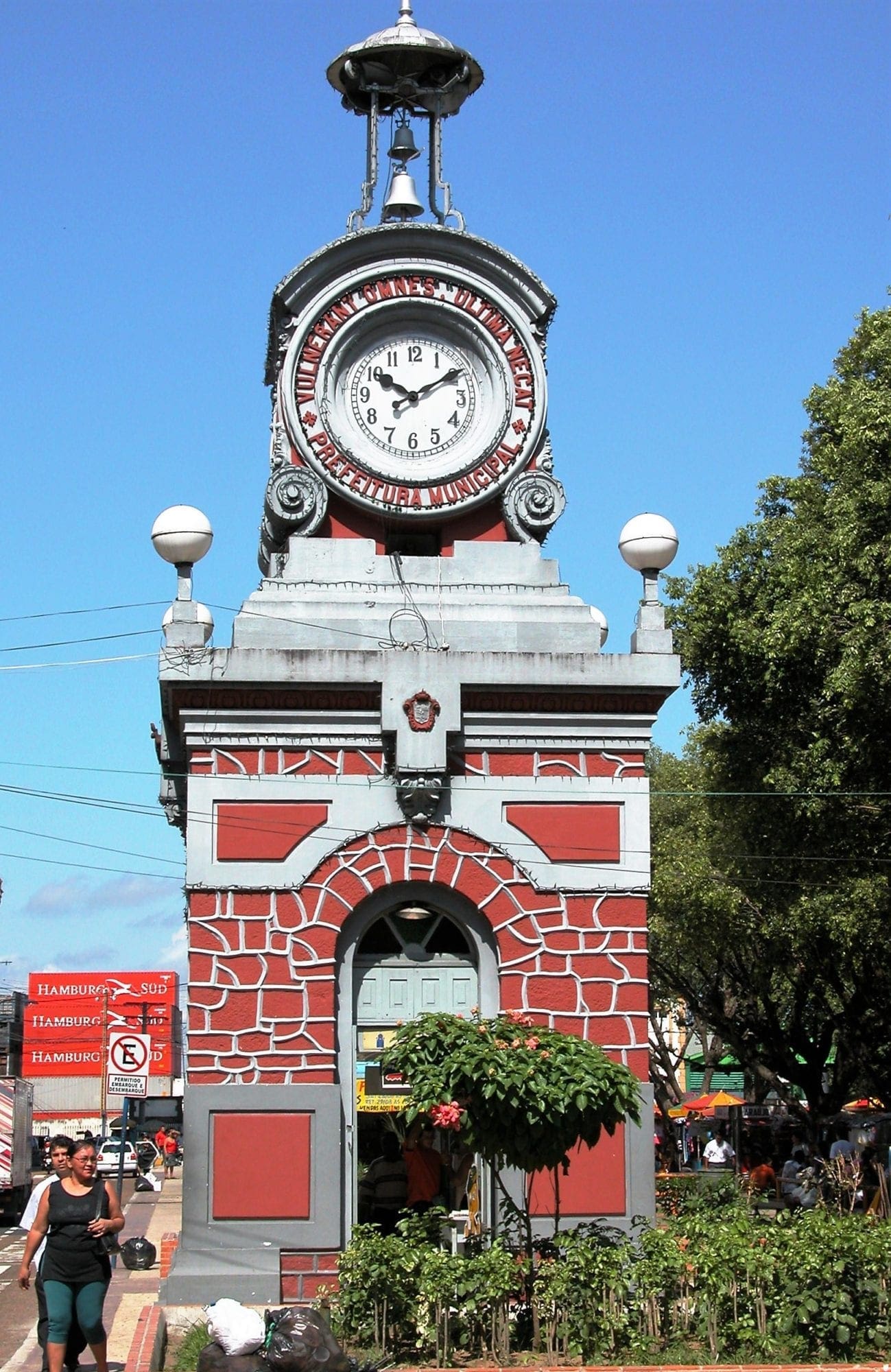
Manaus, in the heart of the Amazon basin, on the banks of the Negro River, has vast tracts of jungle stretching in all directions. That's why its known as The Gateway to the Rainforest. This is where all the Amazon tours and cruises begin.
Manaus was actually the richest city in the world for a while - between 1870 and 1910 - because of the rubber boom. Many wealthy Europeans were lured to the high life. epitomised by the extraordinary Grand Opera House. Just time for a quick visit, before we board the launch, to our stilted lodge.


The Amazon River
En route, we pass the spot where the dark river Negro runs alongside, and then converges with, the lighter brown, muddy amazon River (referred to as the Solimões River, in Brazil, upriver of this confluence). This results in the stripy phenomenon called the 'Meeting of the Waters.' The water flows side by side in different colours (mud-coloured and black) for six kilometres. It's a good moment to understand how huge the Amazon is, even here, 900 miles from the sea.


As we're so isolated, I’ve stocked up on food I can eat, including a can of cashew nuts. The monkey who scrambles across the moored boats to meet us has obviously encountered these previously. Before I can protect my bag, he has purloined my can and is perched high on a branch, devouring them. He has no difficulty with the ring pull. I could swear he’s laughing. The rest of the group certainly are.


To be honest, the much anticipated Amazon is an anti-climax after the Pantanal. It’s quiet and beautiful. We swim by the stilted lodge (no nasties here we’re assured) but there is little new to see. There’s a Caboclo village to visit, to gawk at the ‘natives’, long muddy jungle walks to learn about rainforest plants and fauna (we are exhorted to taste grubs - Kurt does this with glee) and we go piranha fishing – again. This time the guide hauls out some baby caiman for us to admire. Much vaunted river dolphins scoot by. Most of us miss them.
I’ve decided I’m never sharing a room on a tour again. My roommate, German Anne, snores mightily, (deja vu) comes in late and puts all the lights on, and insists on setting the alarm at least 90 minutes before we need to leave in the morning, so she can prink.


Salvador, Brazil
Our last stop is Salvador (Saviour), now the capital of the state of Bahia, It was founded, by the Portuguese settlers, in 1549, initially considered to be the nation's capital, before Rio was deemed to be more practical. It is one of Brazil's most historic cities and still the centre of Brazilian Catholicism.


I read that 'The Pelourinho area, the Portuguese colonial legacy, is regarded as the most important collection of seventeenth-eighteenth century architecture in the whole of the Americas.' It’s a hotch-potch of narrow cobbled streets, gilded baroque churches, and spacious squares surrounded by mansions in need of restoration.
Salvador's magnificent setting and soaring cliffs protect the bay. So, this is one of the most sheltered harbours on the eastern coast of the Americas. The city has a predominantly African feel. This is not surprising as most of the inhabitants are of African descent (working sugar cane and tobacco plantations); there is a real vibe and some incredibly flamboyant costumes. Bruce and Laurie, in the group, pose against a cut out, for photos, and invite me to Fort Lauderdale.


Newsletter Subscription
Stay in touch. Get travel tips, updates on my latest adventures and posts on out of the way places, straight to your Inbox.
I keep your data private and only share your data with third parties that make this service possible. Privacy Policy. No spam I promise. Unsubscribe any time.