This website uses cookies. By continuing to use this website you consent to the use of cookies. Read the Privacy Policy.


I’ve flown out to Brazil from London overnight, along with a lady carrying a poodle in her handbag and several cats in wicker baskets. One escapes and they have to appeal for its owner to come and catch it, over the PA. Some members of the tour group are also on board. Candida is alone, but she’s being met by boyfriend Kurt, who’s been travelling in Peru and Chile. He’s waiting at the airport with a bottle of pisco sour and it’s the first time I’ve been inebriated before nine in the morning. We’re giggling in the back of the bus all through group leader Gabi’s introductions. I'm sure she's really looking forward to this tour now.
Rio de Janeiro, Brazil


I'm starting in Rio de Janeiro, Rio was founded in 1565 by the Portuguese, when it was the seat of the Captaincy of Rio de Janeiro, a domain of the Portuguese Empire. Then, in 1763, it became the capital of the State of Brazil, (still part of the Portuguese Empire).
Rio remains Brazil's most well known city and surely one of the most famous cities in the world with Copacabana and Ipanema Beaches, (don’t leave your belongings unattended), views from the towering summit of Corcovado topped by the immense statue of Christ the Redeemer (too much traffic and too many people) and the cable car up to the huge Sugar Loaf Mountain, from where the late afternoon views of Rio across a scattering of hills and islands are breath-taking.
I also squeeze in the bright, but sad favelas (of City of God fame) and a football match at the renowned Maracana Stadium. Lower league Fluminense are playing Santos and there is plenty of horn blowing and drum rolling, but not many spectators. Football is the country's obsession. Brazil is the most successful international football team ever. They have won the FIFA World Cup five times – more than any other country – and are first in the all-time rankings.
There's also plenty to try, in terms of food and drink. I've already sampled feijoada, the local bean and meat stew, which is traditionally eaten on Sundays, along with pigs' ears, manioc, pork scratchings, greens and garlic and been to a buffet restaurant where you pay according to the weight of the food on your plate. And I've been to several bars. Candida and Kurt are a bad influence and I’ve already learned to love the national drink, the caipirinha. A typical serving costs about 50 pence and is lethal. One is usually plenty. Kurt and Candida go one better than just getting drunk and participate in a mock wedding, at one bar. The ring is a free gift.


Iguassu Falls (Poor Niagara), Brazil and Argentina
Next, Iguassu, home to one of the world’s largest waterfalls. and arguably the most spectacular. There's a story that when US First Lady Eleanor Roosevelt visited Iguassu Falls, in 1944, she is said to have exclaimed, "Poor Niagara!" At 1.7 miles wide, with 275 drops, Iguassu Falls are more spread out than Victoria Falls, but there are more tourists. The horseshoe shaped Devils Throat is the largest and most popular waterfall section, a curtain of 14 separate falls. The air is full of spray, so decent photos aren’t easy, but the upside is plenty of rainbows. And, we view for over four hours, thrills, spills and soaked to the skin.


We follow trails. from the Brazilian side (smaller slice of the national park but better views of the larger Argentine Falls - 80% of them are in Argentina - and plenty of wildlife, like coatis, wandering around), the Argentinian side (many more trails and there’s a close up of the fitfully churning Devil's Throat at the top, where the water plunges over the drop, by navigating a series of catwalks) and from the very bottom in a bobbing (even wetter) boat.


Pantanal, Brazil
Via Sao Paulo to Cuiaba and into the Pantanal. This is the world’s largest tropical wetland, straddling the borders of Brazil, Paraguay and Bolivia. I've visited that area again so read about that trip and more about the Pantanal and my jaguar hunt here.


Manaus, Brazil
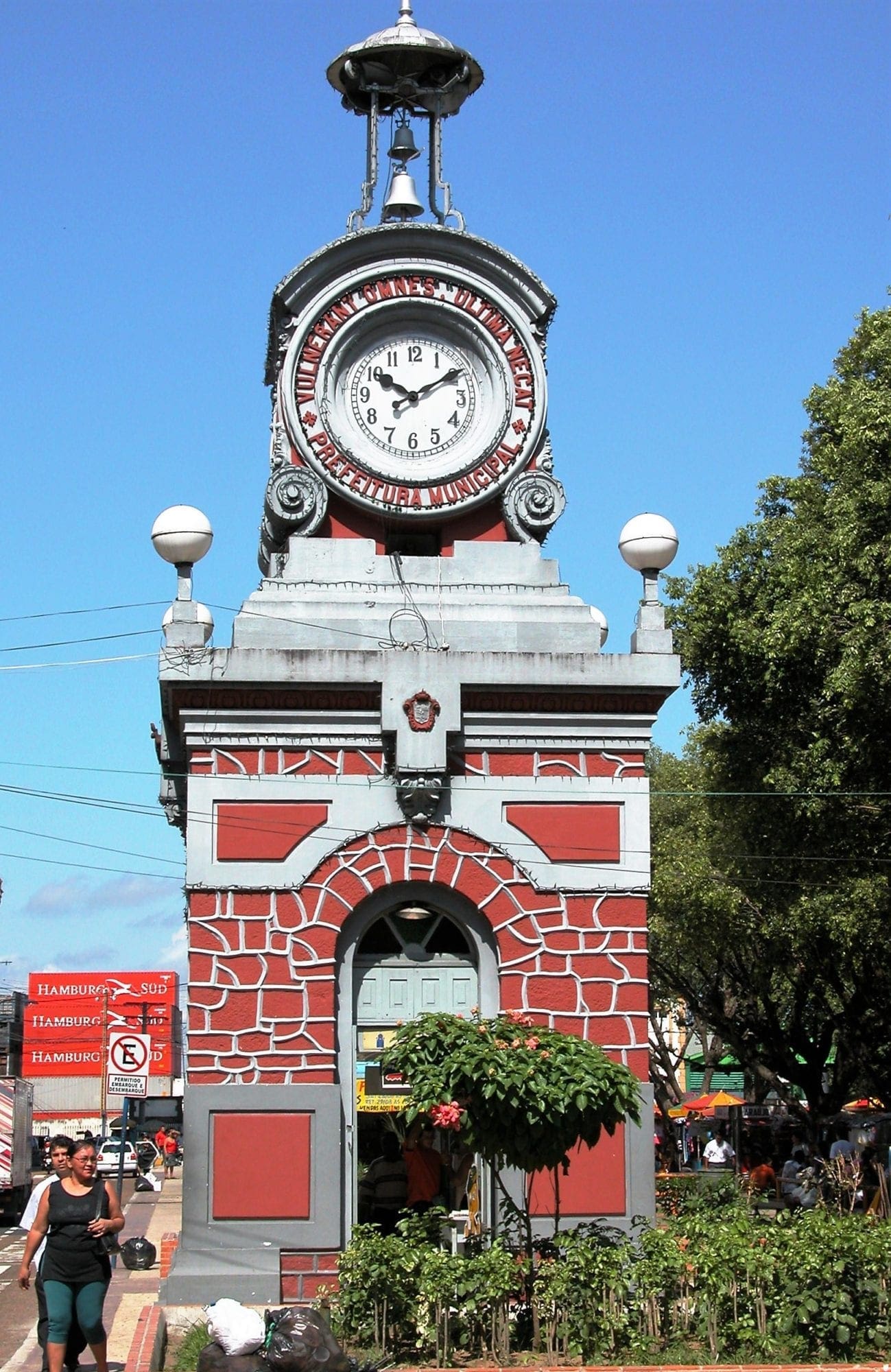
Manaus, in the heart of the Amazon basin, on the banks of the Negro River, has vast tracts of jungle stretching in all directions. That's why its known as The Gateway to the Rainforest. This is where all the Amazon tours and cruises begin.
Manaus was actually the richest city in the world for a while - between 1870 and 1910 - because of the rubber boom. Many wealthy Europeans were lured to the high life. epitomised by the extraordinary Grand Opera House. Just time for a quick visit, before we board the launch, to our stilted lodge.


The Amazon River
En route, we pass the spot where the dark river Negro runs alongside, and then converges with, the lighter brown, muddy amazon River (referred to as the Solimões River, in Brazil, upriver of this confluence). This results in the stripy phenomenon called the 'Meeting of the Waters.' The water flows side by side in different colours (mud-coloured and black) for six kilometres. It's a good moment to understand how huge the Amazon is, even here, 900 miles from the sea.


As we're so isolated, I’ve stocked up on food I can eat, including a can of cashew nuts. The monkey who scrambles across the moored boats to meet us has obviously encountered these previously. Before I can protect my bag, he has purloined my can and is perched high on a branch, devouring them. He has no difficulty with the ring pull. I could swear he’s laughing. The rest of the group certainly are.


To be honest, the much anticipated Amazon is an anti-climax after the Pantanal. It’s quiet and beautiful. We swim by the stilted lodge (no nasties here we’re assured) but there is little new to see. There’s a Caboclo village to visit, to gawk at the ‘natives’, long muddy jungle walks to learn about rainforest plants and fauna (we are exhorted to taste grubs - Kurt does this with glee) and we go piranha fishing – again. This time the guide hauls out some baby caiman for us to admire. Much vaunted river dolphins scoot by. Most of us miss them.
I’ve decided I’m never sharing a room on a tour again. My roommate, German Anne, snores mightily, (deja vu) comes in late and puts all the lights on, and insists on setting the alarm at least 90 minutes before we need to leave in the morning, so she can prink.


Salvador, Brazil
Our last stop is Salvador (Saviour), now the capital of the state of Bahia, It was founded, by the Portuguese settlers, in 1549, initially considered to be the nation's capital, before Rio was deemed to be more practical. It is one of Brazil's most historic cities and still the centre of Brazilian Catholicism.


I read that 'The Pelourinho area, the Portuguese colonial legacy, is regarded as the most important collection of seventeenth-eighteenth century architecture in the whole of the Americas.' It’s a hotch-potch of narrow cobbled streets, gilded baroque churches, and spacious squares surrounded by mansions in need of restoration.
Salvador's magnificent setting and soaring cliffs protect the bay. So, this is one of the most sheltered harbours on the eastern coast of the Americas. The city has a predominantly African feel. This is not surprising as most of the inhabitants are of African descent (working sugar cane and tobacco plantations); there is a real vibe and some incredibly flamboyant costumes. Bruce and Laurie, in the group, pose against a cut out, for photos, and invite me to Fort Lauderdale.


Newsletter Subscription
Stay in touch. Get travel tips, updates on my latest adventures and posts on out of the way places, straight to your Inbox.
I keep your data private and only share your data with third parties that make this service possible. Privacy Policy. No spam I promise. Unsubscribe any time.