This website uses cookies. By continuing to use this website you consent to the use of cookies. Read the Privacy Policy.


An Exceptionally Brief History of China
- The Chinese have a long history. They trace their origins to a cradle of civilization in the fertile basin of the Yellow River, in the North China Plain. This the only culture in the world to have a continuous recorded history of 5,000 years, beginning with the The Three Sovereigns and Five Emperors - a group of mythological rulers and sheng (sages). The first was the wise, Yellow Emperor. He promoted the Tao (or the Way).
- A long series of dynasties followed ensuring the development of Chinese culture, writing, literature, philosophy and inventions like gunpowder, paper and paper money. It began with the Xia dynasty in the 21st century BC and ended with the Manchu-led Qing dynasty. The empire’s fortunes waxed and waned, but the Qing nearly doubled the empire's territory and established a multi-ethnic state. This was the basis for modern day China, as the Qing found themselves at increasing odds with European colonial powers.
- Buddhism reached China from India in 67 AD and also had a profound effect on Chinese culture.
- The Chinese monarchy finally collapsed in 1912, a result of the Xinhai Revolution, when the Republic of China (ROC) replaced the Qing dynasty. The warlord era gave way to civil war between the nationalist Kuomintang (KMT) and the Chinese Communist Party (CCP). This was interrupted by the Japanese invasion in World War. The civil war ended in 1949, with the CCP establishing the People's Republic of China on the mainland while the Kuomintang-led ROC government retreated to the island of Taiwan. Today, both claim to be the sole legitimate government of China.
- The CCP went through several manifestations and the Cultural Revolution, resulting in much hardship for the people. Today, China is governed by a UN recognised CCP,as a unitary Marxist-Leninist one-party socialist republic.


China is widely considered an very safe destination for travellers, with serious and violent crime against foreign nationals being extremely rare. There's a highly visible police presence and extensive public surveillance, especially in major cities like Shanghai and Beijing.
However, the UK Foreign, Commonwealth & Development Office (FCDO) highlights the broad national security laws - be careful where you take photographs (no military establishments) and do not take part in public demonstrations (!).
Tourist targeted scams are more problematic Autorickshaw drivers can be awkward and watch out for The Tea Ceremony Scam ('friendly' locals target you and invite you to a nearby traditional tea house, but then hit you with an extortionate bill), The Art Gallery Scam (similar but you get pressurized into buying) and The Currency-Switch Trick ( taxi drivers or street vendors may take your genuine, large-denomination banknote (like a 100 Yuan note), surreptitiously swap it for a counterfeit bill using sleight of hand, and hand it back to you claiming your money is fake.)
How Expensive is China?
China generally offers excellent value for international travellers, significantly cheaper than Western Europe, North America, Japan, or South Korea for an equivalent standard of comfort. Public transport is very affordable, as are high-quality street food or local noodle dishes. Domestic flights are also inexpensive - but costs can rack up due to the sheer size of the country. However, entrance tickets to landmarks and national parks are relatively steep.
What's in a Name?


Trawling the internet throws up several nicknames for China. Perhaps most common is the “Middle Kingdom”. The Chinese believed that China was the centre of the world, surrounded by inferior cultures and civilizations. But the name “Land of Dragons”, also emerges. The Chinese believed that dragons are sacred creatures, symbols of power, strength, and good luck. The dragon also represented the emperor, who was believed to be a descendant of the mythical creature. Closely related is the alternative epithet,“ Land of the Red Dragon”. (Though Wales also lays claim to this one.) Red is considered lucky in Chinese culture. Finally, China is sometimes referred to as the “Celestial Empire”. The emperor was seen as the son of heaven, related to the divine beings who were in charge and gave rise to divine culture.
China - Facts and Factoids
- Officially called the People's Republic of China (PRC), this is the world's second most populous country, exceeding 1.4 billion (just recently overtaken by India).
- China is the world's third largest country.
- China is the world's largest economy by GDP, at purchasing power parity (around one-fifth of the world economy),the second-wealthiest country and the world's largest manufacturer and exporter, as well as the second-largest importer.
- It has the world's largest standing army by military personnel and the second-largest defence budget.
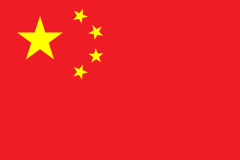
- The Chinese flag was chosen via a competition - there were 2992 entries. The red colour represents the Chinese Communist Revolution. The stars stand for the unity of the Chinese people. The four small stars around one big star show that unity should revolve around one centre.
- China spans the equivalent of five time zones (but only recognizes Beijing time) and has land borders with fourteen other countries (tied for most with Russia). The country is divided into 22 provinces, five autonomous regions, four municipalities, and two special administrative regions (Hong Kong and Macau). The national capital is Beijing, but the most populous city and financial centre is Shanghai. Wow.
- Football was invented in China - but table tennis (or ping pong), one of the national sports, actually came from Great Britain
- As in Japan, the number four is widely avoided - it sounds too similar to the word for death


China - Essential Travel Info
| Border and Entry Control | Visa Regimes | Citizens of 50+ countries (including the UK, Canada, Australia, and many European nations) can enter entirely visa-free for tourism or business stays of up to 30 days. Other nationalities, such as US citizens, must apply for a standard tourist visa in advance or utilise the 240-hour visa-free transit scheme when flying via China to a third country. |
| Passport Regulations | Passports must be valid for at least six months beyond the date of your intended departure. You are required by law to carry your physical passport with you at all times for spot checks, hotel check-ins, train travel, and entering tourist attractions. | |
| Finance | Accepted Currencies | The sole legal tender is the Renminbi (RMB / Yuan). Foreign currencies are not accepted for daily transactions, but can be exchanged at international airports, large hotels, and major bank branches. |
| Payment Ecosystem | China is an entirely cashless society dominated by mobile QR code payments. International visitors need to download Alipay or WeChat Pay and link their foreign credit/debit cards (Visa or Mastercard) before arrival. Physical foreign cards are rarely accepted outside luxury hotels. Cash remains legally valid, but small vendors often lack change. | |
| Banking and ATMs | Major state banks (such as the Bank of China, ICBC, and CCB) have widespread ATMs | |
| Tipping Culture | Tipping is not customary and is traditionally considered unnecessary or even rude across mainland China. It can cause genuine embarrassment to service staff; instead, a polite thank you is the best way to show appreciation. Exceptions are strictly limited to pre-booked international tour guides or high-end cruise staff. | |
| Electrical and Technical | Plug and Socket Types | Sockets typically accommodate three types of plugs: Type A (two flat parallel pins), Type C (two round pins), and Type I (three flat angled pins). |
| Voltage and Frequency | The standard electrical voltage is 220V with a frequency of 50Hz. | |
| Internet and Connectivity | Mainland China operates the 'Great Firewall', which blocks access to major Western sites and applications (including Google Maps, translation tools, WhatsApp, Instagram, and YouTube). To stay connected, you will need a reliable Virtual Private Network (VPN) or to purchase an international roaming eSIM before crossing the border. | |
| Health | Water Potability | Tap water is not safe to drink anywhere in China. |
| Emergency Contacts | Emergency calls are free from any phone: dial 110 for Police, 120 for Medical Emergency/Ambulance, and 119 for Fire Services. For multi-lingual assistance or non-urgent tourist disputes, dial the 24/7 citizen hotline at 12345. | |
| Vaccinations | There are no mandatory vaccine requirements for entry unless you are arriving from a yellow fever risk zone. | |
| Communication | Language | Standard Mandarin (Putonghua) is the official national language. English proficiency is generally very low outside of major luxury hotels or international airport hubs, |
| Best Time of Year to Travel | Weather Patterns | The optimal travel windows are spring (April to May) and autumn (September to October), which offer mild, comfortable temperatures across most provinces. Summers are intensely hot and humid with monsoon rains in the south, while winters are bitterly cold in the north. Crucial tip: Avoid travelling during the major national holiday 'Golden Weeks' (early May and early October) when domestic transport and landmarks suffer from extreme overcrowding. |
What to See in China?


If you’re a traveller, there can be few words more evocative than China. It's not the easiest or most welcoming of places to visit and it's huge. But solo travel is much more possible than it was. The choice of sights, both cultural and scenic, is exciting and overwhelming. The food is a gastronomic experience too. It varies widely across the country (you'll need to practice with chopsticks or you'll go hungry in some places), but in essence the Chinese eat everything. Rats, snakes, dogs, and many other less-consumed animals (pangolin anyone?) form some of the iconic Chinese dishes. Mostly with rice, of course. (N.B. Fortune cookies originated in San Francisco).
My first Chinese visits were to Hong Kong, then a British Overseas Territory. But you can read about my other trips:
- Tibet
- Classic China - Through the Middle
- Cruising the Yangtze
- Kashgar
- Xinjiang
- Shanghai, Hangzhou and Suzhou
- Macau
- And of course, Beijing
Distilled Memories of China
My first trip to China (if you don’t count Hong Kong) was in the nineties. This was pre-digital camera when the images are scanned from old prints, so they are a little grey and dull. That’s pretty well how the weather was when I was there- and the smog. It was a really good route, right up through the middle of China, (with a wiggle to the west and Sichuan/Yunnan), taking in all the major tourist sights. In those days touring was still very controlled and there was a lot of army surveillance. Hotels were dubious and the many diverse sights amazing.
Hong Kong
This visit actually starts in Hong Kong and we catch the train over the border. Hong Kong. (Click for more recent trips.)

Guangzhou
The city of Guangzhou, which the British used to call Canton, is our first stop. It's just 75 miles north of Hong Kong. Guangzhou, a city port on the Pearl River is one of China's largest cities. That makes it huge enough. But it's at the centre of the Guangdong–Hong Kong-Macau Greater Bay Area, which is the most-populous built-up metropolitan area in the world. Approximately 65,594,622 residents. That's about the same as the population of the UK.
Many of the Cantonese temples' contents were destroyed during the Cultural Revolution, but some Chines and Buddhist temples remain here. Perhaps the most famous is the The Temple of the Six Banyan Trees, which dates back as as far as AD 537. The Flower Pagoda, the main structure of the temple, was built in 1097, rebuilt again in 1373 after a fire and restored in 1900.


Another landmark is the Sun Yat Sen Memorial Hall, on the site of Guangzhou's Presidential Palace. It was used when the Nationalists operated a rival Chinese government to the Zhili Clique's Beijing regime. The instigator of the Chinese Revolution remains the only relatively recent Chinese leader to be revered by both the Chinese and the Taiwanese.
But, my most distinct memories are of the amazing market. Just about anything that lives (or has lived) is for sale. Snakes, preserved in jars, dried bats and seahorses. The cutest of puppies. Eat them or take them home as a pet. You choose.
Guilin, Painter's China
A cruise down the Li River from Guilin to Yangshuo is one of China's must dos. The boat passes through some of China's most spectacular scenery as the shallow water winds through the wobbly karst peaks. They've all been named, of course, like stalactites. 'Five Fingers Hill', 'Penholder Peak' or 'Dragon Head Hill'.. The misty pinkish sky frames the the water buffalo and fishermen wafting past on their low bamboo rafts. You can see where so many Chines painters have got their inspiration.
'By water, by mountains, most lovely, Guilin'. says the tourist board. But they are right.
Some of the fishermen still use cormorants to catch their fish. The cormorants perch on the ends of their rafts, attached by a line. If a net has been deployed then they bring in the fish in their beak and are rewarded with smaller ones. Rings round their necks prevent them swallowing the larger catch. At night, the fishermen use lights to attract the fish and guide the birds. It's a practice dating back over 1,000 years, but it doesn't seem very kind to me.


Kunming
East to Kunming. Kunming is the capital of Yunnan province, on the shores of Lake Dian, the cultural, economic, and transport hub of southwest China. It sits at an altitude of nearly 2,000 metres, known as the 'City of Eternal Spring', due to its pleasant year-round, temperate climate.
Kunming also has markets, temples and mountains. and incidentally, some horrible toilets. China has to have the worst toilets in the world. Open trenches round the back of the markets where you squat along with everyone else. amongst all the ordure already deposited. Ugh.


Back to the mountains. Yuantong Mountain (slight exaggeration here), in the northeast corner of Kunming, has a popular down town 'Green Park'. It boasts cherry blossom, which comes earlier than in Japan and a zoo. Sitting at the foot of the mountain, is the 1,200-year-old Yuantong Temple, a series of Buddhist shrines, built around a central landscape pond and octagonal pavilion. They have been expanded, but date back to the late eighth and early ninth century and are packed out with visitors.
Five miles to the to the northeast on the forested slopes of Mingfeng Mountain is the Golden Temple Park. This Taoist site is famous for its large botanical gardens and its hilltop bronze shrine, which is the largest of its kind in China.
But the main tourist attraction in this area is the Petrified Forest, at Shilin about 60 miles further east. Well they call it a petrified forest, but towering grey columns are actually 270-million-year-old limestone karst formations. They were once submerged under the ancient sea; tectonic movements uplifted the seabed, allowing wind, water, and chemical weathering over millennia to sculpt the stone into an incredible labyrinth of rock caves, arches, pinnacles and pavilion. Sections of the site have been designated as UNESCO World Heritage .
.I would have thought it really scenic if I hadn't seen Guilin first.


Leshan and Mount Emei
Now onto Leshan, picking up the Min River, a major tributary of the Yangtze, and following it north to its confluence with the Dadu river, just outside the city. There's a Buddha here, carved out of the red sandstone cliffs. It's 71 metres tall and dates to between 713 and 803 (during the Tang dynasty). That makes it the largest stone Buddha in the world and the tallest pre modern statue.
It's astonishing to find this scene so close to major road networks and conurbations. The river washes its feet and the Buddha faces Mount Emei, You can look down from the top, or descend ladders to the bottom. It is huge and horribly vertigo inducing. It's in the UNESCO recognised Mount Emei National Park.
Emei is one of the four sacred Buddhist mountains of China, an hour's drive west of Leshan. It is the site of the first Buddhist temple built in China, in the 1st century AD. There are seventy-six Buddhist monasteries now, altogether, most of them of the Ming and Qing dynasties and nearly all of them built near the top of the mountain, which is over 3,000 metres high. It's not very warm either, even in August. You can visit them all on a winding 31 mile path, which takes several days to hike. Or you can cheat and take a cable car partway. The monkeys are another deterrent. They bite your fingers if you have food.


Chengdu and the Giant Pandas
We are well into Sichuan province now. Spicy food - liberal use of chilli, garlic and Sichuan pepper, of course. I love the beef, but other dishes such as Kung Pao chicken and Yuxiang shredded pork have become increasingly known in the UK. This is also one of the main tea growing areas in China.
Chengdu is the capital of Sichuan. It's also famous for giant pandas. The Chengdu Research Base of Giant Panda Breeding was founded in 1987. with six giant pandas that were rescued from the wild. These gorgeous black and white bears are endemic to China and live almost exclusively on bamboo. It takes a lot of bamboo to provide enough nutrition, so the bears spend a great deal of time eating. For many years they were endangered, as deforestation drove them out of their natural habitats. They are now classified as vulnerable. China sends other countries pandas - zoos love them, due to their audience appeal, so they make good bargaining tools. But they are never given, always loaned.


I'm sure the centre does a good job in breeding giant pandas, but viewing is more than a little frustrating. They're nibbling away at their bamboo behind plate glass. Even photography is difficult, because of the reflections.
Xi'an
We fly north to Xi'an, as it's a very long drive. Our first journey on internal Chinese airlines. I've been lugging my fat Lonely Planet guide to China round with me. There's a long section describing the poor accident records, and detailing horror stories. They use their own manufactured parts in their Russian fleet to test them out. Both pilots got locked out of the cockpit on one instance and had to use a fire axe to hack their way back in. A kind member of our group goes to great lengths to point this out, as the plane is taking off. In the event, I survive and we are given ice cream for our in flight meal.


Xi’an is the capital of Shaanxi Province in central China, the eastern terminus of the Silk Road. It has historical ties with several of China's ruling dynasties, but it's mostly famous for the Bingmayong (Terra Cotta Army), thousands of life-size, hand-moulded figures buried with China’s first emperor, Qin Shi Huang. They date back to 209-210 BC and were placed there to protect the Emperor in the afterlife. I'm lost for words. (Cameras were banned in those days!)
Also in Xi'an, the Giant Wild Goose Pagoda. This enormous Buddhist pagoda (64 metres) was built in 648/649 (Tang dynasty) to store the translations of Buddhist sutras obtained from India. An earthquake in 1556 Shaanxi reduced its height to 43 metres. The other tourist must-see is the Bell Tower. It's comparatively young, only built in 1384 (Ming Dynasty), but it's said to be one of the grandest in China.
The Great Wall of China
A final flight, even further north, to Beijing. Aaargh, but more ice cream. And we take a day trip to the Great Wall, 'one of the most impressive architectural feats in history'.


Sadly, it's not true that The Great Wall can be seen from the moon. It's debateable whether it can even be seen from space. And it's not just one wall, its several, built at different times, starting in the seventh century BC. Some pieces run parallel, most were eventually conjoined. The best-known parts of the wall were built during the Ming dynasty (1368–1644). Watchtowers, troop barracks, garrison stations and signalling capabilities (through smoke or fire) were all incorporated. Collectively, the wall sections stretch from Liaodong in the east, to Lop Lake in the west and from the present-day Sino–Russian border in the north to Tao River (Taohe) in the south. It spans an astonishing 13,170.70 miles in total.
The purposes of the Great Wall, all too familiar: to control immigration, keep out invaders and ensure that those travelling the Silk Road paid their taxes. It also served as a very useful transportation corridor. Some sections have fallen so badly into disrepair that they have disappeared altogether. The stones are only too handy for building houses. Attempts have been made at restoration in the areas where the tourists are taken. And here, it's thronging.
Beijing, the Capital of China
In the capital city we visit the major sites, fly kites in Tianaman Square and hit the McDonald's close by. We've been eating a lot of Chinese food.


Read more about my visits to Beijing here.
Read more about China here.
Newsletter Subscription
Stay in touch. Get travel tips, updates on my latest adventures and posts on out of the way places, straight to your Inbox.
I keep your data private and only share your data with third parties that make this service possible. Privacy Policy. No spam I promise. Unsubscribe any time.