What is the Capital of Bolivia?
- The official capital is Sucre, the government is based in La Paz and the largest city is Santa Cruz de la Sierra
A Very Brief History of Bolivia
- Early agricultural communities took root throughout the high Andes and the eastern lowlands around 1500 BC, which gradually evolved into complex regional cultures, most notably the Tiwanaku civilization that arose near Lake Titicaca, pioneered advanced stone architecture and sophisticated high-altitude farming, and expanded its spiritual and political influence across the entire altiplano region from 300 AD until its collapse around 1000 AD.
- From the fifteenth to the early sixteenth century the area that is now Bolivia was ruled by the Incas.
- Spanish forces led by Francisco Pizarro conquered the Inca Empire in the 1530s and Bolivia was subsumed within the Viceroyalty of Peru.
- Discovery of massive silver deposits, at Potosí in 1545, transformed the region into an economic powerhouse of the Spanish Empire, fuelled by forced indigenous labour.
- Independence was finally won, by Venezuelan Simón Bolívar, El Libertador, in 1825, after many years of war, (along with Venezuela, Colombia, Ecuador and Peru).
- Venezuela’s then-leader Antonio José de Sucre was given the choice of uniting Charcas (modern-day Bolivia) with either the United Provinces of Rio de la Plata or the newly formed Peru Republic or, to declare independence from Spain and go it alone.
- Sucre chose the latter and named the new republic after Simón Bolívar.


- More war followed, a Civil War and conflicts with all of its neighbours: Peru, Brazil, Argentina, Paraguay and Chile, at different times. Bolivia eventually lost control of several parts of its territory, including its access to the Pacific coastline, (to Chile in 1879). This loss is bitterly resented by the Bolivians. They say that the Chileans invaded at carnival, when everyone was drunk and that this was therefore totally unfair. They still, hopefully, maintain a navy and celebrate Sea Day annually.
- A military coup, in 1964, overthrew the civilian government and initiated nearly two decades of shifting military dictatorships and political repression.
- Democratic governance returned permanently, in 1982, amidst severe economic hyperinflation and deep financial crises.
Native leader Evo Morales won the presidency in 2005, initiated widespread social reforms, nationalised gas resources, and renamed the nation to the Plurinational State of Bolivia. Mass protests over disputed election results led to his resignation in 2019 and triggered a period of political transition, before constitutional elections restored his party to power, in 2020.
Is Bolivia a Poor Country?
- Though historically rich in mineral and energy resources, Bolivia is the poorest of South America's countries. Almost 40 percent of Bolivians live in extreme poverty.
Is Bolivia Safe to Visit?
- There are the usual warnings about petty crime, travelling at night and avoiding con men, especially in La Paz. Intriguingly, the FCO also says this: 'Avoid prison tours. They are illegal and unsafe. There are no guarantees for your safety inside prison premises.'
Facts and Factoids


- Bolvia spans several extreme geographic zones, ranging from the rugged peaks of the Andes Mountains to the tropical rainforests of the Amazon Basin.
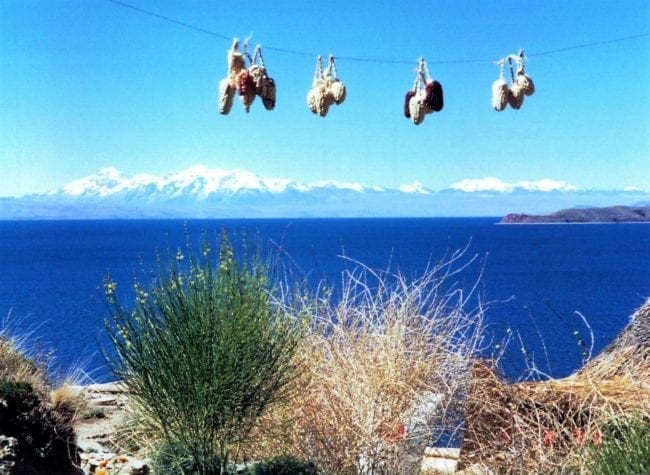
- One third of the country is in the Andes, making Bolivia one of the highest countries in the world. Lake Titicaca, straddling the border between Peru and Bolivia, is the highest and largest navigable lake in the world. Hence the nickname, The Tibet of the Americas. Nevado Sajama is the highest point in the country, reaching an elevation of 6,542 meters above sea level.
- Madidi National Park is recognized as one of the most biologically diverse protected areas on the planet, housing thousands of species of birds, plants, and mammals.
- Salar de Uyuni is the largest salt flat on Earth, covering over ten thousand square kilometers and holding a significant percentage of the global lithium reserves.
- Bolivia has the only Bolivianite (ametrine) mine in the world
- The currency used throughout the country is the boliviano, which is issued by the Central Bank of Bolivia.
- The national flag features three horizontal bands of red, yellow, and green, with the national coat of arms positioned in the center
- The age at which you can vote, in Bolivia, depends on your marital status. If you are married, you can vote at the age of 18. However, if you’re single, you’ll need to wait until you reach 21. And voting is mandatory.
- People dressed as zebras help children to cross the road (lollipop ladies)
What Language is Spoken in Bolivia?
- The nation speaks thirty-seven official languages
- The most prominent indigenous languages include Quechua and Aymara, while Spanish is the most widely-spoken language in the country.
What To See in Bolivia?


- Landlocked Bolivia is the highest, poorest and most isolated country in South America. It is also the cheapest and the most surprising.
- La Paz is a reinvented city
- The rituals in and around Copacabana (Titicaca to La Paz) are fascinating
- The people are friendly and the scenery on the route from the Atacama, across the Altiplano and up to Uyuni (the largest salt deposit in the world) is absolutely astonishing. Surreal painted mountains, vivid lakes, colourful bubbling geysers, a rock city in the desert. Not to be missed.