

Train to Brussels
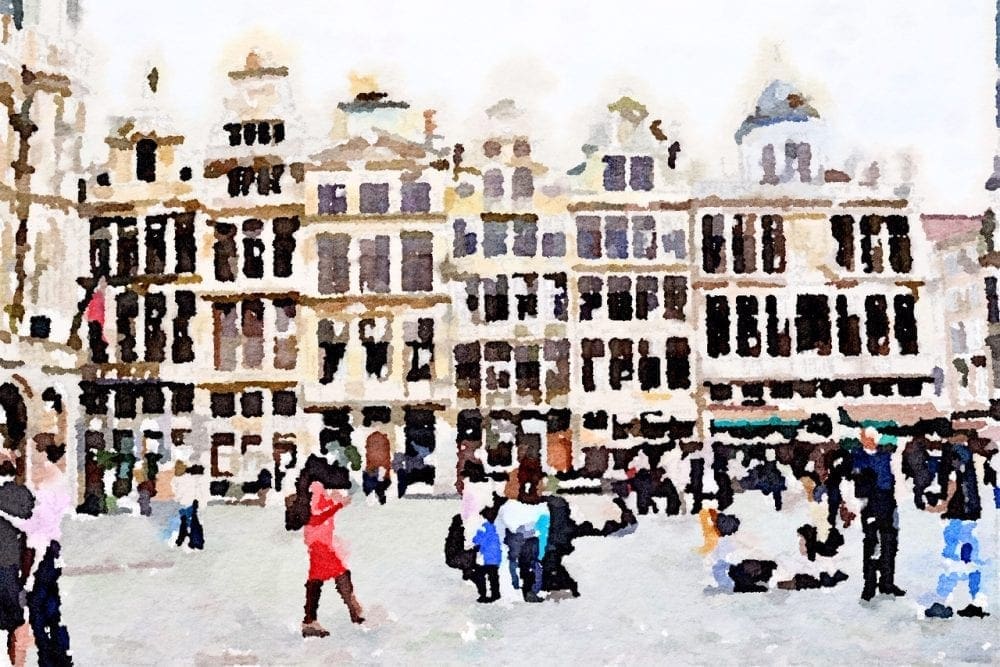
I am marvelling at modern technology, being able to sweep from Carcassonne to Brussels in an easy day, with just one change of train, at Lyon. But we are summarily ejected from the train, at Lille. They can't find a driver to take us onto Brussels. Though they can find one to drive it out of the station. An hour later another chemin de fer turns up and I'm eventually deposited in Brussels Midi. Which is also confusingly known as Brussels Zuid (South). There are signs labelling it as both. The station I actually want is Brussels Centraal. ( You would think that this should be Midi, but no). It’s right adjacent to the Grand Place and my hotel, which is located on a pretty little square, just off this iconic landmark.
Brussels, The Capital of Belgium

Brussels - in a Nutshell
- Brussels is the name given to the capital city, a metropolitan area and a region of Belgium.
- The city is better known as the crossroads of Europe. It's hardly central, but Brussels is a hub for rail, road and air traffic.
- And Brussels is the de facto capital of the European Union, as it hosts a number of principal EU institutions: the official seats of the European Commission, the Council of the European Union, and the European Parliament, but not the judiciary (that's in Luxembourg). As a result, the word Brussels has become synonymous with the EU as a whole, and at times, with annoying bureaucracy.
- Unsurprisingly, the city ranks as one of the most multicultural urban centres in the world, with over 60% of its current population born outside of Belgium.
- Brussels is a unique federal region, completely surrounded by Flanders, meaning it geographically sits inside the Dutch-speaking region of Belgium, despite being predominantly French-speaking. So, the city operates under a strictly bilingual legal framework, requiring all public street signs, official documents, and transit announcements to appear in both French and Dutch.
- The local capital region comprises 19 distinct municipalities, each maintaining its own independent mayor, city council, and local administration.
- The saxophone was invented nearby and heavily championed in Brussels by its creator Adolphe Sax, whose early woodwind innovations are preserved in the city's musical archives.
- Pralines - the world-famous filled chocolate shells - were invented in Brussels in 1912 by Jean Neuhaus, who originally coated medicines in chocolate to improve their taste.
- Brussels has also given its name to the controversial vegetable known as the Brussels sprout. Wheeled out every Christmas, like Marmite, you either love them or loathe them. Personally, I think they're great roasted with chilli or chutney. They originated around the Mediterranean region, first appeared in northern Europe during the fifth century, and were cultivated in the thirteenth century, around Brussels.
Exploring Brussels


I've ended up in a lovely area. The Grand Place is much more impressive than I recall (mostly heavily renovated over the years) with the central lofty Brabantine gothic belfry tower of the City Hall filling the sky (96 metres). This 'fifteenth century masterpiece' is surrounded by gilded and magnificent curly carved gables, astonishingly topped with gold sculptures, frescoes and other motifs, on the Italianate baroque facades. These represent the trade guilds of the Middle-Age: mercers, Serment des Archers, Brewers, Bakers, Grease makers, Cabinet Makers, Stone Cutters, Earthenware Makers, Painters, Boatmen and Coopers are nestled amongst numerous Ionic, Doric and Corinthian columns. A glorious hotch potch.
The King's House, directly opposite the Town Hall, began life as a twelfth-century wooden bread market, before it evolved into a stone administrative seat for the Duke of Brabant (Maison du Roi).It was completely rebuilt in the late nineteenth century, in a highly decorative Neo-Gothic style and today houses the Brussels City Museum. It's really bustling at the weekend, much quieter on Monday, as most of the tourists are locals. They squat in groups on the cobblestones. You weren't allowed to do that last time I came.
Just along a side street, the Mannekin Pis statue, of a boy peeing, is so diminutive you could easily walk by and not notice the number one tourist sight in Brussels. It's seventeenth-century bronze fand is regularly dressed up in elaborate, custom-designed historical costumes. His extensive wardrobe collection is in the City Museum.


I like walking round Brussels. It’s had a bad rep, for being worthy and boring, as has Belgium as a whole. But the warren of curving streets around the central square are vibrant and welcoming. Minutes away from the Grand Place it is definitely more peaceful, especially when the weekend is over. Here are the cathedral, huge and sturdy, the Royal Palace, facing onto a pleasant but small green park and The Royal Museums Complex, an area lined with huge cuboid and colonnaded museums and galleries. The buildings are liberally sprinkled with Art Nouveau embellishments. Sadly, they’re closed on Monday, when I saunter this way and I’m going to miss out on seeing the works of my favourite artist, Magritte. Bruegel and Van Eyck are also variously touted.
A City to Get Fat In


The caveat is that Brussels is definitely a city to get fat in. The side streets are crammed with waffle stalls (oozing cream and ice cream), chocolate boutiques and Belgian frites stands. The chocolate and waffles offers are frequently combined, making for tempting, but even sicklier and more calorific dining.
I'm settling for a set menu in a smart restaurant in an elegantly glass domed and frescoed Galleria. It's one of atrio of three grandly named Royal Galleries of Saint-Hubert. They were opened in 1847 and are home to legacy luxury boutiques, cafes, and prestigious chocolatiers. I'm having raw herring followed by steak. Slightly healthier, if I don't mention the superbly cooked chips. It's delicious.
My Hotel in Brussels
The Brussels Novotel is in an over renovated step gabled building superbly located for the views, night life, Grand Place and the station. It’s just a shame that the rooms, though spacious, have no character whatever, verging on the slightly tacky, with the laminated cupboard fronts. And the staff give the impression that I’m getting in their way by being a guest. They forget to hand me my bag of toiletries (this is how it’s done in Covid times) and my free bottle of water.

Trains in Belgium
Day trip to Bruges today. Trains in Belgium are not a great experience. The stations are gloomy and don't seem to have any lifts. There are no seats on the platforms either, unless you count the ledge at the bottom of a couple of the pillars. It's just about possible to perch on those, crushed alongside all the other waiting passengers. Some of the coaches are totally covered in graffiti. IMHO these pieces of art are well executed and a decided improvement on the original design. However, they've obliterated all of the carriage markings, so its impossible to know what part of the conveyance I'm entering. The shiny silver carriages are especially intimidating. They remind me of Strelnikov's train on Dr Zhivago. Inside, the upholstery is ancient and needs a good vacuum cleaner applied.
There’s a sign indicating the next stop, but it’s incorrect - it's one station behind. And don't even think about looking for electric sockets. Even between stations, for some time, as we traverse the metropolitan sprawl of Brussels, the tracks are lined with paint sprayed concrete.

Bruges
I was choosing between Ghent, Bruges and Antwerp for outings. Bruges is the most highly rated in all the guides and is only a very distant memory, so I'm going there first. The hotel receptionist has also told me that there are rising numbers of Covid cases in Antwerp, so I've put that to the bottom of the list. Maybe another time.
As billed, Bruges it is beyond charming and also thronging with tourists, mainly locals and all wearing masks. They’ve brought in new laws this weekend. Face coverings are now mandatory all the time, even outside in shopping streets.
Bruges - in a Nutshell
- Settlement at Bruges dates back to prehistoric times.
- The city rose readily to importance as a trading port for wool (from Spain and England), spices and other exotica from Europe, Africa and Asia via Mediterranean shipping.
- Its prominence waxed and waned, as its access to the sea became problematic. Channels were cut and then silted up.
- Charles II lived here in exile in the seventeenth century.
- However, Antwerp gradually took over the role of leading city in the low countries.
- Bruges (or Brugge as it is known) then gained a new lease of life in the nineteenth century, one of the first tourist destinations. It is said to be one of the best preserved medieval cities in Europe and is one of several competitors for the title ‘Venice of the North’, due to its extensive network of historic canals which completely encircle and weave through the city centre.
- The entire historic centre of Bruges has been designated as a UNESCO World Heritage Site, since 2000.
- The local lace industry achieved global fame during the Renaissance, and traditional 'bobbin lace' techniques are still taught and practiced by local artisans.
Exploring Bruges
The Centre


The key sites of Bruges are in the squares in the centre. The buildings all have perfect stepped square or curly gables. Each one is unique; the churches and halls have soaring towers that somehow manage to stay aloft. The most famous, unmissable landmark, The Belfry of Bruges, is the thirteenth-century city hall tower, housing a municipal carillon comprising 47 bells. They are still rung by hand today. It is on Grote Markt (Market Square).
Just a two-minute walk east of the Market Square through a short pedestrian alleyway called Breidelstraat, is City Hall and the Burg Square. The Basilica of the Holy Blood, tucked into the corner of the square, but grey. with gold statues, somehow still prominent, claims to have a venerated relic, a cloth stained with what is said to be the blood of Jesus Christ.


The Spiritual Centre
10-minute walk straight south from the main market squares down the Heilige-Geeststraat (I'm going slowly, there is a lot to admire) is the Church of Our Lady. I have lunch under the tower. Not only is it the second highest brick tower in the world, it also houses Michelangelo's Madonna and Child, the only sculpture by the artist to leave Italy during his lifetime. Close by, the Groeningemuseum contains a world-renowned collection of Early Netherlandish paintings, including masterpiece works by Jan van Eyck and Hans Memlin.
The Scenic South Waterfront
Another five-minute walk, south down the Mariastraat, from the Church of Our Lady, brings me to the canal walkways and the De Halve Maan Brewery. The world's first underground beer pipeline, which runs for two miles beneath the streets here, taking the beverage to a bottling plant. It produces Brugse Zot (Bruges Fool) and Straffe Hendrik (Strong Henri) I've never heard of either of them.
The streets of gothic brick houses (actually mostly neo gothic having been restored in the early twentieth century when the tourists first came) are laced together with picturesque canals, waterside cafes and weeping willows. I’m even directed, by locals, to the most photographed spot on the main thoroughfare: the Dijver canal, boats, greenery and the belfry soaring into the corner. This really is a Disneyland visit. It's a theme park city, somehow not real or inhabited, with its lines of chocolate shops and chic perfectly positioned restaurants, serving up tourist menus at exorbitant prices.


Right where the main canals meet the outer moat, another five minutes south, are The Beguinage and the Minnewater Park (Lake of Love). The picturesque Princely Beguinage, guarded by a redbrick gate, was founded in 1245 for Catholic lay women (the beguines) who wanted ascetic seclusion. Today, it is a monastery, with a church and little houses set around a central green with old trees. Benedictine nuns still live there, in complete silence, today.
The Minnewater Park is pretty, with swans. Needless to say, there are Canal Boat Tours galore.
Ghent
I'm apprehensive now about Ghent and hoping it isn't another Disneyland. Apart from the half hour walk from the station to the centre, Ghent is utterly delightful, however. Montreal rather than Quebec, Charleston rather than Savannah, Ghent rather than Bruges. Like Bruges, Ghent has canals, boat tours and elaborate towers, but this time with more soul - edgier. A melange of architecture, art nouveau melded to the medieval merchants’ houses, interspersed every so often with a modern twist – stylish glass apartments or the wood panelled giant that is the new library.
The Skyline Towers of Ghent


One of the must sees is the (mainly) Gothic St Bavo's Cathedral, which was the site of the baptism of Holy Roman Emperor Charles V in 1500. It also houses the Adoration of the Mystic Lamb, a 1432 altarpiece by the Van Eyck brothers that is historically verified as the most frequently stolen artwork in human history.
The Belfry of Ghent (Belfort) is a 91-metre-tall UNESCO World Heritage recognised tower which symbolizes the city's historic independence. An elevator takes you near the top to see the massive 54-bell carillon and panoramic city views.
Numerous other ancient churches, include St Nicholas, which contributes the third skyline tower in the city, after the cathedral and the belfry. This is a decidedly Gothic forbidding blue limestone building. Situated right next to the Korenmarkt (Grain Market) and the old medieval harbour, the church was funded and managed by the local trade guilds and merchants rather than nobility. So, wealthy trade guilds built their own private chapels along the sides of the nave.


Ghent - in a Nutshell
- I first heard of Ghent when I read Robert Browning's great onomatopoeic poem How They Brought the Good News from Ghent To Aix. Sadly, the whole historical incident described was just a figment of Browning's imagination. The real facts (well, according to Wikipedia) are that Ghent came to importance as a port and university city, at the confluence of the Rivers Scheldt and Leie. The river meadows provided ideal pasture for sheep and wool. So, Ghent became the leading city for cloth during the Middle Ages.
- By the thirteenth century, Ghent was the biggest city in Europe north of the Alps, after Paris. The wool industry, expanded to form the first first European industrialized zone. It was so highly developed that wool had to be imported from Scotland and England. This was the basis for Flanders' good relationship with the countries of Great Britain. (Ghent was the birthplace of John of Gaunt, Duke of Lancaster.)
- Trade fluctuated due to ongoing European wars, especially the Hundred Years War between France and England.
- The 1814 Treaty of Ghent, which officially ended the War of 1812 between the United States and Great Britain, was negotiated and signed inside the city's historic charting rooms.
- It's now the third largest city in Belgium, after Brussels and Antwerp.
- Ghent’s unique geography is shaped by the confluence of two major rivers: the Lys (Leie) and the Scheldt (Schelde). Over centuries, these natural rivers were expanded by a complex network of man-made canals. This system served as medieval defensive moats, trade highways, and industrial shipping lanes. Today, they form a scenic loop completely encircling and cutting through the historic centre.
- There's a signature cone-shaped, purple cuberdon candy- locally nicknamed a 'little nose' - which features a firm outer crust and a gooey raspberry centre..
- Ghent has one of the largest continuous pedestrian shopping and cycling zones in Europe.
- The city established a formal 'Thursday Veggie Day' initiative, in 2009, making it the first city in the world to officially encourage all public schools and government offices to eat entirely vegetarian once a week
Ghent: The Medieval Core and Historic Quays


Time to try to take in the city's many notable buildings At the base of the massive Ghent Belfry tower, on Sint-Baafsplein, is The Ornate Cloth Hall (Lakenhalle). Built in the early 1400s, this masterpiece was the official heart of Ghent's thriving medieval wool and textile trade. This is where fabrics were rigorously inspected, appraised, and sold.
Directly opposite the main entrance of St. Bavo's Cathedral on the east side of the square is The Royal Dutch Theatre. You can't miss it, because of the a large, striking mosaic depicting Apollo, the Greek god of music, riding his chariot alongside the muses. North, one minute, to the The Town Hall Complex (Stadhuis) in the Botermarkt. The Ghent Town Hall is a fascinating mish-mash of architectural styles. On one side an extraordinarily ornate, flamboyant late-Gothic facade from the early sixteenth century. The directly adjacent side is far more highly restrained, geometric Renaissance dating from 1635 onwards. Inside sits the famous Pacification Hall, with its black-and-white labyrinth floor where the 1576 treaty was signed, to unify the Low Countries against Spanish rule.
Further north, to yet another square, this time it's the Friday Market Square. Here, I'm admiring the Bond Moyson Building, an Art Nouveau complex which symbolised the 'dawn of a new era', for the working classes at the turn of the twentieth century. The copper rooster on the roof dome represents a new dawn, and the sculpted coat of arms displays three eights for eight hours of work, eight hours of leisure, and eight hours of rest. There's the former house (fifteenth century) of the Corporation of Tanners. It's known simply as The Toreken (Little Tower), because of it's distinctive circular corner turret. It also has, stepped gables, and a market clock, halfway up the tower walls.
Cutting west, to the waterside now, to find the the grim, grey Old Butchers Hall. Inside, there's a soaring Gothic timber roof truss system, where traditional Ganda hams are traditionally hung up to cure. Opposite, the Old Fish Market. This has a magnificent, monumental Baroque gateway, topped by a sculpture of Neptune keeping watch over the Scheldt and Lys rivers. The open-air market stalls behind the gate sit under an elegant, original nineteenth-century cast-iron roof framework. Back inland and south, to the Korenmarkt. The Grain Market is the city’s main bustling town square, bordered by historic buildings, vibrant outdoor cafes (every food known to man), and the astonishingly ornate former Post Office building.
The square, to the west, opens directly to the water again, dropping you straight onto St. Michael's Bridge and Graslei and Korenlei. These two facing riverbanks form Ghent’s highly picturesque historic harbour. They are lined with incredibly well preserved medieval guildhouses, which date from the twelfth to the seventeenth centuries and have slightly tilted front facades to allow workers to hoist heavy goods up from the canal without scraping the stonework.


Ghent Canals and Waterways
A boat tour is a far more attractive proposition than it was in touristy Bruges. We glide trhough illuminated tunnels and past all the arty studios and the beautifully crafted balconies of the many waterside apartments. there are also views of the university and royal palaces, to the south. The Hotel d'Hane-Steenhuyse is an exceptionally lavish eighteenth-century urban palace contributing Rococo and classical aristocratic architecture in the city centre. It was the temporary royal residence for the exiled French King Louis XVIII, during the Hundred Days of 1815.
What's more, the boat saves me walking and delivers me to the Gravensteen Castle (Castle of the Counts). This is another stunningly formidable and solid twelfth century grey edifice, straight out of a medieval history book, with its canal moat and huge keep. Apparently, it features an impressive collection of medieval torture instruments and panoramic views from its battlements.


Read more about Belgium here. Luxembourg next.
