

Belavia to Belarus - Grey, Grey and More Grey
Friday 13th isn’t the most auspicious day to travel, but it’s only a number on a human invented calendar. Isn’t it? I’m having the usual nerves about setting off on my own, to Belarus, not helped by the fact that my Belarusian and Ukrainian beauty therapists have told me that I will get ripped off in taxis, and cheated in restaurants, as soon as the locals hear me speaking English. I’ve also read that Minsk is still very much ensconced in the Soviet Era. Alexander Lukashenko (complete with bad guy moustache) has been president since 1994.
The Belavia plane certainly harks back to communist times. It’s only four seats to a row, all grey, there’s no entertainment and about twenty people on board. The stewards are grey and grim faced too. When I checked in, the clerk told me that there weren’t any window seats left. I think she just couldn’t be bothered to reprint my ticket. There’s an empty window seat next to me. I’ve also got an emergency exit row, though God help us if there is an emergency. I can’t understand a word of the announcements. I can catch the odd bit of English. I’m sure I heard ‘lunch’ and ‘alcoholic drinks’. Perhaps that’s just wishful thinking.


‘Lunch’ does materialise, quite quickly. Some sort of grain (barley?), tinned carrot, tinned beans, some dry lumps of chicken and a roll, with the Russian equivalent of a Dairylea cheese triangle. Only the triangle is edible. Having dispensed this gourmet delight the crew retreat to the back of the plane and read the in-flight magazines.
It’s even grey out of the window. We don’t seem to be able to escape the clouds.
And, when I land at the airport, it’s nine degrees, raining and the welcome sign over the door is - grey.
On the up side I don't need a visa, when I arrive - as I'm staying five days or less. But I am interrogated about medical insurance and get away with my EU medical card. They won’t let you in without it and will make you buy at the airport.
Minsk, Europe's Least Liveable City


It’s time for exploration of Europe’s least liveable city (according to Mercer’s most recent Quality of Living Rankings, based on factors including political stability, crime, currency exchange, recreational facilities, housing and climate). Temperatures in Minsk regularly fall to -25C and below in winter - but can reach as high as 35C in summer. I'm feeling reasonably warm in October. I’ve left my bank cards in the safe and I’m carrying the minimum of money (Belarusian rubles).
Previously, Minsk, the capital and largest city of Belarus, was only remarkable as the remote place where Phoebe’s scientist boyfriend went in Friends. It has mostly been reconstructed, since the World Wars, and is by no means boring. There is the anticipated (grey) Soviet architecture lining the route from the airport, the standard tall blocks of apartments. There are also enormous Soviet government buildings with red stars galore and more recent huge brutalist grey and glass plated edifices. But the roads are eight lane boulevards and the Soviet apartments give way to affluent baroque style (think St Petersburg, but darker), giant monuments, massive domes, parks with pillared entrances and huge squares.
There are also dollops of neo classical with columned palaces and museums. Even the public toilets are embellished citadels. I’ve lost count of the number of McDonalds I’ve seen, all housed in pseudo baroque. Some of them even have turrets. It’s quiet. Quite a few of the locals around are carrying small bunches of flowers. I’m not sure if this is a Saturday tradition or it’s a special occasion.
Minsk: Soviet Grandeur and Main Squares


Minsk is famous for having some of the world's most pristine and complete examples of Stalinist Empire style architecture. Independence Avenue (Prospekt Nezavisimosti) is the 15-kilometre main artery of the city. It's lined with perfectly symmetrical, grand limestone buildings, constructed after World War II.
Independence Square is located at the start of the avenue and is one of the largest public squares in Europe. It houses the grand Supreme Soviet Government House (home to the National Assembly of Belarus), Minsk City Hall, a massive statue of Lenin, and the Church of Saints Simon and Helena (also known as the Red Church), built in 1910. It used to be known as Lenin Square and was the main venue for parades and demonstrations.
It’s another grey, drizzly day; the rain is helpful though. I’ve read (since) that you’re not supposed to take photographs of any government buildings, the station or (especially) the KGB building, but there’s no policeman on duty to tut at me, delete my photos or even cart me off to prison. And, in my defence, I didn’t know it was the KGB building when I framed the photo.
Beyond this, The Gates of Minsk are two symmetrical, 11-storey towers located directly opposite the central railway station. Built between 1947 and 1953, as part of the post-war reconstruction, they were intended to demonstrate the city's resilience and serve as a dramatic and beautifully illuminated welcome to the capital.


Along Independence Avenue, and just off it, various museums and government buildings: the domed Belarusian State Circus (this grand building was the very first permanent, stationary winter circus constructed in the entire Soviet Union) and the Army Palace, which is actually pre-war and one of the oldest monumental buildings in Minsk. That has a Soviet Tank outside it, just in case you weren't sure where you were. The sprawling 85 year old Presidential Administration Building (or Presidential Residence) also managed to survive the war, but it has been superseded by a modern glass Independence Palace on Pobediteley Avenue.
There are more: The Palace of Culture of Trade Unions is 70 years old, having been officially completed in 1954 and opened to the public on 3 July 1956. And, on the northern bank of the Svislach River, tucked just slightly back from the main road, in a leafy park area (there are a lot of those) and, in a completely different style. Opened in 1923, this wooden building marks the site of the clandestine March 1898 founding meeting of the Russian Social Democratic Labour Party. Yet another style and another iconic soviet building, on the far side of the river, in Kommunisticheskaya Street (which Google doesn't recognise) is the upper section and tower-like turret of the landmark House Under The Spire. This 'Stalinist Neoclassical' structure was constructed in the early 1950s, as a premium residential complex specifically to house elite Soviet military families.
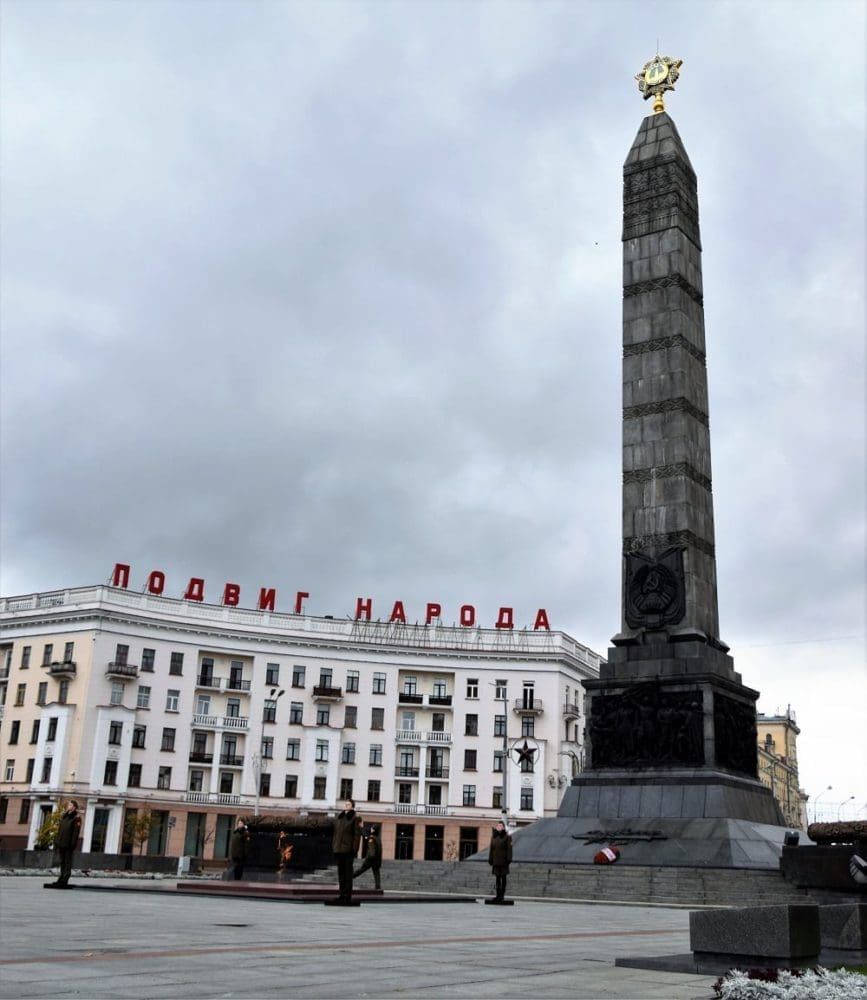
Close to the house, but firmly back on Independence Avenue, is Victory Square. The Victory Obelisk dominates the entire square, a massive 38-metre grey granite monument. It is topped with a large, three-metre bronze replica of the Soviet Order of Victory. The base features detailed bronze relief sculptures depicting scenes of Soviet soldiers and Belarusian partisans fighting Nazi forces.
Positioned directly at the base of the obelisk, The Eternal Flame was lit on 3 July 1954 and has burned continuously ever since. It is surrounded by heavy stone wreaths and fresh flowers. The oval-shaped square is flanked by symmetrical post-war apartment blocks.
On top of these buildings, large red neon lettering spells out the message in Russian 'The Heroic Deed of the People is Immortal'.
Hopefully, you now understand why I think that, overall, Minsk feels more Russian than Russia. There’s a Lenin Street (and a Lenin statue), a Karl Marx street, a GUM department store, a Gorky Park (and the KGB). Everyone speaks in Russian. There are very few signs in English and some saying they can speak Belarusian, if necessary. It’s almost a given that I will get lost, and I do, but not too badly.


Belarus - Facts and Factoids
- The literal translation of Belarus is White Russia, but nobody is sure why that name applies - there are a lot of theories.
- Belarus covers a total land area of approximately 207,600 square kilometres, making it roughly the same size as Great Britain or the US state of Kansas.
- The entire country is completely landlocked, bordered by Poland to the west, Lithuania and Latvia to the north, Russia to the east, and Ukraine to the south.
- The terrain consists almost entirely of flat lowlands and low, rolling hills formed by glacial activity, with no major mountain ranges anywhere in the country. The highest point in the nation is Dzyarzhynskaya Hara, which reaches an elevation of only 345 metres above sea level.
- Belarus contains over 10,000 lakes and roughly 20,000 rivers, with the Dnieper, Neman, and Western Dvina acting as the primary waterways draining the landscape.
- More than 40 percent of the total Belarusian territory consists of dense forests and deep swamplands, giving the land its geographic nickname the 'Lungs of Europe.'
- Belarus is home to Europe's largest land mammal, the European bison, which was saved from extinction and now thrives inside the protected primeval forests of the Belovezhskaya Pushcha National Park.

- The country is a prominent global producer of heavy machinery, manufacturing roughly one-third of the world’s mining dump trucks under the BELAZ brand, including a vehicle capable of carrying 450 metric tons.
- Belarus has one of the largest potash salt deposits in the world, near the southern city of Salihorsk, making it a critical player in the global agricultural fertilizer market.
- Belarus has established its own time zone, to match Moscow time, instead of the rest of Eastern Europe. The country has locked its clocks into permanent daylight saving time (UTC+3) all year round. So, Belarus is one hour ahead of its Baltic neighbours and Ukraine during the winter, and two hours ahead of Poland, despite sharing the same basic longitude.
- This remains the only country on the European continent that has not abolished the use of the death penalty for capital offenses.
- Marc Chagall, one of the most influential modernist artists of the twentieth century, was born and trained in the eastern Belarusian city of Vitebsk, which heavily inspired the dreamlike imagery in his most famous paintings.
- The national economy relies on a massive state-supported IT sector, based in the Belarus High Tech Park. They developed the globally ubiquitous messaging app Viber and the online multiplayer game World of Tanks.
Historic Pockets of Minsk
But, whilst much of Minsk was levelled during the war (the retreating German forces destroyed roughly 80% of the city.), two charming historic pockets have been restored or preserved.
Trinity Suburb


Trinity Suburb is a picturesque nineteenth-century neighbourhood on the banks of the Svislach River. That happens to be where I'm staying. Winding cobblestone paths and brightly painted pastel facades. Trinity Suburb was historically a bustling suburban market and residential quarter for craftsmen, merchants, and peasants, just outside the city walls. It was completely restored, in the 1980s, to showcase how a nineteenth-century European Belarusian neighbourhood looked.
From here, cross a foot bridge to the Island of Tears, a small island monument dedicated to the fallen soldiers of the Soviet-Afghan war. There's also the Maxim Bogdanovich Literary Museum. The Kitajeŭskaja Synagogue, originally built in 1874 for Hasidic Jews, is now a nature museum. The riverfront strip is described as being lined with subterranean bars, traditional Belarusian taverns, and craft shops selling handmade linen and straw goods. But today, it's so deserted it's hard to make out these features. I'm sure they're there, somewhere.
Up Trinity Hill, in the beautifully manicured park behind, is the 88 year old rotunda of the neoclassical National Opera and Bolshoi Ballet House. The area around here is known as Ballet Alley. There's a statue to prove it. And more, of esteemed cultural and literary figures.


A Very Brief History of Belarus
- The territories comprising modern Belarus were unified in the ninth century under Kievan Rus' and became the birthplace of several early Slavic principalities.
- Following the fragmentation of Kievan Rus' and Mongol invasions, the region was integrated into the Grand Duchy of Lithuania in the thirteenth century and later merged into the Polish-Lithuanian Commonwealth in 1569.
- The Russian Empire annexed the Belarusian lands during the late eighteenth-century partitions of Poland, initiating a long period of official Russification policies.
- After the Polish-Soviet War, Belarus lost almost half of its territory to Poland, although some of this was reintegrated after the Soviet invasion of Poland.
- Belarus only really emerged as a nation in the twentieth century, when the Byelorussian Soviet Socialist Republic (SSR) became a founding constituent republic of the Soviet Union, in 1922. (Belarus briefly declared independence as the Belarusian Democratic Republic, in 1918.)
- Nazi Germany occupied the territory during World War II, devastating the infrastructure. Almost 40 % of residents of the Soviet Republic of Belarus (between two and three million) were killed during the Second World War - a higher proportion than any other territory. Most of its 290 cities were destroyed and its Jewish population was wiped out. It wasn’t until 1971 that the republic’s population returned to pre-war levels.
- Then, in 1986, Belarus bore the brunt of the fallout from the Chernobyl disaster.
- The country achieved full sovereignty following the dissolution of the Soviet Union, in 1991, establishing its current borders and national institutions.
- Alexander Lukashenko took office as the nation's first president in 1994, maintaining a centralized political and economic system closely aligned with Russia. He is still there.
Vierchni Horad


Set on the high ground, on the other side the Svisloch River, is the Upper Town, Vierchni Horad, the historic heart of Minsk, A rare fragment of pre-revolutionary brickwork which escaped both Nazi bombs and the subsequent Soviet obsession with grandiose concrete avenues.
Here, we're back to heavy seventeenth-century Baroque style, dominated by the twin towers of the Holy Spirit Cathedral and the unadorned walls of St. Joseph Church. (The Soviet state repurposed the latter as a secure archival vault for decades). Minsk City Hall is right in the centre of Freedom Square (Plošča Svabody).The original stone structure was completed in 1600 to mark Minsk gaining self-governance under Magdeburg Law. It housed the city court, archives, and local administration until 1857, when Russian Emperor Nicholas I ordered the building completely demolished. So, the white, Neoclassical building standing today is a modern, exact replica built from historical blueprints and archaeological excavations. It was actually completed and inaugurated on November 4, 2004.
The Governor’s Carriage is is a life-sized bronze replica of an eighteenth-century carriage, parked permanently on the cobblestones, outside the City Hall walls. The pedestrian square surrounding the building contains glass floor panels built directly into the ground. These are observation windows allowing views into the preserved, excavated stone foundations of the original seventeenth-century structure.
More museums and low brick archways reveal a labyrinth of interconnected rear courtyards, where utilitarian stone walls now shelter small basement bars, coffee shops, and independent art spaces.


Minsk: Exceptional Museums and Modern Architecture
Minsk today is not afraid of bold, futuristic engineering designs. The Belarusian State Museum of the History of the Great Patriotic features a striking façade, shaped like a sunburst or exploding shell. Adjacent, The Minsk Hero City Obelisk. Inside, 10 massive halls showcase authentic World War II hardware, fighter planes, tanks, and immersive dioramas. So I read. I don't like war museums - it's all too upsetting.
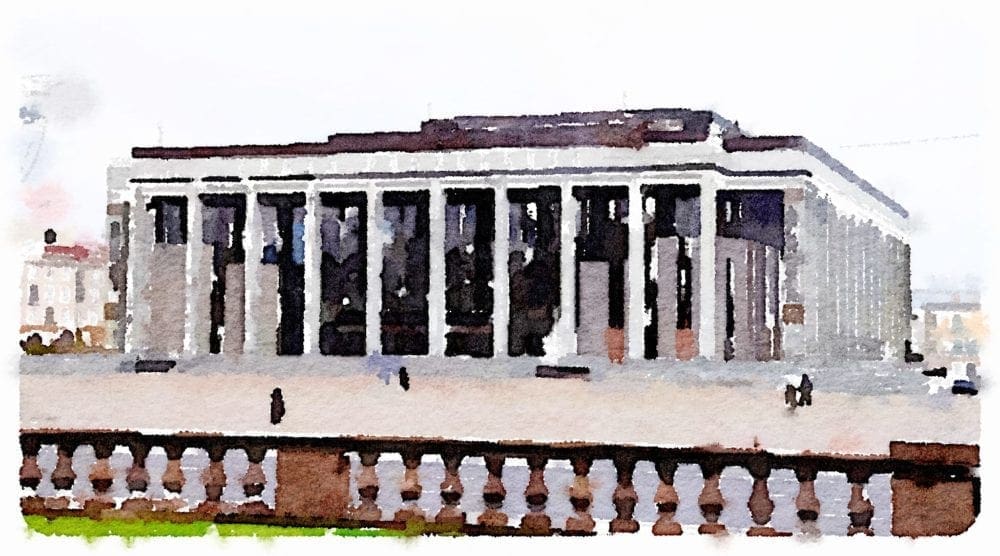
The National Library of Belarus is an unmissable avant-garde architectural marvel, a 26-sided diamond (otherwise known as a rhombicuboctahedron). There's an open-air rooftop observation deck for panoramic views. Also unmissable is The Palace of the Republic. Completed in, 2001, this is actually a huge concert hall, not as its name would imply, a government administration building. It's on the eastern side of October Square, directly on Independence Avenue, facing the older Palace of Culture of Trade Unions and Army Palace. They are separated by rows of national flags. The flag of Belarus is unusual: it has a large red horizontal stripe on top, a narrower green stripe on the bottom, and a vertical white-and-red traditional Belarusian decorative pattern on the hoist (left) side. (Though the patterned bit is sometimes omitted.)


The list goes on: sports palaces. I can't possibly mention everything. Everything is built on a grand scale and monuments abound. Two depicted are the Monument to the Fallen Employees of the Ministry of Internal Affairs and Internal Troops and the Monument to the Sons of the Fatherland. The buildings are surrounded by plenty of parks, as I have said, especially lining the banks of the river. This weekend, they are gorgeously autumnal.
At night, many of the buildings are illuminated in gaudy pinks and blues; there is a fiery torch surrounded by a circlet and the National Library is an enormous glittering disco ball. I can see where Kim Jong-un got his ideas for renovating Pyongyang. The military hats here would also give the North Koreans a run for their money - they have enormously high brims.
Sunday in Minsk

Sunday in Minsk is even quieter. I’m fitting in, as my blonde hair is straight today, and I clearly look like a local. The few people people around keep wandering up and chatting to me. I hope I’m smiling in the right places. There are groups of Belarusian tourists but there don’t seem to be any other Europeans. I’m the lone diner in the hotel restaurant, where I retreat in the end, cold and damp. I’m sampling draniki, the national dish, which is stuffed potato pancakes. They come with a huge dollop of cream alongside. And vodka. The average citizen of Belarus consumes more alcohol than anywhere else in the world according to the Internet, but it says this about several countries, all in the ex U.S.S.R.
Another perambulate through the cathedrals and city halls of the ‘Old Town’. The cathedral service is being broadcast in the square through speakers. It’s peacefully inviting and there’s a stream of well bundled up locals (mainly female) through the main door. It’s packed inside here.


Chauffeur Driven to the Airport
I have a chauffeur driven car to the airport (to make up for forgetting to book me in at all). The effect is rather spoiled by the driver’s beanie. In daylight, I get a better look at the outskirts of the city. It’s grandiose, even to the edges. Beyond that is deciduous forest, like the parks, enlivened by gorgeous autumn colour. In the city, the golden yellow contrasts effectively with the marble facades, though it’s not quite New England, it’s missing the rosy red and orange hues. I seem to have escaped the worst aspects of the least liveable city in Europe. All I’ve seen is quiet, calm efficiency, on agrand scale. The plane takes off early again. Ukraine next.