

1990 - Saddam Interferes
I'm very excited to revisit Jordan. This is a last minute invitation from Hayley, who's a very big traveller too (she finished the 193 just after me). Also along are Hayley's friends, Summer and Louis. The last journey was a tour to Jordan, Palestine and Israel. A trip I’d been wanting to make for a long time; we learned so much about the Holy Land at school - I was expecting a very spiritual experience. But my trip had become much too scary, before I’d even left home. Saddam Hussein, with immaculate timing, had invaded Kuwait and the Middle East was in uproar. We were wondering if the trip would be cancelled, but the FCO hadn't declared Jordan a no-go zone, even though Israel was polishing up its rockets. And we got the go-ahead.
Naturally, by the time my plane landed, the FCO had changed its mind. David, our tour leader told us to keep our heads down, in all senses of the phrase. The British were not very popular and sightseeing in capital city, Amman, was off. We were not too oppressed, fortunately, though there were some surly faces and a few internationally recognised gestures in our direction. It’s ironic that Amman was the original Philadelphia - City of Brotherly Love. It was re-named, for a time, after Ptolemy II Philadelphus, the Macedonian ruler of the Ptolemaic Kingdom, who reigned from 283 to 246 BC.
Jordan, 35 Years Later


This time, 35 years later, the situation is not hugely different. Many would be visitors have cancelled their trips. (There were one million visitors in 2018). Today, the hotels are virtually empty and the tourist sites still sleepy. It's Ramadan, which is a partial explanation for the quiet. But, more importantly, you can't get to Amman, without crossing a war zone. Israel is still polishing up its rockets, but this time they're aimed at Gaza, Lebanon and a little further away, towards Iran. That means they have to fly over our heads, in Jordan. I'm staring anxiously at my Google map, as my plane traverses Tel Aviv and Jerusalem, en route to Amman. Thankfully, it doesn't take very long.
And it's a very different welcome. Smiling, friendly folk everywhere, all eager to help. Arab hospitality at its best. Amman Airport is modern and formalities quickly dispatched. Our Jordan Passes help here. They're astonishingly good value. Bought online before arrival, 70 Jordanian dinars secures you free entry to all the significant tourist sites, plus a free visa.
The staff in the W Hotel (referred to as talent here) are ultra friendly and can't do enough for us. This tower block hotel (splendid views across the city from the upgraded Spectacular Rooms) is beyond cool, with its artfully dressed mannequins, mock markets and carefully designed lighting. You even enter through a narrow neon lit siq, which is a ringer, maybe, for the one at Petra. It's much too hip for the likes of me.
My only complaint is that the water tastes horrid, full of chemicals, even in tea. But I don't suppose that's down to the hotel.
Amman, the Capital of Jordan


Amman, almost entirely tasteful white or cream cuboids, spilling across hills to the horizon, as far as the eye can see. Even from the top of the W Hotel. Amman is home to four million, the largest city in the Levant. Much of the modern, mixed with glimpses of the ancient. The earliest evidence of settlement in Amman dates to the 8th millennium BC. One of the oldest cities to ever exist, is home to the oldest statues in the world. The Ain Ghazal Statues date back to 7500 BC and are housed in the Jordan Museum.
This time, I'm able to sightsee. Amman is not a city busting with tourist attractions. But the historic Citadel, atop Jabal al-Qala’a Hill, is a must-visit. A cross section of Jordanian history, it includes the pillars of the Roman Temple of Hercules and the eighth-century Umayyad Palace complex, with its impressive mosque dome. It's a relaxing and tranquil circular perambulation, offering more city views (and national flags fluttering). Down below, built into a different downtown hillside, the restored stone Roman amphitheatre has a 6,000 seat capacity.
The parliament building, the Palace of Justice, the blue domed, King Abdullah I Mosque and a dip into a local, beautifully decorated mall, in Abdala. It's almost deserted. There are a couple of stalls open in the food hall (take away only), if you don't mind waiting twenty minutes. They're' gearing up for dusk, when the Muslims break their fast, with the iftar meal.


Jordan - A Very Brief History
- The area where modern-day Jordan exists has been inhabited by humans since the Paleolithic period. Three stable kingdoms emerged there at the end of the Bronze Age: Ammon, Moab and Edom.
- In the third century BC, the Arab Nabataeans established their Kingdom here, with Petra as the capital.
- Over the years, the land was incorporated into the Assyrian, Babylonian, Roman, Byzantine, Rashidun, Umayyad, Abassid, and Ottoman empires.
- After World War I, the Greater Syria region (previously ruled by the Ottomans) was partitioned by Britain and France. The Emirate of Transjordan (East Jordan) was established in 1921, by the Hashemite, then Emir, Abdullah I, and the emirate became a British protectorate.
- In 1946, Jordan gained independence and became officially known, in Arabic, as the Hashemite Kingdom of Jordan.
- The country captured the West Bank of the Jordan River (actually designated by the UN to be part of Palestine), during the 1948 Arab–Israeli War (which erupted after the State of Israel was declared) and annexed it, until it was lost to Israel, in the Six-Day War, in 1967. Jordan renounced its claim to the territory in 1988 (and therefore also the Jordanian citizenship rights of all the Palestinians living there), and became the second Arab state to sign a peace treaty with Israel, in 1994.
Jerash

Jordan is home to many biblical sites including, among others, the Jordan River, where Jesus was baptised by John, as well as the sinful cities of Sodom and Gomorrah. And, I'm now lucky enough to revisit Ancient Jerash, in the wooded Gilead Hills. Here, 45 kilometres north of Amman, the more fertile landscape is enlivened by emerald grass and silvery olives.
The itinerary, on my first visit, says that ‘this beautiful Roman city (Gerasa) is considered to be the best preserved of the Decapolis, a confederation of ten Middle Eastern cities, established by Pompey’. But I understand it’s the only one to have survived at all, in any meaningful way. Jerash boasts an unbroken chain of human occupation, dating back more than 6,500 years. It's lucky enough to have good access to water. And was hidden for centuries in sand, before being excavated, and restored, over the past 70 years.
It doesn't seem to have changed much, since 1990, except that the shopping souq, at the entrance is considerably larger. Ancient Jerash is a long thin strip in the centre of the modern city, arranged either side of the 800 metre long, colonnaded Cardo Maximus. This is still paved with the original stones - ruts worn by chariots are still visible - as is the underground sewage system with regular holes at the sides of the street, draining rainwater, into the sewers. It's hard to know which way to look, which steps to take, so many glorious buildings beckon.


Possibly the most impressive sight is the Oval Plaza, a colonnade of first century AD Ionic columns. It's best appreciated from the Temple of Zeus, up above. Soaring pillars, hilltop temples, not one, but two grand theatres, a hippodrome, spacious public squares and plazas, baths, fountains and city walls interrupted by monumental towers and gates follow. It's a fascinating Graeco-Roman experience, with the Orient, both old and new, peeping through.
The South Theatre, adjacent to the Temple of Zeus, was built during the reign of Emperor Domitian, between 90-92 AD, and can seat more than 3,000 spectators. It has remarkable acoustics, taken full advantage of today, by bag pipe players. The locals persistent attempts to make money from tourists here, revolve around trickery with mobile phone cameras. Sadly, for them, I really don't have any cash with me.


So many other notable buildings: Hadrian’s Arch (built to commemorate the visit of the Emperor Hadrian to Jerash in 129 AD, this triumphal arch was intended to become the main Southern gate to the city, but the expansion plans were never completed, the Nymphaeum (an ornamental fountain constructed in 191 AD and dedicated to the Nymphs. and the cathedral (the richly-carved gateway to the second century Roman Temple of Dionysus, later a Byzantine church and never a cathedral).
The Jordanians regularly hold Roman Army & Chariot Experience shows at Jerash, 'the only large scale Roman re-enactment performance in the world'.

Madaba and Mount Nebo
South west of Amman, to Madaba. This is home to the sixth-century mosaic map of the Holy Land, in the Greek Orthodox Church of St. George.
Northwest, of here. the biblical hill of Mount Nebo overlooks the Jordan Valley, the West Bank, Jericho and the Dead Sea. Mount Nebo is an elevated ridge, approximately 710 metres above sea level. (The lowest point on Earth in terms of dry land is the shore of the Dead Sea in Jordan. It lies 420 metres beneath sea level.) The Bible tells us that this the place where Moses was granted a view of the Promised Land before his death. (He was not allowed to actually reach there after transgressing.) A Brazen Serpent sculpture commemorates the event and the saving of the snake bitten Israelites by Moses' bronze serpent. It was created by Italian artist Giovanni Fantoni and represents both the miracle of the bronze serpent in the wilderness and the cross upon which Jesus was crucified.
Mount Nebo crops up again in the Old Testament (Maccabees), as the prophet Jeremiah hid the tabernacle and the Ark of the Covenant in a cave there. There's also a Christian church from Byzantine times, with some nice mosaics.


Jordan - Facts and Factoids
- Today, Jordan is a mainly Sunni Moslem, population, considered an upper middle income economy and a major tourist destination.
- Medical tourism is also, apparently big business here.
- The Jawa Dam here was the first dam ever to be built; it was constructed in 3,000 BC, in the Black Desert of Eastern Jordan
- The national dish is mansaf - lamb cooked with fermented yogurt and usually served with rice topped with pine, almond or cashew nuts. It's delicious, as is the associated dessert, sweet puff pastry, cream and lots more nuts.
- In Jordan, it is considered courteous to refuse a meal three times before actually accepting it.


The Dead Sea
Last time I was in this area I visited the Dead Sea at Masada, in Israel. This time, Masada beckons across the water, and I'm on the east coast highway, bordering the 31 mile lake, salt rimmed and glimmering in the haze. The lake's surface is 440 metres below sea level, making its shores the lowest land-based elevation on Earth. It is 304 metres deep, the deepest hypersaline lake in the world. And, with a salinity of 342 g/kg, or 34.2%, this is one of the world's saltiest bodies of water- nearly ten times as salty as the ocean. Its impossible for plants and animals to survive here - hence its name. The salt is associated with the story of Sodom and Gomorrah. Lot's wife was punished by being turned into a pillar of salt and it's sometimes referred to as The Sea of Lot.


The Dead Sea itself may be barren, but the scenic hills which form the backdrop are green and the lakeside is market garden country: garlic, carrots, onions, tomatoes and potatoes are being harvested and laid out on roadside stalls or trundled away to market. Its fed by the River Jordan (via the Sea of Galilee) and numerous small streams. But this is an an endorheic lake, meaning there are no outlet streams. Everything runs downhill to here. That accounts for all the salt. It's currently retreating fast, with global warming and less water incoming. The Jordan River, has been substantially diverted and now only contributes about one-sixth of the inflow to the Dead Sea, less than direct rainfall.


The Dead Sea has never been short of tourists. It was one of the world's first health resorts and is a good source of minerals. Everything from asphalt, for Egyptian mummification, to potash for fertilisers. There are plenty of very pricy stores crammed with dead sea scrubs and mud. I'm partial to some deed sea scrub (with frankincense) myself, but it's a far more reasonable price from Boots, in England.
The north end of the Jordanian shore is replete with pricy spa resorts. Most of them offer day passes and we've opted for one of the most expensive - the Movenpick. It's 40 Jordanian dollars per head, and we have to show our passports, as if we're checking in. But it's decadently worth it. Golf carts to transport us up and down the steep cliffs and through the resplendent gardens. An attractive pool and attentive staff who bring us lunch on the pool patio.
There's another beach, right at the lake's edge, with imported sand and deckchairs. Buckets of the mineral rich mud are provided, to daub your skin. It tingles, long after the mud has been washed off your now infinitely softer dermis. Getting in and out of the water takes some perseverance. The pebbles and huge salt crystals are not kind to the feet. Beach shoes are required. Lying back in the water and floating is easy. Getting back upright, especially when you're out of your depth is more of a challenge. I make an idiot of myself, spinning like a top. Swimming is impossible.
There's a magnificent view of the whole Dead Sea, from the plane, on my way home.


Castles in Jordan
There’s a crusader castle or two, to take in. Kerak Castle ( Krak of the Desert) is probably the most famous and one of the largest. It dates back to 1140, constructed on a strategic ridge, looking out to the Dead Sea, controlling Bedouin herders, as well as the trade routes from Damascus to Egypt and Mecca. It was the seat of the gloriously named Pagan the Butler and saw many significant crusader battles. Today, it's surrounded on all sides, by village buildings, although the tourist photos manage artfully, to leave those out.
Qasr Al-Kharana (to the right) is one of Jordan’s best-preserved and most frequently visited Desert Castles, located just 60 kilometres to the east of Amman, near to the Jordanian – Saudi Arabian border. This one is older, believed to have been constructed at some point during the first half of the eighth century AD by an Umayyad caliph. so again. Most of the castles are twelfth century, actually built during the Crusader Wars. At the time of my visit I’m more concerned with a distinct lack of toilets - gut rot has already set in.


In 1990 it was then over the Allenby Bridge...
See Israel and Palestine for the next few days of that trip.
Petra, the Rose Red City
Back into Jordan, in 1990, from Israel and down the King's Highway, roller-coastering over huge 'wadis' (valleys). Through the rocky desert, only enlivened by beige residential areas arranged on each side of the highway. I'm following the same route, on two lane highways, today. We've all been lulled into false expectations weather wise. Last week, according to the weather apps it was a suitably arid 28 degrees Celsius. I packed accordingly. Today it's six degrees and raining, in the north.


There's more dark green, as we turn off to Petra but it's glistening heavily, with light snow and frost. We finally reach Nabataean Petra, billed as one of the world's most outstanding ancient cities. As John William Burgon wrote:
' It seems no work of Man's creative hand,
by labour wrought as wavering fancy planned;
But from the rock as if by magic grown,
eternal, silent, beautiful, alone!
Not virgin-white like that old Doric shrine,
where erst Athena held her rites divine;
Not saintly-grey, like many a minster fane,
that crowns the hill and consecrates the plain;
But rose-red as if the blush of dawn,
that first beheld them were not yet withdrawn;
The hues of youth upon a brow of woe,
which Man deemed old two thousand years ago,
Match me such marvel save in Eastern clime,
a rose-red city half as old as time.'


Petra is one of the suggested New Seven Wonders of the World and a UNESCO World Heritage Site. The area around Petra has been inhabited from as early as 7000 BC, and was settled by the Nabataeans, a nomadic Arab people, in the fourth century BC. Petra grew to become the capital city of the Nabataean Kingdom in the second century BC.
The Rose Red City is deliberately located in the midst of mountains, most of the buildings carved out of the rock face, making it virtually unapproachable. This was to protect the riches, collected in levies, on caravans, mainly following the incense route. The Nabataeans were accustomed to living in the barren deserts and had learned the skills to maintain and defend their kingdom: agriculture, stone carving and rainwater harvesting.
In 1990, we ventured in on horseback (walking is discouraged), through the siq, an exceedingly narrow chasm. Today, the equine owners are frustrated, as though the ride is included in the ticket (a whacking 50 dinars, unless you have the Jordanpass) most visitors choose to walk, or to avail themselves of the golf buggies which now proliferate.
It's incongruous to see the carts alongside the two thousand year old carvings. They've even smoothed over the approaching roads, to facilitate passage. (And it's even worse on the way out. They've moved the shuttle bus stop, which takes you back to the visitor centre, several hundred metres to encourage use of alternative transport. And when you do reach the bus there's an obligatory stop at a new handicraft market.)


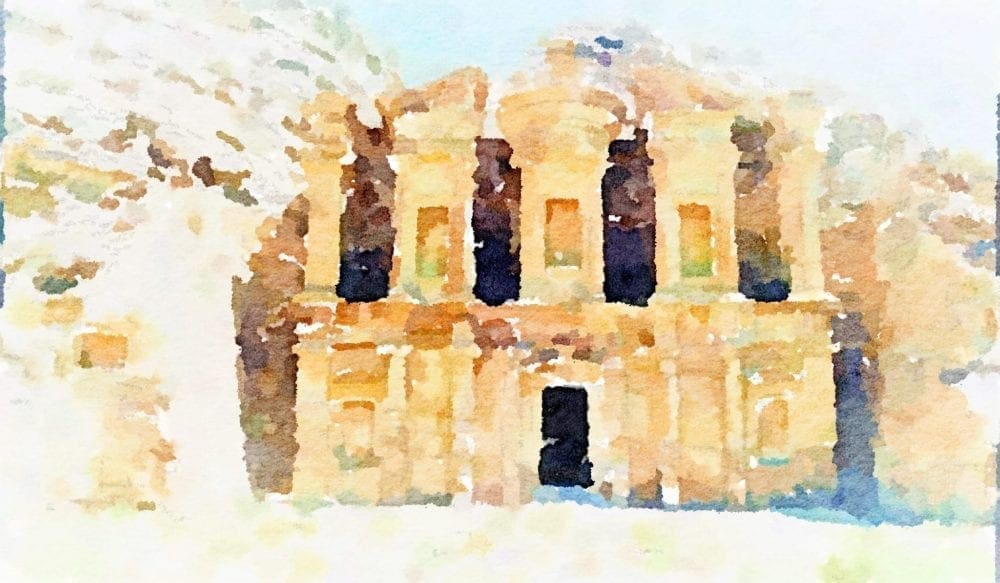
There's still the delightful reveal of the huge basilica of the (Khazneh) Treasury, made famous in Indiana Jones and the Last Crusade, as we emerge from the siq. The Nabateans must indeed have made a lot of money, if they had a dedicated treasury. Today, we're not allowed inside, but I've still got the photo from last time.
Petra is possibly even more enjoyable the second time round. The size and hues are more noticeable. And appreciated. The first time, Petra was hot and eerie. All the other tourists had gone home. (In-between I've been fortunate enough to visit Al Ula, Petra's' smaller Nabatean sister, in Saudi Arabia.) On this occasion, Petra is still incredibly quiet. Not so good for those working in the tourist industry, but it’s lovely to have it all to ourselves. To counterbalance things, our eight kilometre walk, from one end to the other, is an endurance test. My hands are so cold I can hardly feel my fingers. I've lent Hayley my coat. She has brought even less than me.
We are guided high and low - the monastery, as photogenic as the Khazneh (but half an hour's climb up some steep steps), royal tombs, peering through windows in cave houses, a wonderfully colourful theatre, once colonnaded walkways, columned temples and shards of pottery lying in heaps, on all the mountainsides (don't, under any circumstances, be tempted to remove). It is a unique and unforgettable place, beautifully enhanced by the play of light and shadow.
Aqaba
There's no time, on this trip, to take the highway south, all the way to Aqaba. Last time it was an extraordinary experience, the Desert Highway, increasingly full of vans and trucks. Egyptians workers pouring out of Iraq, to retreat to their homeland, in anticipation of a war. The route closer to Aqaba lined with stationary vehicles, as the fleeing occupants waited patiently (some had been here for several days already), for a ferry back home, to Egypt. Jordan has just 16 miles of coastline along the Red Sea and Aqaba is a very important port city. This was my first opportunity to snorkel - and this area, of course, is famous for its coral reefs. But Aqaba is struggling with its influx of refugees and we are patently unwelcome.

Wadi Rum
Wadi Rum, to the east, not so far from the Saudi border, is the largest wadi in Jordan. This Protected Area is also known as Valley of the Moon (not a unique name by any means...) But this is how one imagines deserts to be, instead of the rocky desolate places that often manifest. It has dunes and dramatic sandstone mountains rising from the sandy desert floor. This is where T.E. Lawrence (of Arabia) operated, when he led the Arabs in revolt against the Turks. He described the landscape lyrically. And this is where part of the wonderful film was actually shot. I'm playing the theme, as I revisit and get some better (much needed) pictures.

In 1990 it had become, naturally, a tourist mecca: 4x4 tours -'dune bashing', camel rides, galloping Arabian horses, Bedouin style camping, hiking and rock-climbing among the massive rock formations. Since then, Wadi Rum has also featured in sci fi movies, The Martian and Star Wars. Hoteliers have embraced the theme enthusiastically and we're now staying in a Bubble Hotel. It's very strange. And very expensive. It's also exceptionally cold. The warmest thing in the room are the bottles in the fridge, which hasn't been turned on. You couldn't make it up.


The domes are inflated by continuous streams of air. You get in through double, air lock style doors. We are warned not to leave both open at the same time 'or the bubble will deflate'. I have to fight the mad urge to find out if this is true. The bathroom floor wobbles and my ankles freeze, whilst my neck roasts. The heater is mounted above the bed.
As the lights go out, the stars appear above our heads twinkling against the dusty backdrop of the transparent dome. I'm sharing with Summer, who snuffles gently. I'm briefly awoken at 4 a.m., as the moon makes an appearance and the dome brightens.
Early next morning, a VIP drive (safari style seats facing forwards) to explore the rock formations. Much safer, and more sedate, than dune bashing. And we've been given warm Bedouin coats to wrap up in. The highlight is apparently, the so called Mushroom Rock.


Finishing Up
Back in Amman, Hayley and her friends take me to a colleagues house for dinner. He lives in a veritable mansion and serves up incredibly delicious food for dinner, cooked by his Mongolian wife. Then, they play drinking games, until midnight.

I'm very sad to leave, it was an excellent decision to revisit. I'm all checked in and I've only got carry on luggage. But the passport officer tries to refuse my mobile boarding pass. After I've convinced him it's acceptable I have to attempt security clearance. The officials identify my camera and toilet bag for further inspection. The camera has to be swabbed for explosives. Then, it takes six men to remove my nail scissors and measure them against a template. The boss man deems them allowable and his colleagues all look on, fascinated.
The cold snap is over, as I depart. The depression has passed and it's going to be high twenties again .....tomorrow.