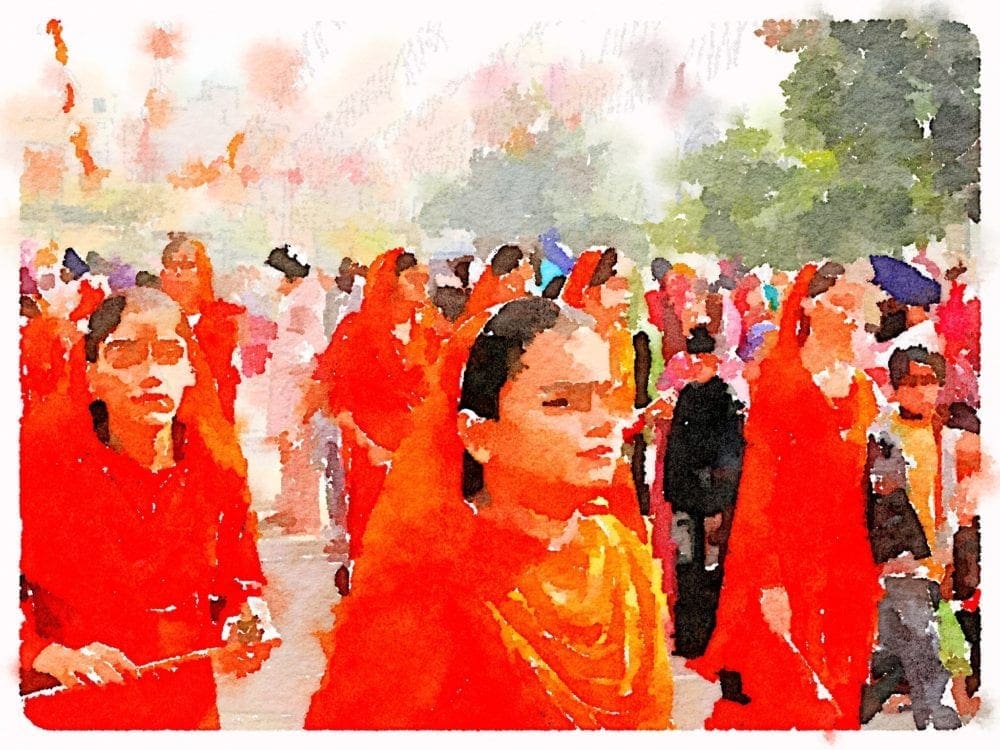
Kolkata, India
I have an ambiguous relationship with India. I’m sucked back in to further visits, drawn by the exotica, the colour and the fact that it is fascinatingly utterly different to anywhere else. It’s also, always, a challenge to my resilience and patience. This group 'adventure tour' crosses north east India by train, Kolkata to Amritsar. It begins in the most unpromising fashion, as I have dinner with the wrong tour group (mine haven't arrived yet - the plane is late) and I manage to acquire an upset stomach before I’ve even met the other participants. I think it was probably the cocktail in the hotel bar that did it. I fear the barman used raw egg to froth it up. I catch up with the rest of the group and guide Rafeequi touring Kolkata in the afternoon. They're not as much fun as last night's group. I'm wondering if it's too late to change my plans.
Kolkata is the capital of West Bengal in eastern India, on the banks of the Hooghly (great name) River. Possibly the most famous city in India, it’s the third biggest and probably the dirtiest, most sprawling and chaotic. The street outside my hotel is filthy and there is a small herd of painted sheep nibbling at the heaps of rubbish.


Kali Festival
In Kolkata, the Goddess Kali is revered above other Hindu gods. In fact, the very name 'Kolkata' stems from Kalighat, an ancient, highly sacred pilgrimage site where devotees have gathered for a millennium and around which the modern city originally grew. Kali is not just the fierce destroyer of evil, but a deeply loved, protective mother figure (Ma Kali). And, every November, Kali Puja is celebrated, passionately, in Kolkata, a massive nocturnal festival which overlaps with Diwali.
Different neighbourhoods across the city erect spectacular, themed pandals - elaborate, temporary pop-up temples handcrafted from bamboo, wood, and cloth - which house magnificent, custom-made clay idols of the goddess. And, of course, there are street lights galore - and fireworks.


We start our tour with the colourful flower market and the clay modellers' village. The potters and papier-mâché artists here spend all year creating a wealth of images and idols for the annual festivals and, as the Kali festival is just finishing, there are ongoing ceremonies and pujas in the streets and at the Kali Temple. Some of the brightly coloured and richly attired idols have accomplished the necessary goals and are now being dumped ceremoniously in the River Hooghly.


Colonial Calcutta
Also on the agenda, of course, are visits to buildings erected during Kolkata's colonial past, when it was Calcutta, the capital of British India. During the British colonial era, Kolkata was divided into three socio-urban zones based on race and commerce: the White Town, the Black Town, and the Grey Town. The White Town was the European administrative and residential area. This is where we see the grand, European-style architecture, built to project imperial power. To the north lay the Black Town, the densely populated native Indian sector. This was where the indigenous Bengali population lived and where the traditional markets are now found. Separating these two regions was the Grey Town, a cultural melting pot housing diverse global immigrant communities, such as Anglo-Indians, Armenians, Jews, Chinese, and Parsis. They acted as the commercial bridge between the colonial rulers and the Indian public.
At the very heart of White Town sat Dalhousie Square (today called B.B.D. Bagh). It's a monumental hub arranged around a large central water reservoir known as Lal Dighi. It's surrounded by some of the most striking Victorian, Baroque, and Neoclassical architecture in Asia, including the red-brick Writers' Building, the massive domed General Post Office, and St. John's Church. What is today known as the Metropolitan Building, on Chowringhee Road, was the ornately domed and renowned Whiteway Laidlaw department store.


On the southern end of White Town, nicely abutting the river, is the 400 acre Kolkata Maidan (urban park), a welcome green space. It was originally cleared, in 1758, by the British as a military parade ground, around Fort William. This was the location of the notorious Black Hole of Calcutta (there's a monument in the church graveyard). The story behind this says that the Nawab of Bengal, Siraj-ud-Daulah, confined British prisoners of war there, on the night of June 20, 1756, after attacking the fort. He was angry because the British East India Company had defied his sovereignty 'by building unauthorised fortifications, abusing trade privileges, and sheltering a wealthy tax-evader'. According to British survivor John Zephaniah Holwell, 146 captives were packed into this tiny, unventilated 18-by-14-foot cell, overnight. There were, he said, 123 deaths from suffocation and heat exhaustion. Whatever, this was the political justification for Robert Clive’s retaliatory campaign, defeating the Nawab at the Battle of Plassey, in 1757 and establishing British colonial rule in India.
The Maidan is also home to Eden Gardens (India's oldest cricket stadium) and the Victoria Memorial Building. The latter is an unmissable white Makrana marble edifice, incorporating a mishmash of Mughal, Islamic, and Venetian architectural elements. It is crowned by a massive central dome, featuring a 16-foot bronze Angel of Victory, which rotates with the wind. It sits nestled within its own 64 acres of sprawling, manicured gardens and reflecting pools. It was commissioned by the Viceroy of India, Lord Curzon, in 1901, following Queen Victoria's death, to serve 'primarily as a grand monument to the deceased Queen, and secondarily as a National Gallery and Valhalla, for the Indian Empire'. It's now a museum.
Then, there's Mother Teresa Home and Orphanage, even further south. I didn't know this famous nun was Albanian. (In fact it’s more complicated than that - she was born in Skopje (now the capital of the Republic of North Macedonia), then part of the Kosovo Vilayet of the Ottoman Empire).
Religious Buildings in Kolkata
I've already mentioned St John's Church, in White Town. Most notable also, are the Tipu Sultan Shahi Mosque (built in 1842 in memory of Tipu Sultan, the eighteenth-century ruler of the Kingdom of Mysore) and Kolkata's wonderfully intricate pastel coloured Jain temple. (Jain temples are always eye catching). Generally known as the Parshwanath Jain Mandir, it was built in 1867 by a wealthy Jain jeweller named Rai Badridas Bahadur Mookim. This one has dazzling Venetian glass mosaics, mirror-inlaid pillars, and tranquil (for India) European-style gardens.


On the Train In India
Then, onto the train for the first time, and west. Train travel in India is, it has to be said, an experience. This is one of the largest and most intensely utilised rail networks in the world, with more than 68,000 kilometres of track, which moves over 20 million people every single day. You can’t see an awful lot out of the windows, as they are covered in grime, but the sense of chaos and confusion pervades. Local trains chunter by, stuffed to the gunwales, with live torsos hanging out of the windows and doors and clinging on to the roof. No-one takes any notice of crossing gates. Pedestrians keep moving until the train is bearing down upon them, horn blaring loudly.

Bodh Gaya
West, to Gaya city and the important and fascinating Buddhist pilgrimage site of Bodh Gaya, on the plains of the eastern Ganges. Bodh Gaya is the site of the tree under which Prince Siddhartha Gautama achieved enlightenment over 2600 years ago, so it is besieged by pilgrims. The actual Bodhi, (tree where the Buddha sat, for 49 days), is dead. A prominent plaque marks the spot, but a descendant, grown from a cutting, replaces it. This one, in its turn, is so old it has to be propped up with wooden staves. I’ve lost count of the places I’ve visited elsewhere that claim to have trees grown from cuttings of the original. There are signs to indicate where Buddha meditated and stone lotuses to show where he stood.
Adjacent, is the majestic Mahabodhi Temple, built in the sixth century AD, to replace the original temple erected by the emperor Ashoka, in the third century BC. It's topped by a towering 50 metre high spire and is one of the oldest brick built Buddhist temples in India. It was declared a World Heritage Site in 2002. We also visit a 25 metre high Great Buddha Statue, financed by the Japanese. I’ve seen more than a few big Buddhas now, but this one is impressive.


Finally, a lake, where Lord Buddha spent time after his enlightenment. A statue commemorates the spot where the king of the serpents (Naga) rose up from the water, to protect Gautama from a severe storm, created by Mara (the god of chaos), who wanted to disturb his meditation.
Sarnath


Next, another of the four holiest Buddhist sites, Sarnath, known as the cradle of Buddhism. The massive Dhamek Stupa here, in the deer park, is said to mark the precise location where the Buddha preached his first sermon, around 528 BC, after his enlightenment. His sermon, known as the Dhammacakkappavattana Sutta (The Turning of the Wheel of Dharma), explained the foundational core of Buddhist philosophy (the Four Noble Truths and the Eightfold Path). His audience was his first five disciples.
Here, there is probably the most expansive collection of Buddhist temples and monasteries on earth, although that's not as exciting as it sounds. The site was destroyed by Muslim armies, although two stupas and some towers have been restored, after it was rediscovered by British archaeologists in the middle years of the nineteenth century.
Varanasi, India

Another train journey, to the fabled holy city of Varanasi, which is utterly intoxicating. The schizophrenic nature of India is totally to the fore here, with pungent scents, amazing colour, light and atmosphere. It’s believed to be one of the oldest continuously inhabited cities on earth and is arguably the most venerated Hindu pilgrimage centre in India. Countless thousands come here to the banks of the sacred River Ganges, to perform puja and cleanse themselves at its myriad temples and riversides ghats.
Varanasi, historically known as Kashi or Benares, is built atop a high, natural clay ridge to keep it above the seasonal monsoon flood line. Because this safe, elevated land was strictly limited, the buildings are packed tightly together, round a labyrinthine network of narrow, high-walled alleys (galis). This tight layout was also encouraged to maximise security. The many blind corners disoriented outsiders and the extreme narrowness forced invaders to break formation, into single file; hostile forces could be trapped at strategic choke points or targeted from elevated balconies.


At the core of this urban maze sits the Kashi Vishwanath Temple, the religious complex that gave rise to Varanasi's fame. It has undergone multiple historical destructions and reconstructions; the current structure dates back to 1780. Myth says that, 'During the primeval dispute, at the dawn of creation, the supreme deity Shiva manifested as an infinite, unmeasurable pillar of cosmic light, to humble the gods Brahma and Vishnu'. He subsequently (it's quite a long story) allowed this 'boundless energy' to cool and condense into twelve physical stone anchors, across Earth. The Jyotirlinga (stone pillar) inside Varanasi's Kashi Vishwanath Temple is believed to be the most important, manifested stone, marking the exact place where that cosmic column broke into the ground. Put simply, the Hindus believe that this is where the material and spiritual worlds meet.
This is why Varanasi is dedicated to Shiva and the temple caters to hundreds of thousands of pilgrims daily, all wanting to see (and hopefully touch) the Jyotirlinga. Religious tourism brings in the money, but Varanasi is also known for its thriving cottage industries (especially handloom Banarasi silk textiles and brassware), and for its street food. Varanasi by rickshaw is an adventure, a teeming vibrant mass, which we edge around, within an inch of our lives.
On the Ganges at Varanasi

In Varanasi, we have two boat rides along the sacred river, one for sunset and one for sunrise. The riverbanks, teeming with colour, are jam-packed with pilgrims and our boat is an excellent place to watch (from a respectful distance).
The city’s soul resides in its ghats - the long stone stairways leading down to the Ganges. There are over 84 ghats, mainly eighteenth century, each with its own history and spiritual purpose. At sunrise we sit off Assi Ghat, at the far southern end, famous for Subah-e-Banaras, its peaceful sunrise ritual featuring morning prayers, classical music, and yoga.
Ahilyabai Ghat is named for Queen Ahilyabai. It's significant because it was the first ghat to be built entirely out of solid pink Chunar sandstone (it doesn't look very pink today), under Queen Ahilyabai's patronage. This is a relatively quiet, residential ghat used mostly by locals for morning baths.


Dashashwamedh Ghat is the central and most vibrant ghat, by the Vishwanath Temple. According to Hindu legend, Lord Brahma visited Varanasi, wanting to help Lord Shiva return to the city after a human king named Divodasa had taken over its rule. To test the king, Brahma asked him to carry out ten Ashwamedha Yajnas (sacred horse sacrifices) on the banks of the Ganges, hoping he would fail and giving Shiva an excuse to come back. Instead, Divodasa completed all ten sacrifices perfectly, earning the gods' blessing. Then he stepped down voluntarily, so Shiva could return - giving Dashashwamedh Ghat (the steps of the ten horse sacrifices) its name.
Every evening, the steps are packed as it hosts the spectacular and revered Ganga Aarti, the highly choreographed ritual, where priests swing brass lamps, burn incense, and there is mystical singing and chanting, to offer gratitude to the holy river.
Further down, on Manikarnika Ghat, we can see the cremation rituals (photography forbidden) and feel the heat of the roaring fires, adding to the glow of the sun: the golden light bathing the ghats is glorious. (The funeral pyres burn continuously.) In Hinduism, dying or being cremated in Varanasi is believed to grant Moksha (liberation from the cycle of rebirth).


We are informed that there are several circumstances – such as snakebite and pregnancy – where the dead are not allowed to be burned. On these occasions the bodies are embalmed and thrown into the river. It is at this point that I notice the cloth wrapped figures bobbing in the water around us.
Agra, India
Agra, rebuilt by Emperor Akbar, was once the capital of the mighty Mughal Empire. It has a huge red sandstone fort and 20 metre high walls to protect its opulent buildings and treasures: tombs, towers, mosques and an enormous fort.


The Taj Mahal is much hyped, but it doesn’t disappoint - even though this is the second time I’ve visited. It is truly an exquisite building. It required the labour of 20,000 men and is estimated to have cost something in the region of three million rupees (at today's prices that equates to around $70 million). Shah Jahan, Akbar's grandson, built it as a tomb for his wife, Mumtaz, and then was overthrown by his son. It’s poignant to think of the imprisoned shah locked up across the river, in the fort - so near and yet so far.
Again, the Taj Mahal has to be toured both at sunset and sunrise, for the rosy light and the atmospheric photos. Little men pop up to lead us to the best spots for pictures - for a suitable reward, of course. And visiting Indians queue up to take our photos and have shots taken with us.
The hotel is the same one I stayed in on my first visit a very long time ago. I don't think they have done anything to it since. We are stuck in the lift for a while - it's not a good experience. Neither is tour leader Rafeequi's announcement that I can come to his room any time. It's conveniently next to mine.


Fatehpur Sikri
There’s a side trip (again covering old ground) to the nearby abandoned city of Fatehpur Sikri, lying to the west of Agra and, for a brief time, yet another capital of the Mughals, under Akbar the Great. Founded in 1569, it was only inhabited for 16 years – no-one is quite sure why it was abandoned. There's a pachisi board in the courtyard. (The Indian equivalent of chess, except that the emperor used slave girls as pieces.)
It’s very brown and ghostly, but the deserted arched buildings and squares are interesting. The key sights are the
Panch Mahal, the five tiered palace surrounded by water and the Diwan-E-Khas (The Hall of Private Audience), used by Akbar. The highlight (as on my last visit), is the old man with flowing grey locks and beard who dives from the ramparts into a tiny algae covered tank many feet below. (As long as he can collect enough rupees from the watching crowds to make the plunge worthwhile.)


New Delhi, Capital of India
I’ve been to Delhi several times now. It’s not my favourite place, but it improves on each visit. Fewer people are living on the streets and it is less overwhelming than it was. It's a shame, however, that the snake charmers and floating fakirs round the fort have all been moved on. It's much less atmospheric. Most of the main thoroughfares are blocked by roadworks today, causing additional delay - preparations for the forthcoming Commonwealth Games are in full swing and volunteers in white sarees are assembling.
George V visited Delhi in 1911, to celebrate his coronation with a Grand Durbar, and to announce that they were shifting the capital of the British Raj from Calcutta to Delhi. Calcutta had become worrying, the hub of Indian Nationalism, following the highly unpopular 1905 Partition of Bengal into Muslim and Hindu regions (a precursor of things to come.) What's more, Calcutta sat on the eastern edge of the subcontinent, far from the critical northwest frontiers, the vast territories of the interior and the loyal Maharaja states. Delhi was centrally located and there were precedents. It had been the seat of power for the Mughal Empire and several previous dynasties.


Movement of the capital led to the building of a brand new imperial city, to house it, south of the walled old city. New Delhi's streets are filled with a rich collection of the architectural creations of Edward Lutyens. First, the huge memorial arch of the India Gate, a testament to the 90,000 Indian troops who lost their lives during World War I and along the Northwest Frontier.
Old Delhi
A tour of Old Delhi by metro and cycle rickshaw. This old city is a magnificent fusion of grandiose architecture and vibrant chaos, centred around the Chandni Chowk Bazaar, an eclectic cacophony of noise, colour and deafening barter. The spectacular Shah Jama Masjid (Mosque) is the largest in India. It was built by Shah Jahan. (I have to don a flowery hospital type robe to cover myself up before I’m allowed in.)


Next, a minor kerfuffle, as Rafeequi abandons us, amidst remonstrations. He says that only a morning tour is included. If we want to see anything else here we can do it ourselves. He won't take us into the much vaunted Red Fort, even though we have been to the Drum House (Naubat Khana), at the entrance. Scottish Ken takes over, with his map, and we navigate back to the Red Fort, through the bazaar, without getting lost too many times. It was the home of the Mughal emperors, when Shah Jahan moved the capital from Agra to Delhi.
Monuments around Delhi
Humayun's Tomb
To the east of the city, next up is Humayun's Tomb, a sixteenth century Mughal emperor's mausoleum, famed for its Mughal architecture and garden setting. Alongside, is the Isa Khan Tomb. That belongs to an Afghan nobleman.


The Qutub Minar Complex
The Qutub Minar complex, also on the tourist must-see list is a sprawling UNESCO World Heritage Site, in South Delhi, showcasing the earliest surviving examples of Indo-Islamic architecture in India. At its heart, the Qutub Minar, a spectacular thirteenth century edifice made of sandstone and marble and glowing in the mellow sunshine. It was built to mark the arrival of the Muslim sultans and soars some 73 metres above the city.
The surrounding grounds are filled with other deemed historically significant ruins, including the twelfth-century Quwwat-ul-Islam Mosque, built from even older temple spoils, the beautifully domed Alai Darwaza gateway (the rest of the replacement mosque was never finished) and the fourth-century Iron Pillar, which has baffled scientists for centuries, due to its remarkable resistance to rust.
Shri Laxmi Narayan Hindu Temple


Time to do some exploring on my own. You can't miss the gargantuan, bustling and impressive Shri Laxmi Narayan Hindu Temple (Birla Mandir). The grounds are full of local women relaxing. I soon have a long queue demanding to have their portraits taken.
And then, a complete contrast in the serenely beautiful Bahai Lotus Temple. It opened in December 1986, like all Bahá’í temples it welcomes people of all religious persuasions to sit, meditate, and pray in peace.

And another festival to celebrate. It’s Diwali when I first arrive and firecrackers and loud parties keep us all awake, well into the small hours.
Toy Train to Shimla


More trains – this time to Kalka, just to the north of Chandigarh. There are small mice running up and down the carriage, feeding on biscuit crumbs, strewn under the metal seats. From here we transfer to a narrow gauge track and continue to Shimla, on the legendary 'Toy Train' (Shimla and the train were made famous in the TV series Indian Summers). The train negotiates a meandering journey of some 93 kilometres, ascending over 1600 metres, through 103 tunnels.
The stations are a dainty blue and white, decorated with elephants. Locals try to sell us cookies and samosas at the stations, wave at us from the front carriages, as the train chugs round the many bends, and risk their lives hanging out of the windows to pose for photographs.
Shimla
Shimla, the capital city of Himachal Pradesh, is India’s most famous hill station and the former summer capital of British India. This is where the British went to the mountains, seeking a cool, refreshing escape from the scorching summer heat of the plains. Nestled in the Himalayan foothills at an altitude of approximately 2,205 metres, it is famous for its stunning mountain ridges and pine and deodar forests.


Shimla is pleasantly cool and much as expected. Views of snow capped mountains in the distance. At the heart of the city is the pedestrian-only Mall Road and the Ridge, dominated by the iconic, golden-hued Christ Church. There are shopping streets, signposted, Upper Mall, Middle Bazaar and Lower Bazaar. As the trip dossier says: ‘the mock Tudor architecture presents a quite surreal imitation of Old England, against the magnificent backdrop of the Himalaya’.
This intersection is known as Scandal Point. The spot owes its name to an 1892 colonial romantic scandal. According to local legend, Bhupinder Singh, the young and dashing Maharaja of Patiala, fell in love with, and eloped with, the daughter of the British Viceroy, Lord Lansdowne. The couple allegedly met secretly, at this exact intersection, before fleeing. Outraged by this behaviour, the British authorities banned the Maharaja from entering Shimla. In retaliation, the Maharaja built his own summer capital at Chail, a nearby hill station, constructing a palace that rivalled the Viceroy's lodge.
Today, Scandal Point is the primary gathering place in Shimla. It is a vibrant, pedestrian-only zone/main square where locals and tourists gather to socialise, enjoy the fabulous mountain views and people-watch. The square is presided over by Shimla's historic General Post Office, a striking heritage building, constructed in 1882 and featuring bright red paint.
Talking of the ViceRoy's Lodge, this monumental building, now known as Rashtrapati Niwas (President's Residence), was designed by British architect Henry Irwin and completed in 1888, on the summit of Observatory Hill, to the west. Built in the Jacobethan Revival style, using local grey-blue sandstone and lavish Burmese teakwood interiors, this was the grand summer residence of the British Viceroys (the first building in Shimla to feature electric lighting). And, this is where modern South Asian history was set on its path, hosting conferences that shaped the roadmap for India's independence and partition.


Today, the beautifully preserved heritage building offers guided tours and is also the campus for the Indian Institute of Advanced Study, with its manicured botanical lawns and fabulous Himalayan vistas. We meet a troop of Sikh scouts and more pictures need to be taken.
The ancient Hindu Jakhoo Temple, at the summit of Jakhoo Hill (Shimla's highest peak at an elevation of 2,455 metres) is known as the Monkey Temple, as it is dedicated to the monkey god, Hanuman. Even more clear, panoramic views of the surrounding Shivalik mountain ranges and valley, and monkeys, of course.
And our hotel is a little surreal too. The swimming pool is full of rubble.
Amritsar, India
Finally, an afternoon train to the Sikhs' holy city of Amritsar, in the Northern Punjab. Amritsar was founded by Guru Ram Das, who established the town around a holy water tank known as the Amrit Sarovar. It was believed by devotees to possess healing, purifying and life-giving properties: a sacred pool of nectar. The fifth Sikh Guru, Guru Arjan, completed the design by constructing the Harmandir Sahib, (the Golden Temple), in the centre of this tank. Wanting to demonstrate interfaith inclusivity, Guru Arjan invited the Muslim Sufi saint Hazrat Mian Mir to lay the foundation stone of this temple, and had it designed with doors opening on all four sides, to welcome people of every caste, creed, and religion.


In the nineteenth century, the city grew into a powerful geopolitical and mercantile centre, under Maharaja Ranjit Singh. He fortified the city walls, built the grand Gobindgarh Fort, and donated the 700 kilograms of pure gold plating which covers the main part of the exterior of the Harmandir Sahib, transforming it into the Golden Temple.
Today, the urban area of Amritsar is split into two contrasting zones, separated by railway lines. To the north, the modern new city has been designed with wide avenues and upscale shopping areas. The historic walled city to the south is a labyrinth of medieval lanes and ancient archways. The area surrounding the central shrine has been transformed into a pedestrian-only Heritage Street, crafted from uniform pink sandstone.
It's yet another festival - I’ve been very lucky - it’s the founder of Sikhism, Guru Nanak’s birthday (Gurpurab). The temple is magnificently illuminated, strewn with hundreds of thousands of traditional earthen lamps and modern decorative LED lights, casting a radiant golden glow across the sacred Amrit Sarovar water tank. The day begins in the early hours before dawn with Amrit Vela prayers, followed by continuous Akhand Path scripture readings, soul-stirring Kirtan hymn recitations.


The grounds of the temple are thronging with the bobbing orange heads of Sikhs on pilgrimage. Millions of pilgrims from across the globe gather to take a ritual dip in the holy waters and partake of food at the langar, the world's largest kitchen. It operates around the clock, serving free festive meals to everyone, regardless of religion or social status. It's fascinating - all those volunteers preparing food and all those chapattis rolling off the machines. And it is all provided free.
The entire city is in carnival mode, with a grand 'Nagar Kirtan' procession, through the walled city lanes. It features traditional Gatka martial arts performances and beautifully decorated floats.


The temple is home to the Sikh holy book, the Sri Guru Granth Sahib Ji. In Sikh tradition, the holy scripture, is revered not merely as a book, but as a living Guru. Because of this, it is treated with the same respect as a living sovereign. During the day it rests on a raised throne, under a royal canopy, inside the main golden building, for public viewing and continuous reading. At night, it lives in the Akal Takht - a five-story white building with a golden dome, which is seen as the earthly seat of authority in the Sikh religion. Here, wrapped in silk, it lies on a bed inside a bedroom called the Kothri Sahib.
It is transported across the marble causeway between the two, twice a day, once at dawn (Prakash), once at night (Sukhasan), using a palanquin called the Palki Sahib. This heavy gold and silver domed structure is outfitted like a royal carriage, with a bed, silk pillows, and fine brocades and lifted onto the shoulders of volunteers.


To mark the importance of today's occasion the entire work is read in 48 hours, at the celebrations, and the holy scripture is placed in a different, specially designed vehicle, laden down with marigold garlands and wheeled along, in the procession. It is led by five barefoot men representing the Panj Pyare (the Five Beloved Ones) carrying the Sikh flag. Crowds of devotees clear the paths and shower the route with flower petals.
And there's a spectacular display of fireworks over the temple complex at night.
Jallianwala Bagh
Amritsar has not been without bloodshed. The memorial garden at Jallianwala Bagh commemorates the 1919 massacre of Indian protesters by British soldiers, led by General Dyer. Days prior to the massacre, violent anti-colonial riots had broken out in Amritsar following the arrest of two local nationalist leaders. During this unrest, several British banks were burned, five British men were killed, and a British schoolteacher, Marcella Sherwood, was assaulted in a street.
In response to the riots, General Dyer was brought in to restore order. On the morning of that day, he had banned all public gatherings and processions. However, this proclamation was not widely distributed or read out in the dense, inner-city areas of the walled city. A crowd of thousands of unarmed men, women, and children had gathered in this enclosed ground to celebrate the Punjabi harvest festival of Baisakhi and to peacefully protest the arrest of two nationalist leaders under the Rowlatt Act. But the vast majority of the people who went to Jallianwala Bagh that afternoon had no idea a ban was in place.


When Dyer was informed that a large crowd had gathered anyway, he viewed it as a deliberate act of defiance against British authority. He did not order the crowd to disperse, nor did he issue a warning before firing. British troops blocked the main entrance, which was the only functional exit out of the high-walled garden, and as ordered, opened fire. They killed hundreds of innocent people and wounded over a thousand more. Today, the garden has been transformed into a memorial park with a towering flame-shaped monument, preserved walls still riddled with visible bullet holes, and the Martyr’s Well, into which many desperate people jumped, to escape the gunfire.
And there was another massacre, in the temple itself, when Indira Gandhi sent the Indian army in to quell protests, in 1984. It's thought that this was the reason she was assassinated, later that year, by her two Sikh bodyguards.
Amritsar 2016, India's Independence Day
I am back in Amritsar, in 2016, en route from Pakistan to Kashmir, with my odd tour group. It is August 15, India’s seventieth Independence Day and also the final day of the Sikh calendar month of Sawan. So, I'm lucky again, as there's another festival scale event, at the Golden Temple. To mark the occasion, the palanquin's exterior is even more elaborately blanketed with garlands. The temple kitchen serves free meals to over 100,000 pilgrims who have arrived for the long weekend, and the community includes special Ardas prayers for national independence, alongside the traditional evening procession. The causeway passage to the temple is even more congested than last time I was here.


Wagah and the Beating Retreat Flag-lowering Ceremony
A comedic interlude on both my visits to Amritsar is an excursion to see the Beating Retreat flag-lowering ceremony. The Wagah border crossing (often called the Attari-Wagah border) is the international land border checkpoint on the Grand Trunk Road, about 30 kilometres west of Amritsar and 25 kilometres east of Lahore, Pakistan. This highly theatrical military ritual is performed jointly by the cockaded Border Security Force (BSF) of India and the Pakistan Rangers, every evening, just before sunset. The 45-minute display features synchronised, aggressive posturing and ridiculous high-stepping military drills. John Cleese at the Ministry of Silly Walks comes to mind. It's accompanied by loud patriotic chants from stadium seating, packed with thousands of spectators on both sides. The event concludes with the simultaneous lowering and precise folding of both national flags, a formal handshake between officers, and the clanking shut of the massive iron border gates.
On August 15, 2016 there's an exceptionally large holiday crowd to mark India’s seventieth Independence Day, especially in the face of ongoing tensions between the two countries. The daily routine has expanded into a grand festive spectacle. Before the flag-lowering drill commences, Indian and Pakistani border forces exchange traditional sweets and greetings at the gate. There are bands and dance performances and an intensely high-energy performance of the traditional high-kick drill, as the sun goes down.


Read more about India here.